CBI minions of the world unite, you have nothing to lose but your credibility!

If a week was once a long time in politics, it’s now no time at all when it comes to thinking up new legislation. For a week was all it took for renowned Star Trek fan Sajid Javid, newly promoted from culture to business secretary, to master his brief and decide that what Britain really needs right now is another small business and enterprise Bill. Not just any old small business and enterprise Bill, mind, but an “ambitious” small business and enterprise Bill. And this less than two months after the last small business and enterprise Bill – which clearly wasn’t anywhere near ambitious enough – reached the Statute Book.

According to Tuesday’s BIS press release, the Starship Enterprise Bill will:

“Help make Britain the best place in Europe to start and grow a business, and help create two million jobs over the next five years, so that more people have the security of a regular pay-packet. Unless, of course, they are employed on a zero-hours contract. Ha ha ha, beam me up Scottie.”

Yes, I made that last bit up. But the Bill really will “cut red tape for business by at least £10 billion over the next five years” and “create a Small Business Conciliation Service to help resolve disputes [especially over late payment]” – these being pledges in the Conservative Party Manifesto 2015.

Fortunately for Mr Javid, he didn’t have to spend any of his first week in 1 Victoria Street working out exactly how the Bill will cut £10bn worth of red tape for business. No, that’s not how policy-making works these days. Mr Javid left it to junior BIS minister Anna Soubry to explain:

“This will be a no nonsense Bill [unlike the last one!] to back small businesses and help create jobs, giving financial security and economic peace of mind to hard-working people across the country. We will be asking businesses for evidence in the coming weeks and months. We want them to be our partners in identifying and scrapping needless burdens at home and in Europe.”

Yes, that’s how evidence-based policy-making works these days. You – the one-week-old cabinet minister – decide to have a Bill, then you hunt around for evidence to justify said Bill. They didn’t tell us this on my MSc in Public Policy, but hey.

To be fair to Mr Javid and his colleagues, a Small Business Conciliation Service doesn’t sound such a bad idea. I just wonder whether there will be fees for small businesses to use the Service. And whether those fees will be anywhere near £1,200. That would only be right and proper, after all. Why should hard-working taxpayers have to bear all of the cost?

As for how to cut that £10bn of red tape, I imagine Ms Soubry’s inbox is already filling up with lengthy emails from Sir Michael Rake and his numerous minions at the CBI. Because, on Wednesday, while being skewered by Sarah Montague on the BBC Radio 4 Today programme (start at 2:34:55), Sir Michael blustered that we desperately need to cut Red Tape because “where [employment] rights are so extensive it leads to employers not being willing to employ people, that is not helpful to anyone”. And who could argue with that?

Later that morning, I tweeted the CBI to ask them which employment rights, exactly, are currently “leading to employers not being willing to employ people”. And also to ask them to explain what it is that causes the “inflexibility in being able to adjust your workforce to changing circumstances quickly enough” that, apparently, so concerns Sir Michael. Needless to say, I didn’t get any response, but it seems reasonable to assume that it’s not the statutory right to four weeks’ paid holiday that Sir Michael has in mind. Could it be the legal right not to be subject to unfair dismissal?

Well, I guess it could be. But, if you are an employer, and minded to employ one or more extra members of staff, you will know (unless you are a complete idiot, in which case you probably shouldn’t be an employer) that you have no less than two years to decide whether you’ve made the right decision, before those employees qualify for legal protection against unfair dismissal. That is, you can get rid of them as quickly and as unfairly as you like, as long as you do it within two years of hiring them. And, even if you decide that you made the right decision in hiring them, but circumstances somehow change for the worse after two years, you can still dismiss them (or make them redundant). You just can’t do so without following a fair procedure. And how hard can that be for titans of industry with their gene-based, wealth-creator superbrains?

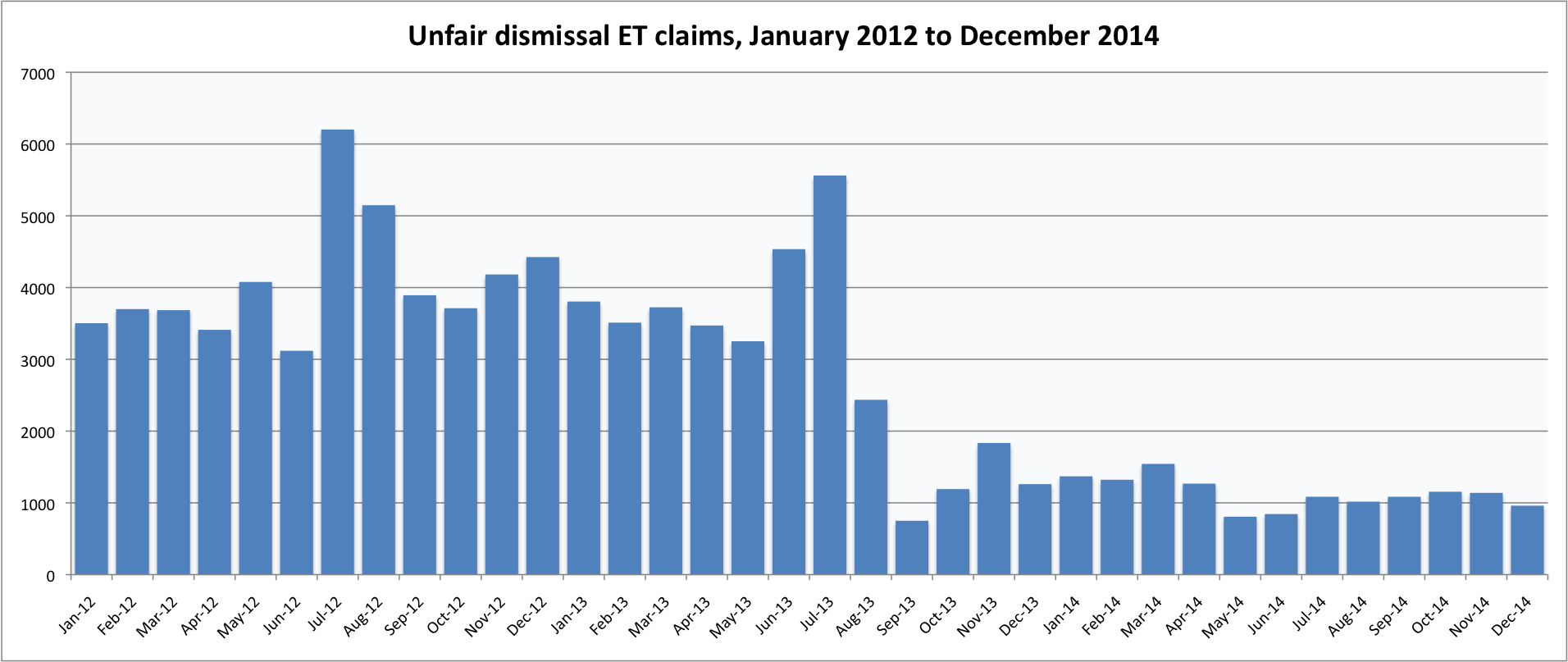
Even if you’re a regular, non-superbrained oik who somehow made it to being CEO of a wealth-creating company, it wouldn’t take you (or your unpaid intern) long to discover that, these days, the risk of facing an employment tribunal claim for unfair dismissal, however badly you treat your human capital units, is … well, negligible. Since the introduction of upfront tribunal fees of £1,200 in July 2013, and the introduction of Acas early conciliation in April 2014, the number of unfair dismissal claims has fallen by two-thirds, to fewer than 13,000 per year.
UD

Yep, that’s fewer than 13,000 unfair dismissal claims per year, from a workforce of some 26 million. Put another way, each of the UK’s 1.2 million employers now faces an unfair dismissal claim – maybe well-founded, maybe not – about once every century, on average. But, according to the superbrained, wealth-creating Sir Michael Rake, that is still far too often for our entrepreneurial classes to cope with. So we must cut Red Tape now! Over to you, Sajid.

Copyright Steve Bell 2015/All Rights Reserved e.mail: belltoons@ntlworld.com tel: 00 44 (0)1273 500664

Copyright Steve Bell 2015/All Rights Reserved e.mail: belltoons@ntlworld.com tel: 00 44 (0)1273 500664

[Many thanks to the great Steve Bell for granting me permission to use this image.]

.

ET fees: still no evidence for the Hancock Theorem

In more than one previous post on this blog, I have included charts showing how – up to the second quarter of 2014-15, at least – the evidence from the Ministry of Injustice’s quarterly tribunal statistics strongly counters the theory, advanced by the former BIS minister Matt Hancock (now at the Cabinet Office) and his friends in the media, that the introduction of hefty ET fees in July 2013 has since deterred only weak or vexatious claims, without deterring well-founded claims. For the charts show that – contrary to what one would expect, were the Hancock Theorem a valid one – the proportion of claims that are ultimately successful has fallen, and the proportion of claims that are ultimately unsuccessful has risen.

Somewhat annoyingly, when the Ministry released the tribunal statistics for the third quarter of 2014-15 (i.e. October to December 2014) in March, I was unable to update my charts because the ET outcome figures are given only as percentages, and those percentages were grossly distorted to the point of being meaningless by the settlement (and disposal by being ‘struck out’) during the quarter of one exceptionally large airline multiple claimant case involving some 240,000 jurisdictional claims.

Screen Shot 2015-05-19 at 16.10.16

On 15 March, therefore, I emailed the Ministry of Injustice to request the base figures from which the Q3 outcome percentages were calculated. And today, after a couple of chasing emails, the Ministry finally replied – without the figures I had requested but with an explanation of how I could calculate them myself by cross-referencing two of the tables in the statistical bulletin. How helpful of them.

And so, after many hours sweating over a hot Excel spreadsheet, I have calculated the figures I need to add the third quarter of 2014-15 to my outcome charts. In doing so, I have excluded disposed claims made under the two jurisdictional headings of Working Time and Unauthorised Deductions, because – as well as the 243,606 Working Time claims that were struck out – unusually large numbers of Working Time and Unauthorised Deductions claims were withdrawn, and I assume that many if not most of those jurisdictional claims were also part of the airline case (or a related case). This exclusion might well have introduced a minor distortion of its own, but I can’t see any obvious way around that (though I’m expecting a tweet or email from Michael Reed any time now). Whatever, the tribunal statistics for the fourth quarter of 2014-15 will be published on 11 June, and I’ll update my charts again then.

Here are the updated charts. Enjoy.

Outcomes1 May 2015

From this chart, we can see that both ‘successful claims’ and ‘unsuccessful claims’ – in the strictest sense – have continued to move in the wrong direction, as far as the Hancock Theorem is concerned. Similarly, the second chart, below, shows that the broader measure of ‘successful’ claims – including those that are conciliated by Acas or withdrawn (in most cases following settlement) – has also continued to fall. Yet, according to the Hancock Theorem, this measure of ‘successful’ claims should by now be nearing 100 per cent – all the weak and vexatious claims having been deterred by fees.

Outcome2

Busy day at work: the next Minister for #ukemplaw should not be a part-timer

The polls still suggest a close result but, with the Tory campaign in disarray and their supportive press barons suffering a collective nervous breakdown, I’ve started to feel vaguely optimistic that the next BIS employment relations minister will be a talented Labour MP such as Gloria De Piero, Stella Creasy or – if he survives the SNP tsunami – the excellent Ian Murray. And the reported remarks of Labour’s Lord Falconer, that the shadow cabinet has “very, very few” machinery of government changes in mind, has set me thinking about just how long a ‘to do’ list the new BIS minister would find waiting for them on their desk at 1 Victoria Street.

Because, as easy as it is to criticise the Labour manifesto for its lack of ambition on employment law-related reform, and the woolliness (ET fees) and/or daftness (zero-hours contracts) of some of its specific policy pledges, there’s actually quite a lot for a new Labour employment relations minister to be getting on with. In their first 12 months in the job, she or he will need to devote time and energy to some or all of the following work strands:

  • Working out how to translate the high-profile manifesto pledge to “ban the abuse of zero-hours contracts” into meaningful policy action;
  • Initiating the promised process, jointly led by the CBI and TUC, for agreeing reforms to the ET fees regime and – seemingly – the ET system more generally;
  • Working out how to implement a package of woolly pledges to enhance enforcement of the minimum wage (increased fines/penalties for non-compliance, a role for local authorities, a reformed/beefed up Low Pay Commission, and a possible new emphasis on criminal prosecutions);
  • Launching a consultation on “allowing grandparents who want to be more involved in caring for their grandchildren to share in parents’ unpaid parental leave”;
  • Developing a plan to “tackle exploitation in the care sector as a route to protecting staff and improving standards”;
  • Responding to the findings of the Equality & Human Rights Commission’s inquiry into pregnancy and maternity discrimination in the workplace (originally due out in March, but postponed until after the election);
  • Working out how to translate the pledges to “tackle undercutting by rogue employment agencies”, including by “taking action to crack down on rogue agencies that exploit workers illegally for profit”, and to “extend the Gangmasters’ Licensing Authority approach to cover sectors where there is evidence of high levels of migrant labour and exploitative working practices” into meaningful policy action; and
  • Preparing a Bill to legislate as necessary in relation to these and other strands of work.

That’s quite a ‘to do’ list for anyone to cram into five days a week, let alone someone who has a second job as a constituency MP. Yet the position of BIS employment relations minister has always been both a junior and a part-time role – the remit of the Parliamentary Under Secretary of State for Employment Relations and Consumer Affairs currently covers, in  addition to employment relations: Post Office and postal policy; consumer policy and consumer affairs; competition policy; corporate governance; company law; social enterprise; Insolvency Service, including company investigations; and BIS better regulation, efficiency and reform agenda.

So, if Labour are serious about “supporting firms to win the race to the top, not get dragged into a race to the bottom”, perhaps one minor ‘machinery of government’ change they should consider is separating employment relations and consumer affairs, and appointing a Minister of State for Employment Relations. Some of of the above work strands will involve tricky negotiations with HM Treasury, the Ministry of Injustice and other departments, and on ET reform the minister will no doubt need to bang heads together at the CBI and TUC, so it would be handy not to be at the very bottom of the ministerial food chain. And promoting the position to Minister of State level would widen the talent pool from which to select what should be a prominent voice in any Labour government formed after 7 May.

Postscript: As if I hadn’t made the case well enough above, today the following photograph emerged, showing that the current holder of the post is too exhausted from her ministerial duties to notice that her campaign team are holding her placards upside down.

Nosnims


Are there really no votes in employment rights?

So, the longest general election campaign in history – it surely started at least 12 months ago – has at last reached its final phase, with the three main political parties publishing their manifestos over a frantic three days at the start of this week. This blog’s founder, the fantabulous Sean Jones QC, has put his sanity at risk (so that you don’t have to) by ploughing through their combined 330 pages and documenting every last relevant policy commitment in the Hard Labour Guide to #ukemplaw Election Pledges. But I can’t resist adding a bit of (highly) subjective commentary.

Overall, it’s hard to avoid concluding that all three main parties see no great electoral advantage in trying to improve the working lives of some 30 million people. In 330 pages, there is just one mention of ‘flexible working’, and even that is just a reference (by the Lib Dems) to the Coalition’s extension of the right to request FW in 2014. Labour and the Liberal Democrats each use the word ‘exploitation’ in relation to workers just once, and the Tories four times – but five of those six uses of the word are in relation to migrant workers. Zero-hours contracts get six mentions by Labour, two by the Liberal Democrats, and one by the Tories, but there are no new ideas on how to tackle the exploitative use of such contracts. Despite the Coalition having handed the EHRC £1m to investigate “systemic” maternity discrimination, the issue gets just one brief mention (by Labour). And there is no mention anywhere of unfair dismissal.

Disappointingly, there is no space in the Liberal Democrats’ whopping, 160-page tome for Vince Cable’s October 2014 promise of a new Workers’ Rights Agency to “revamp efforts to enforce employment law and tackle the exploitation of workers” by combining the remits of “the minimum wage enforcement section of HMRC, the working time directive section at the Health & Safety Executive, the BIS Employment Agency Standards Inspectorate, and the GLA.” Perhaps I shouldn’t have pointed out that this was my idea. [Since I wrote this post, Jo Swinson has responded to a tweet from Sean Jones, saying “the idea still there” – ‘there’ presumably being the inside of Vince Cable’s head.]

Regular readers of this blog – hello David, Gem, Michael, Paul and Peter! – will not be surprised to hear that the first object of my skim reading was the issue of employment tribunal fees. The Tories let the cat out of the bag by claiming credit for “reducing the burden of employment law through our successful tribunal reforms” – that’s not what they said about their hefty, upfront fees at the time – and Labour can only find space for a tweaked, two-sentence version of the pledge previously set out in its Manifesto for Work:

The Conservatives have introduced fees of up to £1,200 for employment tribunal claimants, creating a significant barrier to workplace justice. We will abolish the Government’s employment tribunal fee system as part of wider reforms to make sure that affordability is not a barrier to workers having proper access to justice, employers get a quicker resolution, and the costs to the tax payer do not rise.

However, as noted previously on this blog, this raises at least as many questions as it answers. And note that the Manifesto for Work’s “costs to the taxpayer are controlled” has mutated to the arguably more restrictive “do not rise”.

Somewhat surprisingly, the Liberal Democrats are even more parsimonious on the subject of what their BIS employment relations minister, Jo Swinson, recently described as “one of the most high-profile debates around employment law in the last Parliament”. Their manifesto manages just a wishy-washy half sentence:

We will improve the enforcement of employment rights, reviewing employment tribunal fees to ensure they are not a barrier.

Whoopie doo. The Liberal Democrats devote more space to a promise of legal protection for bumblebee nests. Clearly, worker bees are more important than workers to a Liberal Democrat economy.

On the plus side, all three parties pledge to work to close the gender pay gap. The Tories say they “want to see full, genuine gender equality. The gender pay gap is the lowest on record, but we want to reduce it further and will push business to do so: we will require companies with more than 250 employees to publish the difference between the average pay of their male and female employees”. Similarly, a Labour government would “go further in reducing discrimination against women, requiring large companies to publish their gender pay gap and strengthening the law against maternity discrimination” – though there’s no indication of how they would do the latter. The Liberal Democrats only have enough space to say they would “work to end the gender pay gap, including with new rules on gender pay transparency”. The voting public could be forgiven for not realising that  little if any of this is new, mandatory gender pay gap reporting having been one of the last actions of the Coalition.

More positively, all three parties commit to the national minimum wage, and it’s especially heartening to see the Tories confirm they “strongly support the [NMW] and want to see further real-terms increases in the next Parliament”. They go on to expose the pathetic timidity of Labour’s promise of £8 per hour from October 2019, by stating: “We accept the recommendation of the Low Pay Commission that the [NMW rate] should rise to £6.70 this autumn, on course for a [rate] that will be over £8 by the end of the decade”. This is accompanied by a pledge to increase the tax-free Personal Allowance from £10,600 to £12,500, so that “those working 30 hours on the minimum wage pay no Income Tax”.

However,  as the FT’s John McDermott notes, this pledge is “less than it seems”, as a minimum wage rate of £8 per hour by the end of the decade would mean £12,480 per year for a worker on 30 hours per week. So, “give or take £20, [a Personal Allowance of £12,500] won’t make any tangible difference”. In any case, most workers on the minimum wage work fewer than 30 hours per week, so already pay very little if any Income Tax. And then there’s National Insurance.

Much the same can be said of the Tories’ other eye-catching move to outbid Labour’s core childcare offer (an expansion of “free childcare from 15 to 25 hours per week for working parents of three and four-year-olds, paid for with an increase in the bank levy”) with a pledge to “give families where all parents are working an entitlement to 30 hours of free childcare for their three and four year-olds”. This pledge is costed at £350m, which sounds too good to be true – and it is. As Sarah Hayward, leader of Camden council, points out in a splendid demolition job, the Tories have previously ‘costed’ Labour’s less ambitious pledge at £1.5bn (Labour’s own figure is £800m). So, to deliver 50% more extra hours than Labour for just £350m, “the quality of the childcare would need to be so appalling that no right-minded parent would ever subject their child to it”.

Elsewhere, the Liberal Democrats re-iterate their offer of an extra four weeks of paternity leave, but only at the current, lousy rate of pay (£138 per week, or just 60% of the NMW), and Labour repeats its February 2015 pledge of an extra two weeks, paid at a much more respectable £260 per week. And, in Labour’s separate Manifesto for Women, issued two days after the main event, there is an interesting promise to “consult on allowing grandparents who want to be more involved in caring for their grandchildren to share in parents’ unpaid parental leave, enabling them to take time off work without fear of losing their job”. This has been welcomed by the CBI, and represents a significant and well-deserved win for Grandparents Plus, which has mounted a sustained campaign on the issue.

And that’s about it. I just hope that, in 2020, at least some of the political parties will bear in mind the axiom that less is more. Because I just don’t think Sean Jones could survive 330 pages again.

Manifesto manifestations: Labour & Lib Dems offer hope on employment tribunal fees

I had been thinking I would save writing this post until after the main political parties have published their general election manifestos – which, back in the day, surely used to happen at the start of election campaigns? But it’s not often that I get a chance to write about good news and, well, I can contain myself no longer. For, over the past week or so, both Labour and the Liberal Democrats have restated their policy position on employment tribunal (ET) fees with a certainty and clarity that was previously somewhat lacking.

First up was Labour, which chose the afternoon my builders locked me out of my house (so away from my computer) to publish its Better Plan for Britain’s Workplaces (i.e. what normal people might have titled ‘Labour’s Manifesto for Work’). This states:

The introduction of fees of up to £1,200 for employment tribunal claimants has failed. It represents a significant barrier to workplace justice, and has failed to raise any money. Labour will abolish the Government’s employment tribunal fee system as part of reforms to make sure that workers have proper access to justice, employers get a quicker resolution, and the costs to the taxpayer are controlled. We will ask Acas to oversee a process led by the CBI and the TUC to agree reforms to the system.

Which is a significantly clearer (and bolder) statement of policy than that set out in last summer’s National Policy Forum report and first announced publicly if somewhat cryptically by shadow business secretary Chuka Umunna at the TUC conference in September, even if it still fails to answer the question of what kind of fees regime Labour might put in place of the current, “failed” regime. Which is an important question if, like me, you find it hard to believe that Labour would abolish fees outright. Or if you find it hard to believe that “a process” jointly led by a powerful business lobby group vehemently opposed to outright abolition would result in ‘agreement’ on outright abolition. Whatever, the clarification is vindication for those within Labour who have bravely pushed hard on the issue, especially NEC member Johanna Baxter.

However, the revised position also raises some new questions. If abolition of the current, “failed” regime would be tied to completion of a process, led by the CBI and TUC, of reaching agreement on a wider package of reforms aimed at ensuring that “employers get a quicker resolution, and the costs to the taxpayer are controlled”, how long would that take? Weeks? Months? A year? And would the current, “failed” regime continue in the meantime?

Call me picky, but to my mind that would be unacceptable. I suggest there would need to be an interim solution, involving an immediate (and substantial) reduction in the current level of claimant fees. Ideally, that would involve lowering both issue and hearing fees to a nominal level, at which I would hope to see them remain in the longer term as part of a revised fees regime including similarly nominal fees for employers to defend a claim, and a ‘polluter pays’ penalty on employers found by a tribunal to have flouted the law. The CBI has already indicated it could live with nominal fees for claimants, though of course it would have to be persuaded to accept nominal fees for respondents. Whatever, I very much doubt we will get answers to these (and other) questions before 7 May.

Three days later, and with much less fanfare, it emerged that Labour is not alone in tightening up its policy position on ET fees. On 4 April, employment lawyer (and Chair of the Law Society’s employment law committee) Laurie Anstis tweeted extracts from the contributions by each of the three main political parties to the April 2015 edition of the Employment Lawyers’ Association briefing (unpublished, but available online to ELA members, of which I am not one). The ELA had invited the three parties to “provide their manifesto proposals on employment law”, and the briefing sets out responses from Lord Hunt for the Conservatives, shadow BIS minister Ian Murray for Labour, and BIS employment relations minister Jo Swinson for the Liberal Democrats. Laurie has now very kindly provided me with a copy.

The section of Ian Murray’s contribution on ET fees is simply a reiteration of Labour’s previous, somewhat strangled position, now overtaken by the above events. And Lord Hunt hints that a Conservative government would go even further than the Coalition in restricting access to the ET system, as “There is still work to be done to ensure that ‘frivolous’ claims, which cost the taxpayer thousands of pounds in legal fees, are reduced”. There is? Really? But it was the contribution of Jo Swinson that most excited me (no, I never thought I’d write that either :-)). In a refreshingly candid section on ET fees, that is worth setting out in full (with my emphasis added), Ms Swinson says:

Liberal Democrats only supported the Conservative proposal to introduce employment tribunal fees on the basis that a rigorous review would be conducted, within a year of its introduction, to assess its impact and ensure no one was deterred from legitimate access to justice. Since fees were introduced, claims received by the employment tribunal have fallen substantially between July 2013 and September 2014 (notwithstanding the pre-claim conciliation service changing to the early conciliation service in [April] 2014).

Employers know that fees will put many potential claimants off bringing a claim. While I appreciate that many employment disputes will settle out of court, there is a real concern that bona fide claims are being unheard due to workers being unable to afford fees. Two years after its implementation, the Ministry of Justice’s failure to deliver an open and objective assessment of the impact of these reforms is inexcusable. It’s an issue repeatedly raised by myself and my colleague, Vince Cable. There is a clear, necessary and urgent need for this review to take place which goes to the credibility of our judicial system, not just the need for fairness.

There is also scope for tribunals to require the employer to reimburse a successful applicant. Studies have shown that over a third have not received any [of their monetary award] at all. It is absolutely wrong that employees end up paying fees in respect of successful claims for which they will never receive an award. The Liberal Democrats believe that a balance can be struck between managing the costs in terms of time, money and stresses of the tribunal system, and ensuring that employees’ rights are protected. That’s why we would review the level of tribunal fees to ensure that they do not prohibit people from making bona fide claims. A nominal fee could be appropriate to not unduly deter sound claims.

This is music to my ears, both on ET fees and on the shockingly common non-payment of awards, an issue I banged on about for a decade when at Citizens Advice, to very limited effect. Section 150 of the Small Business, Enterprise & Employment Act 2015, which received its Royal Assent in the last week of the Coalition, provides for the imposition of a financial penalty on employers who fail to pay an award (though as yet there’s no date for implementation). And just this week BIS added: “We are also introducing a scheme whereby employers who receive [such] a penalty may be publicly named.” But the next government needs to return to this issue, as there is still more to do, and Labour should think about including it in its proposed ‘reform process’ led by the CBI and TUC (which would, one hopes, include others such as the ELA).

So, I was a very happy bunny over the Easter weekend, and I’m looking forward to reading the Labour and Liberal Democrat manifestos. Normal service will no doubt resume shortly.

[With thanks to Laurie Anstis for granting me permission to include the above extracts from the ELA briefing]

ET fees: the BIS minister that time forgot

On Saturday, in a stunning example of the laughably low journalistic standards at the Daily Mail and the inability of some political dinosaurs to adapt to changes in the known environment, the paper re-ran it’s infamous story of the ‘£1.6 billion a year gravy train for employment lawyers’ derailed by ET fees.

In a bold attempt on the world record for the number of factual errors in the opening paragraph of a newspaper article, and appropriately illustrated with a stock photo of a gavel – never used in British courts, let alone employment tribunals – the paper’s political editor, James Chapman, writes:

“The £1.6 billion a year industrial tribunal gravy train has been brought to a shuddering halt. Official figures reveal there has been a fall of almost 80 per cent in the number of cases brought against firms by employees. Business leaders said the Government’s introduction of changes to deter vexatious claims appeared to have ended the damaging ‘no win, no fee’ culture that flourished under Labour.”

At no point in the article does Chapman bother to explain how he arrived at his figure of £1.6 billion a year, but he does throw around a few clues by telling us that, thanks to ET fees:

“The level of claims has returned to levels seen in the early 2000s, before the escalation of no win, no fee cases helped the number to spiral to almost 240,000 a year. Under the last government the taxpayer met the £86 million a year cost of running the tribunals. Firms were spending around £1.6 billion a year in defence costs. The British Chamber of Commerce estimated the average cost to a business of defending itself at tribunal is £8,500, and the average cost of agreeing a settlement is £5,400.”

However, we don’t need Chapman to tell us how he got his £1.6 billion figure, because we know this from the original version of his article, penned by Steve Doughty and which appeared in the Daily Mail as long ago as 29 July 2014. That article – headlined “Hallelujah! The gravy train’s derailed” – informed us that “there were 191,000 employment claims in the financial year to March 2013 … with the average defence costing £8,500.” Multiply £8,500 by 191,000 and you get … £1.6 billion.

Strangely, that July 2014 article made no mention of ‘no win, no fee’ lawyers – the target of Doughty’s wrath being “the multi-billion pound industry built on vexatious discrimination claims against employers.” But the evident source of that vexatious story (and another in the Sunday Express the same week), Conservative BIS minister Matthew Hancock, has this time put his head above the parapet to tell Chapman that:

“Labour’s compensation culture was totally out of hand. It cost millions and warned businesses off creating jobs because of the risk of being held to ransom by a spurious claim. We have worked hard to reform tribunals so they work better and more fairly … and genuine abuses can be dealt with properly and only reach court where absolutely necessary. Yet Ed Miliband has not learned lessons and would reverse this progress.”

In fact, it is Matthew Hancock and James Chapman who have failed both to learn the lessons from the debacle of the Daily Mail’s July 2014 article, and to absorb the factual evidence that has emerged from the Ministry of Injustice over the past eight months.

Let’s leave aside the facts that employment tribunals haven’t been called industrial tribunals since 1998, and that employment tribunal cases are down by some 65 per cent, not “almost 80 per cent”, and focus on Chapman’s ignorant confusion of employment tribunal claims, and employment tribunal cases. For the BCC’s average cost figures of £8,500 for a business to defend itself at a tribunal hearing, and £5,400 to agree a settlement, are per employment tribunal case, not employment tribunal claim. And there have never been 191,000 – let alone 240,000 – employment tribunal cases a year; those figures are for the total number of claims, including both single claimants and all the claimants in the relatively small number of multiple claimant cases. If the concern is the impact of ET claims on business, then it is the total number of cases (single claims/cases + multiple claimant cases) that is most meaningful, since that is also the number of employers affected.

In 2012-13, the headline total of 191,541 claims used by Doughty to calculate his £1.6 billion figure consisted of 54,704 single claims/cases brought against 54,704 employers (or slightly fewer than that, in fact, as some claims would have been against the same employer), and a total of 136,837 multiple claimants in just 6,104 multiple claimant cases brought against 6,104 employers. So Doughty would have been a little more accurate if he had multiplied the BCC’s figure of £8,500 by 60,808, not 191,541.

Furthermore, the £8,500 figure is wrong, firstly because it’s a considerable over-estimate (the government’s own figure is £6,200), and secondly because only about one in five cases go to a tribunal hearing. Most cases are settled or otherwise resolved before they reach a hearing, so the BCC’s lower figure of £5,400 applies (though, again, the government’s own figure for settlements is £3,500). Indeed, the government’s figure for the average cost to employers across all tribunal outcomes is just £3,900.

So, all in all, Doughty’s bogus figure of £1.6 billion – mindlessly regurgitated eight months later by Chapman – is more like £366 million (£0.37 billion), if you accept the BCC’s dodgy average cost figures, and just £237 million (£0.24 billion) if you prefer the government’s more reliable average cost figure of £3,900. And, finally, only about two-thirds of that total cost to employers is borne by businesses, as one in three employment tribunal cases (including the vast majority of those pesky multiple claimant cases) are brought against employers in the public and voluntary sectors. In short, Doughty and Chapman overstate the ‘problem’ for their beloved private sector firms by a factor of 10.

As for the dinosaur Hancock, his entire argument rests on the assumption that only weak or vexatious claims/cases have been deterred by the hefty, upfront fees. But if that were true, and only strong claims/cases were making it to the tribunals, the proportion of successful claims would have risen towards 100 per cent, and the proportion of unsuccessful claims would have dropped towards zero. And what we – but seemingly not the Minister – have learned since he first fed the ‘£1.6 billion gravy train’ story to the Daily Mail and Sunday Express in July 2014, is that the very opposite is happening.

As the following chart (based on official figures) shows, the proportion of successful claims (the blue line) has gone sharply down, not up, and at just eight per cent in the most recent quarter for which the figures are available (July to September 2014) was less than half that in each of the six years before the introduction of fees. And the proportion of unsuccessful claims is markedly up, not down.

outcomes

Now, it might be said that the proportions shown in the above chart are not the full story, as four in five claims do not go to a hearing, and are either conciliated (i.e. settled) by Acas, or are withdrawn by the claimant. And, as Naomi Cunningham and Michael Reed have noted recently, “most of these withdrawals, but not all, represent some form of non-Acas settlement.” So, it might be said that the proportion that matters is the grand total of those claims that are successful at a hearing or result in a default judgment, plus those that are conciliated by Acas, and those that are withdrawn.

However, as the following chart shows, that proportion has also gone down, not up.

outcomesALL

So, another Hancockusaurus and Daily Mail #Fail. Though you do have to admire their persistence.

ET fees income from single claimants (wonkish)

Last week’s publication by the Ministry of Injustice of the latest set of quarterly tribunal statistics, covering October to December 2014, was in many ways a damp squib that added little to what we already know about the impact of ET fees since July 2013. ET claim/case numbers continued to bobble along at about one-third the pre-fees level, and the claim outcome percentages – which might have enabled us to pour further scorn on the assertion of Matthew Hancock and others that only weak or vexatious claims have been deterred by the fees – were rendered meaningless by the striking out of one exceptionally large multiple claimant airline case involving some 243,000 claims.

The only real cause for excitement – yes, I’m that sad – was the inclusion, for the first time, of figures on applications for and grants of fee remission (or ‘fee waivers’, as ministers have taken to calling it). From the four tables in Annex D, covering the five quarters up to September 2014, we learnt that 95 per cent of remission grants to single claimants have been for full remission, and only five per cent for partial remission. And we learnt that, while 48 per cent of the single claimants from whom the issue fee was requested applied for remission, only 21 per cent of those from whom a hearing fee was requested did so.

With a bit of work, the figures also allow us to unpack – to some extent at least – the Ministry’s previous statement that gross annual fee income is running at about £12 million, of which some £3.2 million is “foregone in remission”. Because there is enough data spread over the four tables in Annex D to construct the following table for gross and net fee income from, and remission to, single claim/cases (but not multiple claimant cases, or EAT cases) over the 12-month period October 2013 to September 2014.

Issue fee (single claims/cases)
Gross income (£) Remission (£) Net fee income (£)
Type A 619,360 102,720 516,640
Type B 3,906,250 794,000 3,112,250
Total 4,525,610 896,720 3,628,890
Hearing fee (single claims/cases)
Gross income (£) Remission (£) Net fee income (£)
Type A 286,005 25,415 260,590
Type B 3,984,775 1,312,425 2,672,350
Total 4,270,780 1,337,840 2,932,940
Total (£) 8,796,390 2,234,560 6,561,830

(NB – To arrive at these figures, I assumed that the five per cent of claimants granted partial fee remission received an average remission of 50 per cent of the relevant fee.)

From this, we can see that single claimants in the ETs contribute £8.8 million (73 per cent) of the Ministry’s gross income of £12 million, and £6.56 million (75 per cent) of the Ministry’s net income of £8.8 million. And they benefit from £2.23 million (70 per cent) of the £3.2 million foregone in fee remission. The other 25 per cent (£2.2 million) of the Ministry’s net fee income comes from claimants in multiple claimant cases, and appellants to the EAT.

We can also see that, of that £8.8 million contribution to the Ministry’s gross fee income, £7.9 million (90 per cent) comes from claimants making Type B claims (e.g. discrimination, unfair dismissal). Similarly, of the total £2.23 million foregone in remission, all but £128,000 (5.7 per cent) is granted to those making Type B claims.

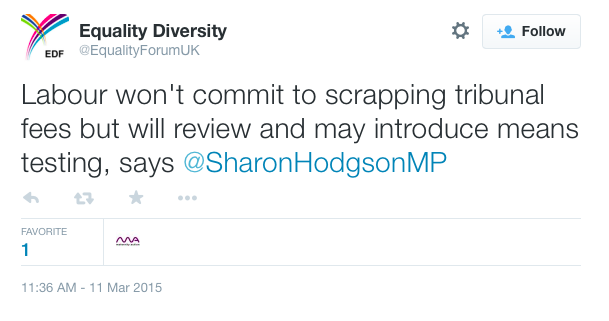
Well, I think that’s interesting, and if your name’s Michael Reed I suspect you will too. However, in terms of what might happen next, it’s probably much less significant than this tweet, posted on 11 March but which I only stumbled upon today:

Screen Shot 2015-03-18 at 16.04.46

Which conveys a somewhat different message to these and similar tweets by other Labour shadow ministers in recent months:

Screen Shot 2015-03-18 at 16.25.14

Screen Shot 2015-03-18 at 17.46.08

No wonder then, that Sadiq Khan got the following response from junior injustice minister Shailesh Vara when he raised the issue of tribunal and court fees in the House of Commons on Tuesday:

Screen Shot 2015-03-18 at 08.09.31

Followed shortly after by this response from the Lord of Injustice himself, Chris Grayling:

Screen Shot 2015-03-18 at 08.21.32

And then there’s former shadow attorney general Emily Thornberry, who yesterday re-iterated (during her Westminster Hall debate on equal pay) her proposal that equal pay claims be exempted from ET fees for five years – the clear implication being that she would be happy for fees to continue for other claims.

Sadly, working out what the three tweets above, and Emily Thornberry’s proposal, might tell us about the policy on ET fees of any future Labour government is beyond my tiny brain. So I’m going to bed.

Employment tribunal Fees-Another Twist of the Knife

Today High Court fees are increased by up to 600%, leading Michael Reed the Legal Officer Employment at FRU to quip on twitter

“Can I just say that when we told MoJ employment tribunal fees were disproportionate compared to court fees, this wasn’t what we had in mind”.

Pricing claimants out of the courts has severe implications for access to justice but my concern today is with a decision of the Employment Appeal Tribunal reported last week, L Goldwater & Others -v- Sellafield Ltd.  This was a decision of HHJ Shanks on the papers about a cost application for the recovery of the £1,600 fees paid by the employees for the privilege of successfully correcting the error of an employment tribunal judge (where they may have paid a fee of at least £390), on a claim for shift allowances.  It is not clear from the original judgment how much money was at stake, but there appear to be 16 claimants affected.

The original reserved decision allowing the appeal was handed down on the 26th November, and Thompsons solicitors on behalf of the successful appellants, made an application under rule 34A(2A) of the EAT Rules for the respondents to pay the £400 issue fee and the £1600 hearing fee.  Rule 34A(2A) states

“If the Appeal Tribunal allows an appeal, in full or in part, it may make a costs order against the respondent specifying that the respondent pay to the appellant an amount no greater than any fee paid by the appellant under a notice issued by the Lord Chancellor”

Eversheds solicitors, on behalf of the respondents made written submissions as to why the fee should not be paid even though they had comprehensively lost the appeal.  No doubt they were encouraged to be inventive in their submissions by recent decisions of the EAT where successful appellants have not had a cost order for the fees made in whole or part in their favour such as Look Ahead Housing -v- Chetty.  In that case an appeal was successful but the EAT judge exercised a residual discretion not to order the fee to be paid by the losing party in the appeal.  Eversheds submissions were:-

  1. The appeals were not wholly successful.  This is described as false and “almost disingenuous” and any fair reading of the original judgment in November would be that the Appellants had won.
  2. There is no entitlement to an order.  The judge has a wide discretion and it was “perfectly appropriate and reasonable” for the respondent to resist the appeal.  These submissions were rejected on the basis the Appellants had to bring the appeal to correct the employment judge’s error.  Incidentally, I always considered it unfair that the parties had to pay for the Employment Judge’s mistake and having to pay a fee only compounds matters.
  3. The fees were not paid by the Appellants but by their union, the GMB and so no award can be made under Rule 34A(2A).

I think it is fair to say this is a particularly speculative argument turning on the most literal reading of the language of Rule 34A(2A), especially as HHJ Shanks notes the definition of “costs” in Rule 34(2) says

“… “costs” includes fees … incurred by or on behalf of a party … in relation to the proceedings …”

There was no dispute that the tribunal claims and appeals were supported by the Appellants trade union, the GMB, no doubt under the union’s legal advice scheme.  Free legal advice is one of the main benefits of union membership.  It is akin to legal expense insurance.  Many unions extended their schemes to cover the cost of fees when they were introduced in July 2013.  Just like legal expense insurance, all the schemes are subject to terms and conditions that vary, but may include continuing to pay union dues, meeting criteria as to the prospects of success, following advice from retained solicitors and payment of all costs and expenses if the member instructs new solicitors.  Nearly all schemes reserve a residual discretion to the union as to whether to support or continual to support a claim.  In Mardner -v- Gardner & another the HHJ Eady in EAT held that the fact that a party was insured was not a relevant factor to take into account when considering whether to award costs.  There were public policy grounds for holding that a Respondent should not benefit from the prudence of the Appellant in taking out insurance.

Incidentally, HHJ Eady exercises her discretion at the end of the decision to award the £1600 appeal fees to the Appellant.  Although it is not clear from the judgment, it may well be a reasonable supposition to assume that the appeal was supported by legal expense insurance and the fee ultimately paid by the insurer.  There is just a finding that the claimant had “incurred” the fee.

HHJ Shanks refers to the difference in wording between “incurred by or on behalf of” in Rule 34(2) for the definition of costs and the limit on the “amount” of costs which can be made under Rule 34A(2A) to “…any fee paid by the appellant”.  He finds that the Appellants paid no fees at all in this case and so the maximum order that could be made is nil.  He therefore dismissed the application for fees to be paid whilst pointing out his decision is confined to Rule 34A(2A) and did not affect Rules 34A(1) and 34B-D about ordinary costs or expenses.

The reaction on twitter was immediate and damning.  The decision is wrong and leads to absurd results.  “Paid by” must include “paid on behalf of” or “paid by union/insurer/etc”. 

More importantly, the wording of Rule 34A(2A) is replicated in the Employment Tribunals (Constitution and Rules of Procedure) Regulations, 2013 Rule 75(1)(b), Rule 76(4) and Rule 78(c) where there  is reference to “tribunal fee paid by the receiving party”, “where a party has paid a Tribunal fee…” and “…a specified amount as reimbursement of all or part of a Tribunal fee paid by the receiving party”.  I anticipate it will not be long before a similar argument is made in the tribunal to resist a claim for fees when a claim is lost.  It will not just be union supported claims, but also legal expense insurance claims, No Win, No Fee lawyers or even solicitors who pay fees upfront in an emergency when a claim is going out of time before any retainer agreement is signed.

Until the matter is resolved (I understand the Appellants are considering an appeal), advisers should ensure they can demonstrate that the party claiming the fee has paid” it.

Ironically, if the case reaches the Court of Appeal where an inflated court fee will be paid there will be little or no argument that the losing party has to pay the winning parties costs and disbursements, including any court fee (although see Unison -v- Kelly for an exception).

Access to justice in employment cases just got even harder.

ET fees: how to find Sadiq Khan £20 million

With Labour shadow ministers and policy wonks seemingly too scared of their own shadows to find a place in their ‘better economic plan’ for their party’s employer-friendly policy pledge to at least substantially reduce the Coalition’s employment tribunal fees, now seems a good time to revisit my April 2014 attempt to set out a fiscally credible means of delivering on that pledge.

Since April 2014, we’ve learnt a fair bit about the level of fee income to the Ministry of Injustice, and the operational cost savings to the Ministry resulting from the steep decline in claims/cases since July 2013. Fee income (net of fee remission) is running at £8.8 million per year, and gross annual expenditure on the employment tribunal system has fallen by £14.4 million, from £86.7 million in 2012/13 (the last financial year before fees), to £76.3 million in 2013/14 (when fees were in force for eight months of the financial year), and £72.3 million in 2014/15. So, assuming for one moment that outright abolition of the fees regime would return the number of claims/cases to pre-fees levels, such abolition now appears to carry a price tag of some £23.2 million per year (£8.8m + £14.4m).

However, it’s very unlikely that outright abolition of the fees regime would return the number of claims/cases to 100% of its pre-fees level, for the simple reason that claim/case numbers had been in slow but steady decline for several years before the introduction of fees in July 2013, and that downward trend would most likely have continued had fees not been introduced. In other words, some – perhaps as much as 15 per cent – of that £14.4 million reduction in operational costs would have happened anyway. Furthermore, the figure of £14.4 includes efficiency savings made within the ET system unrelated to the impact of fees. So, as precision is not really available to us here, let’s just say that the actual price tag associated with outright abolition of the fees regime would be more like £20 million per year.

Now, many will say that £20 million is a piddling sum, and in one sense they’re right: it’s just 0.3 per cent of the Ministry’s overall annual budget of £6.8 billion. But there’s ample evidence that any incoming Chancellor and Justice Secretary would take a different view. Money is going to be very tight under the government elected on 7 May (or, the government undemocratically constructed by political horse-trading in the days following 7 May). In any case, it’s pretty clear that Labour’s policy pledge on fees does not amount to outright abolition (and all that the Liberal Democrats have said so far is that they’d conduct a review). So, it’s more realistic to assume that fees will remain in some form, and to set ourselves the task of constructing an alternative fees regime that would restore access to justice, while covering at least some of that £20 million.

To my mind, that implies no more than nominal fees for claimants. In April 2014, I suggested flat-rate issue and hearing fees of £50. And I argued that, with the advent of state-funded early conciliation of potential claims by Acas, there’s a perfectly sound case for employers having to pay similar fees to defend a claim that they have failed to resolve via Acas. If the number of single claims/cases rose to just 30,000 per year – almost double the current rate of 17,000 per year, but still well below the 54,700 in 2012-13 – such fees would generate £3 million per year in issue fees and, assuming 20 per cent of cases went to a hearing, a further £600,000 per year in hearing fees.

Alternatively, if the number of single claims/cases rose to 40,000 per year – more than twice the current rate of 17,000 per year, but still 27 per cent down on 2012-13 – such nominal issue and hearing fees would generate a total income of £4.8 million per year from single claims/cases.

In April 2014, I also suggested that each claimant in a multiple claimant case pay nominal, flat-rate but reduced issue and hearing fees of £25, and I see no good reason to resile from that view. If the number of such claimants increased to 60,000 per year – double the current rate of 28,000 per year, but still well below the 136,800 in 2012-13 – that would generate another £1.5 million per year in issue fees and, assuming (perhaps conservatively) that 50 per cent of such claims would go to a hearing, a further £750,000 in hearing fees. To that we can add £225,000 in issue and hearing fees (of £50 each) from the 3,000 defending employers, making some £2.5 million in total.

Yes, that amounts to only £7.3 million at most (assuming 40,000 single claims/cases). But those figures are based on scenarios in which claim/case numbers would rise from their current low level, but still remain well below their pre-fees level. In which case, the price tag associated with such a modest fees regime would be much less than the £20 million cited above. And, in the event that claim/case numbers rose to just below their 2012-13 level (say, 50,000 single claims, and 100,000 multiple claims in 5,000 multiple claimant cases), my nominal fees regime would then generate a total fee income of £10.1 million per year (which, you may remember, is what Ministry officials said in 2012 would have to be raised by any alternative regime to their own).

Of course, that would still leaves us £9.9 million short on our £20 million. But the final element of my April 2014 proposal was a ‘polluter pays’ penalty for those employers found by a tribunal to have breached the law – that is, those employers that create the need for an employment tribunal system. Each year, about 12 per cent of all claims are successful at a hearing or result in a default judgement in favour of the claimant. And, if claim/case numbers rose to just below their 2012-13 level, as described in the previous paragraph, there would be about 6,500 losing employers. Imposing a penalty of £1,000 on each of those losing employers – a hefty sum, for sure, but still less than the £1,200 some claimants have to pay in fees now – would generate an income of £6.5 million.

But your name is Sadiq Khan or Ed Balls, and you’re still fretting about another £3.4 million. So increase my ‘polluter pays’ penalty to £1,500. Why shouldn’t employers found by a tribunal to have acted unlawfully make such a contribution to the overall cost of the tribunal system? They would have had ample opportunity to settle the claim by that stage, including through early conciliation by Acas.

There are, of course, any number of ways in which my proposed nominal fees (plus ‘polluter pays’ penalty) regime could be tweaked, but the essential point is that it is entirely feasible to construct a regime based on very low level claimant fees that would nevertheless cover most if not all of the increase in operational costs associated with the inevitable increase in claim/case numbers.


Labour losing race to the top on employment rights policy

So, the supposedly free-market Tories have had their Stalinist-sounding ‘long-term economic plan’, and now Labour has a ‘better economic plan’. Towards the end of the latter, a chapter entitled ‘Supporting firms to win the race to the top, not get dragged into a race to the bottom’, states:

Too often it is assumed that the only way for firms in sectors such as retail, hospitality and social care to compete is by cutting employee pay and conditions. But many firms in these sectors want to be able to compete through higher skill, higher wage business models, without being undercut and dragged into a race to the bottom.

The [Coalition] Government has actively encouraged a race to the bottom by weakening the UK’s enforcement regime and promoting a hire-and-fire culture: doubling the qualification period for unfair dismissal, introducing fees for employment tribunals, and setting up a controversial scheme whereby employees trade their employment rights in return for a share in the company.

[Labour’s new industrial strategy] is about giving employers the tools they need to raise standards, and also protect them from being undercut, by raising the minimum wage, ending the abuse of zero-hours contracts, and making it illegal to use agency workers to undercut wages and conditions.

Bafflingly, there’s no further mention of – let alone any pledge to reverse – that doubling of the unfair dismissal qualifying period. Nor is there any mention of Labour’s previous pledge to reform the tribunal fees that have done so much damage to the ‘enforcement regime’. Given that employer lobby groups such as the CBI and FSB have openly called for the hefty fees to be substantially lowered, this is an astonishing omission from what is clearly intended to be a business-friendly document.

Indeed, once you cut through the rather repetitive references to ‘the race to the bottom’ and ‘raising our ambitions for the domestically-traded sectors’, there are precious few commitments to policy reform that might actually help achieve the plan’s lofty goals. Apart from reiterating both welcome plans to “encourage more employers to pay a living wage” and the disappointingly modest pledge to “increase the minimum wage to £8 an hour before 2020”, the 80-page document sets out just three broad policy pledges specific to “reducing the pressures employers face to get dragged into a race to the bottom”:

1. Banning the abuse of zero-hours contracts: giving workers on zero-hours contracts new legal rights to be protected from employers forcing them to be available at all hours, insisting they cannot work for anyone else, or cancelling shifts at short notice without compensation, and giving workers on zero-hours contracts who are actually working regular hours week-in week-out a right to a contract with fixed minimum hours. We will also introduce a new Acas Code of Practice [on zero-hours contracts].

This is all very well, but – as I’ve previously noted elsewhere and the document itself recognises just two paragraphs later, in relation to enforcement of the minimum wage – there is no point having rules if they are not enforced. And, presumably, the only way to enforce these proposed new rules would be for individual workers to pursue a tribunal claim against their abusive employer. Which very few workers would be likely to do, even without the fees of up to £1,200 on which the document is so surprisingly silent. So, new Labour ministers could huff and puff all they like, but their shiny new rules wouldn’t blow many rogue employers down.

2. Tackling undercutting by rogue employment agencies: taking action to crack down on rogue agencies that exploit workers illegally for profit – for example through a licensing system that ensures agencies are complying with basic standards or stopped from operating; extending the Gangmasters Licensing Authority approach to cover sectors where there is evidence of high levels of migrant labour and exploitative working practices; and closing the loophole in the Agency Workers Directive that allows agency workers to be used to undercut employees.

This is more encouraging, even if it is somewhat ill-defined. However, both the employer lobby groups and past Labour ministers have been strongly against extending the GLA’s licensing regime to other sectors – with good reason. And, since 2010, Coalition ministers have reduced the BIS employment agency standards inspectorate to a rump of just three staff. So it’s not at all clear who Ed Miliband, Rachel Reeves and Chuka Umunna think would do all the cracking down. In short, there’s a lot of work yet to be done on this policy pledge if it’s to become more than a vague sop to the TUC, which has stuck rigidly to its call to extend the GLA regime.

3. Ensuring proper enforcement of the rules: there is no point in having rules if they are not enforced. Under this Government, the number of inspections into whether the National Minimum Wage was being paid has more than halved and there have been just two prosecutions since 2010. There is widespread agreement that better enforcement would support employers that play by the rules. Labour will improve this by: increasing the fines for breaching the minimum wage to £50,000; extending the remit of the HMRC minimum wage unit to cover holiday pay; giving councils a role in enforcement; and trebling the fines for knowingly employing illegal migrants.

The last of this third set of policy actions is little more than dog whistle politics, but there’s a good case for capitalising on the local, front-line knowledge of councils in order to improve enforcement of the NMW. And extending the HMRC unit’s remit to cover holiday pay is something I suggested in 2011, as an obvious first step in incrementally fusing the HMRC unit and the GLA into a genuine fair employment agency; more recently, it was a recommendation of the June 2014 report on low pay by Alan Buckle.

But Labour are kidding themselves – and the voting public – if they think that increasing the maximum penalty for breaching the NMW to £50,000 will have more than a marginal impact. For the penalty is set at 100 per cent of the total arrears owed, and in all but a handful of cases that sum is relatively small, and certainly well below £50,000. For example, among the 162 NMW-flouting firms named and shamed by BIS to date, including the tranche of 70 named today, the total arrears owed – and so the penalty imposed – was less than £10,000 in 154 cases, and exceeded the current maximum of £20,000 in just four cases. And, as they each involved a number of workers, those four cases would have been more than adequately covered by the Government’s proposed new maximum penalty of £20,000 per underpaid worker, set out in the Small Business, Enterprise & Employment Bill and almost certain to become law before Parliament is dissolved on 30 March.

Of course, Labour could increase the penalties by increasing the penalty rate from 100 per cent of the arrears owed to, say, 200 per cent. But that’s quite different to what Labour are saying they would do, and might be quite hard to justify when, in the vast majority of cases, the total sum owed in underpayments is relatively small, and the employer is a (very) small business. Among the 162 firms named and shamed by BIS, the average underpayment per worker was just £306.11, and no fewer than 35 of the 162 firms are hairdressers or beauty salons. We’re (mostly) not talking big corporates here.

All in all, Labour’s ‘better economic plan’ is depressingly short on credible, fully-formed (and costed) policy ideas for halting the race to the bottom in pay and working conditions. The good news is that I’m available to help sort that out, and my daily rate is a lot less than Jack Straw’s.

Waiting for your call, Chuka.