ET fees: how to find Sadiq Khan £20 million

With Labour shadow ministers and policy wonks seemingly too scared of their own shadows to find a place in their ‘better economic plan’ for their party’s employer-friendly policy pledge to at least substantially reduce the Coalition’s employment tribunal fees, now seems a good time to revisit my April 2014 attempt to set out a fiscally credible means of delivering on that pledge.

Since April 2014, we’ve learnt a fair bit about the level of fee income to the Ministry of Injustice, and the operational cost savings to the Ministry resulting from the steep decline in claims/cases since July 2013. Fee income (net of fee remission) is running at £8.8 million per year, and gross annual expenditure on the employment tribunal system has fallen by £14.4 million, from £86.7 million in 2012/13 (the last financial year before fees), to £76.3 million in 2013/14 (when fees were in force for eight months of the financial year), and £72.3 million in 2014/15. So, assuming for one moment that outright abolition of the fees regime would return the number of claims/cases to pre-fees levels, such abolition now appears to carry a price tag of some £23.2 million per year (£8.8m + £14.4m).

However, it’s very unlikely that outright abolition of the fees regime would return the number of claims/cases to 100% of its pre-fees level, for the simple reason that claim/case numbers had been in slow but steady decline for several years before the introduction of fees in July 2013, and that downward trend would most likely have continued had fees not been introduced. In other words, some – perhaps as much as 15 per cent – of that £14.4 million reduction in operational costs would have happened anyway. Furthermore, the figure of £14.4 includes efficiency savings made within the ET system unrelated to the impact of fees. So, as precision is not really available to us here, let’s just say that the actual price tag associated with outright abolition of the fees regime would be more like £20 million per year.

Now, many will say that £20 million is a piddling sum, and in one sense they’re right: it’s just 0.3 per cent of the Ministry’s overall annual budget of £6.8 billion. But there’s ample evidence that any incoming Chancellor and Justice Secretary would take a different view. Money is going to be very tight under the government elected on 7 May (or, the government undemocratically constructed by political horse-trading in the days following 7 May). In any case, it’s pretty clear that Labour’s policy pledge on fees does not amount to outright abolition (and all that the Liberal Democrats have said so far is that they’d conduct a review). So, it’s more realistic to assume that fees will remain in some form, and to set ourselves the task of constructing an alternative fees regime that would restore access to justice, while covering at least some of that £20 million.

To my mind, that implies no more than nominal fees for claimants. In April 2014, I suggested flat-rate issue and hearing fees of £50. And I argued that, with the advent of state-funded early conciliation of potential claims by Acas, there’s a perfectly sound case for employers having to pay similar fees to defend a claim that they have failed to resolve via Acas. If the number of single claims/cases rose to just 30,000 per year – almost double the current rate of 17,000 per year, but still well below the 54,700 in 2012-13 – such fees would generate £3 million per year in issue fees and, assuming 20 per cent of cases went to a hearing, a further £600,000 per year in hearing fees.

Alternatively, if the number of single claims/cases rose to 40,000 per year – more than twice the current rate of 17,000 per year, but still 27 per cent down on 2012-13 – such nominal issue and hearing fees would generate a total income of £4.8 million per year from single claims/cases.

In April 2014, I also suggested that each claimant in a multiple claimant case pay nominal, flat-rate but reduced issue and hearing fees of £25, and I see no good reason to resile from that view. If the number of such claimants increased to 60,000 per year – double the current rate of 28,000 per year, but still well below the 136,800 in 2012-13 – that would generate another £1.5 million per year in issue fees and, assuming (perhaps conservatively) that 50 per cent of such claims would go to a hearing, a further £750,000 in hearing fees. To that we can add £225,000 in issue and hearing fees (of £50 each) from the 3,000 defending employers, making some £2.5 million in total.

Yes, that amounts to only £7.3 million at most (assuming 40,000 single claims/cases). But those figures are based on scenarios in which claim/case numbers would rise from their current low level, but still remain well below their pre-fees level. In which case, the price tag associated with such a modest fees regime would be much less than the £20 million cited above. And, in the event that claim/case numbers rose to just below their 2012-13 level (say, 50,000 single claims, and 100,000 multiple claims in 5,000 multiple claimant cases), my nominal fees regime would then generate a total fee income of £10.1 million per year (which, you may remember, is what Ministry officials said in 2012 would have to be raised by any alternative regime to their own).

Of course, that would still leaves us £9.9 million short on our £20 million. But the final element of my April 2014 proposal was a ‘polluter pays’ penalty for those employers found by a tribunal to have breached the law – that is, those employers that create the need for an employment tribunal system. Each year, about 12 per cent of all claims are successful at a hearing or result in a default judgement in favour of the claimant. And, if claim/case numbers rose to just below their 2012-13 level, as described in the previous paragraph, there would be about 6,500 losing employers. Imposing a penalty of £1,000 on each of those losing employers – a hefty sum, for sure, but still less than the £1,200 some claimants have to pay in fees now – would generate an income of £6.5 million.

But your name is Sadiq Khan or Ed Balls, and you’re still fretting about another £3.4 million. So increase my ‘polluter pays’ penalty to £1,500. Why shouldn’t employers found by a tribunal to have acted unlawfully make such a contribution to the overall cost of the tribunal system? They would have had ample opportunity to settle the claim by that stage, including through early conciliation by Acas.

There are, of course, any number of ways in which my proposed nominal fees (plus ‘polluter pays’ penalty) regime could be tweaked, but the essential point is that it is entirely feasible to construct a regime based on very low level claimant fees that would nevertheless cover most if not all of the increase in operational costs associated with the inevitable increase in claim/case numbers.



Labour losing race to the top on employment rights policy

So, the supposedly free-market Tories have had their Stalinist-sounding ‘long-term economic plan’, and now Labour has a ‘better economic plan’. Towards the end of the latter, a chapter entitled ‘Supporting firms to win the race to the top, not get dragged into a race to the bottom’, states:

Too often it is assumed that the only way for firms in sectors such as retail, hospitality and social care to compete is by cutting employee pay and conditions. But many firms in these sectors want to be able to compete through higher skill, higher wage business models, without being undercut and dragged into a race to the bottom.

The [Coalition] Government has actively encouraged a race to the bottom by weakening the UK’s enforcement regime and promoting a hire-and-fire culture: doubling the qualification period for unfair dismissal, introducing fees for employment tribunals, and setting up a controversial scheme whereby employees trade their employment rights in return for a share in the company.

[Labour’s new industrial strategy] is about giving employers the tools they need to raise standards, and also protect them from being undercut, by raising the minimum wage, ending the abuse of zero-hours contracts, and making it illegal to use agency workers to undercut wages and conditions.

Bafflingly, there’s no further mention of – let alone any pledge to reverse – that doubling of the unfair dismissal qualifying period. Nor is there any mention of Labour’s previous pledge to reform the tribunal fees that have done so much damage to the ‘enforcement regime’. Given that employer lobby groups such as the CBI and FSB have openly called for the hefty fees to be substantially lowered, this is an astonishing omission from what is clearly intended to be a business-friendly document.

Indeed, once you cut through the rather repetitive references to ‘the race to the bottom’ and ‘raising our ambitions for the domestically-traded sectors’, there are precious few commitments to policy reform that might actually help achieve the plan’s lofty goals. Apart from reiterating both welcome plans to “encourage more employers to pay a living wage” and the disappointingly modest pledge to “increase the minimum wage to £8 an hour before 2020”, the 80-page document sets out just three broad policy pledges specific to “reducing the pressures employers face to get dragged into a race to the bottom”:

1. Banning the abuse of zero-hours contracts: giving workers on zero-hours contracts new legal rights to be protected from employers forcing them to be available at all hours, insisting they cannot work for anyone else, or cancelling shifts at short notice without compensation, and giving workers on zero-hours contracts who are actually working regular hours week-in week-out a right to a contract with fixed minimum hours. We will also introduce a new Acas Code of Practice [on zero-hours contracts].

This is all very well, but – as I’ve previously noted elsewhere and the document itself recognises just two paragraphs later, in relation to enforcement of the minimum wage – there is no point having rules if they are not enforced. And, presumably, the only way to enforce these proposed new rules would be for individual workers to pursue a tribunal claim against their abusive employer. Which very few workers would be likely to do, even without the fees of up to £1,200 on which the document is so surprisingly silent. So, new Labour ministers could huff and puff all they like, but their shiny new rules wouldn’t blow many rogue employers down.

2. Tackling undercutting by rogue employment agencies: taking action to crack down on rogue agencies that exploit workers illegally for profit – for example through a licensing system that ensures agencies are complying with basic standards or stopped from operating; extending the Gangmasters Licensing Authority approach to cover sectors where there is evidence of high levels of migrant labour and exploitative working practices; and closing the loophole in the Agency Workers Directive that allows agency workers to be used to undercut employees.

This is more encouraging, even if it is somewhat ill-defined. However, both the employer lobby groups and past Labour ministers have been strongly against extending the GLA’s licensing regime to other sectors – with good reason. And, since 2010, Coalition ministers have reduced the BIS employment agency standards inspectorate to a rump of just three staff. So it’s not at all clear who Ed Miliband, Rachel Reeves and Chuka Umunna think would do all the cracking down. In short, there’s a lot of work yet to be done on this policy pledge if it’s to become more than a vague sop to the TUC, which has stuck rigidly to its call to extend the GLA regime.

3. Ensuring proper enforcement of the rules: there is no point in having rules if they are not enforced. Under this Government, the number of inspections into whether the National Minimum Wage was being paid has more than halved and there have been just two prosecutions since 2010. There is widespread agreement that better enforcement would support employers that play by the rules. Labour will improve this by: increasing the fines for breaching the minimum wage to £50,000; extending the remit of the HMRC minimum wage unit to cover holiday pay; giving councils a role in enforcement; and trebling the fines for knowingly employing illegal migrants.

The last of this third set of policy actions is little more than dog whistle politics, but there’s a good case for capitalising on the local, front-line knowledge of councils in order to improve enforcement of the NMW. And extending the HMRC unit’s remit to cover holiday pay is something I suggested in 2011, as an obvious first step in incrementally fusing the HMRC unit and the GLA into a genuine fair employment agency; more recently, it was a recommendation of the June 2014 report on low pay by Alan Buckle.

But Labour are kidding themselves – and the voting public – if they think that increasing the maximum penalty for breaching the NMW to £50,000 will have more than a marginal impact. For the penalty is set at 100 per cent of the total arrears owed, and in all but a handful of cases that sum is relatively small, and certainly well below £50,000. For example, among the 162 NMW-flouting firms named and shamed by BIS to date, including the tranche of 70 named today, the total arrears owed – and so the penalty imposed – was less than £10,000 in 154 cases, and exceeded the current maximum of £20,000 in just four cases. And, as they each involved a number of workers, those four cases would have been more than adequately covered by the Government’s proposed new maximum penalty of £20,000 per underpaid worker, set out in the Small Business, Enterprise & Employment Bill and almost certain to become law before Parliament is dissolved on 30 March.

Of course, Labour could increase the penalties by increasing the penalty rate from 100 per cent of the arrears owed to, say, 200 per cent. But that’s quite different to what Labour are saying they would do, and might be quite hard to justify when, in the vast majority of cases, the total sum owed in underpayments is relatively small, and the employer is a (very) small business. Among the 162 firms named and shamed by BIS, the average underpayment per worker was just £306.11, and no fewer than 35 of the 162 firms are hairdressers or beauty salons. We’re (mostly) not talking big corporates here.

All in all, Labour’s ‘better economic plan’ is depressingly short on credible, fully-formed (and costed) policy ideas for halting the race to the bottom in pay and working conditions. The good news is that I’m available to help sort that out, and my daily rate is a lot less than Jack Straw’s.

Waiting for your call, Chuka.


Will the next government put the ‘fair’ back into unfair dismissal law?

Last week, for some reason, my mind kept wandering back to 2011, the year in which every stakeholder meeting with BIS officials was dominated by a shouty policy wonk from the British Chambers of Commerce. The year in which BIS spent taxpayers’ money compiling a consultation response that – without so much as a ‘winking’ emoticon to let you in on the joke – stated:

In a survey of 1,100 of their nuttiest members, the Institute of Directors told us that large numbers of businesses had expressed concerns about dismissal and the risk of tribunal claims in relation to recruitment plans. Fifty-one per cent of respondents to the survey said that the one-year qualifying period for unfair dismissal was a ‘significant’ or ‘very significant’ factor in considering whether to take on an additional employee.

Yes, OK, I added ‘nuttiest’. But I don’t think it makes any difference. For the fact is business secretary Vince Cable opted to extend the unfair dismissal qualifying period to two years, on the basis that 561 (two per cent) of the 34,000 members of a Pall Mall-based organisation that’s had only two female heads in its 112-year history thought they could get a bit more deregulation of the labour market by ticking a box in a survey questionnaire. Perhaps, being a Liberal Democrat, Dr Cable just felt a natural affinity with the largely woman-free Institute.

To be fair to Dr Cable, the somewhat less nutty CBI did say that extending the unfair dismissal qualifying period would “have a positive impact on marginal hiring decisions, particularly in smaller firms.” But then that sort of depends on how you define ‘marginal’. Because what the November 2011 BIS consultation response failed to note is that, at that time, the UK’s 1.2 million employers faced an unfair dismissal claim just once every 27.5 years, on average. So, if business leaders really were hamstrung by anxiety over whether their next hiring decision would result in an unfair dismissal ET claim, then we know who to blame for the UK economy lagging behind so many of its competitors.

The BIS consultation response also overlooked the fact that, as shown by the following chart, the number of unfair dismissal claims had been declining steadily since early 2009 (when, of course, the economy was not exactly in best form). Faced with such statistical evidence, as distinct from the views of a self-selecting sliver of the membership of an exclusive Pall Mall club, most time-pressed ministers would probably have opted not to try and fix something not obviously broken. But poor Dr Cable had the abominable Adrian Beecroft and his pals in 10 and 11 Downing Street to deal with. So, with the economy struggling to get out of first gear, Dr Cable thought it best to make workers (aka consumers) a little bit more insecure, but not quite as insecure as Beecroft would have made them.

UDeras

And so it was that, in April 2012, the Unfair Dismissal and Statement of Reasons for Dismissal (Variation of Qualifying Period) Order 2012 extended the unfair dismissal qualifying period from 12 months to two years, and what we might call the Blair-Brown era of unfair dismissal claims (the red columns in the chart) came to an end. Then, somewhat ironically, given that the BIS consultation response had predicted the extension would result in a 3.3 per cent fall in the number of unfair dismissal claims, the dawn of the Beecroft-Cable era (the blue columns in the chart) saw a not insignificant increase in the number of such claims. (That 3.3 per cent, incidentally, is what we policy nerds call ‘spurious precision’. BIS had absolutely no idea how much claim numbers would fall by, if at all, but cunningly concealed that fact by suggesting it had calculated the drop to a tenth of one per cent. MPs and especially journalists fall for this every day of the week.)

Yes, there might have been an even bigger rise, had Dr Cable not acted as indecisively as he did. There’s simply no way of knowing. Whatever, by early 2013, the number of unfair dismissal claims had slipped back pretty much to where it had been in late 2010. And then, of course, we entered the Grayling-Swinson era (the orange columns in the chart), during which the number of unfair dismissal claims has fallen to levels not seen since the Institute of Directors last had a female head, in 1926. With the result that UK employers now face an unfair dismissal ET claim just once every 87 years, on average.

In short, this was evidence-free policy making, based on nothing more than an ideological hunch that eroding legal protection against unfair dismissal would somehow boost job creation. Yet, amid ever greater casualisation of the labour market, the move has unquestionably shifted the imbalance of power between workers and employers a little bit more in favour of the latter. So, with the economy now doing somewhat better than it was in late 2011, there’s a good case for putting the qualifying period back to one year (or even lowering it all the way to six months).

Good employers would have nothing to fear from such a move, as the law on unfair dismissal does not prevent an employer from dismissing a qualifying employee for incompetence or even just for not working hard enough – it simply requires the employer to follow a fair process when doing so. And, as Simon Jones notes in this blog post, that isn’t hard to do. But a shorter qualifying period would create a bit more security in what is an increasingly insecure labour market.

It seems safe to assume this is not a direction of travel in which Conservative ministers would go after 7 May, and the Liberal Democrats’ pre-manifesto, published last September, is entirely silent on the matter. The July 2014 report of Labour’s National Policy Forum, which is supposed to form the basis of the party’s general election manifesto, does include the extension of the qualifying period among a list of Coalition policies that have “fundamentally undermined employment rights”, but there’s no clear commitment to reverse the extension. Similarly, Labour’s better economic plan for prosperity, published yesterday, states:

The [Coalition] Government has actively encouraged a race to the bottom [in wages and skills] by weakening the UK’s enforcement regime and promoting a hire-and-fire culture: doubling the qualification period for unfair dismissal; introducing fees for employment tribunals; and setting up a controversial scheme whereby employees trade their employment rights in return for a share in the company.

Despite this highlighting of the issue, there’s still no place in the plan for a pledge to reverse the doubling of the qualifying period for unfair dismissal (or, indeed, to do anything at all about the equally controversial employment tribunal fees). But then there was no mention in the National Policy Forum report of increasing paternity leave and pay, and that omission – together with a price tag of some £150m per year – hasn’t prevented Ed Miliband from pledging to do exactly that if Labour win in May.

If they genuinely believe in supporting businesses to win the race to the top, not get dragged into a race to the bottom, senior figures in both Labour and the Liberal Democrats should ensure their election manifesto includes a commitment to promptly lower the unfair dismissal qualifying period to 12 months. British bosses should not need more than 12 months to decide whether or not they’ve hired the right person. And the Institute of Directors should be told to go fish.

Rights At Work

“Workers and their families have always distrusted the law, and rightly so. It is not an instrument geared to our needs, and the people who administer it are unrepresentative, out of touch and antagonistic to our demands. Nevertheless, through political and industrial action workers have secured a set of legal rights which can be exploited.

Use the law only when industrial activity fails…Going to law is always a risky business-it takes time, it exposes individual workers to publicity and harassment, it hardens attitudes, and workers rarely win outright…You should only use the law when all prospect of solving an industrial problem through negotiation, conciliation or industrial action have vanished”.

Powerful words especially if you are a young, post-grad student about to start writing a thesis with the pretentious title “The Historical Development of Individual Employment Law”. They are from the first 2 paragraphs of “Rights At Work, A Workers Guide to Employment Law” published in 1979 by Pluto Press.  This book was found on the shelf of many union officials and quite a few labour lawyers, including myself in the 1980’s.

The words quoted above deliberately echo the famous opening words of “The Worker and the Law” by his teacher at the LSE, Bill Wedderburn

“Most workers want nothing more of the law than that it should leave them alone”

The author has just died, tragically young…HHJ Jeremy McMullen QC.  He was then an official in the General and Municipal Workers Union.  Subsequently he became a practising barrister, QC and Senior Judge at the EAT until 2013.  A pretty unique career path.

I leave it to others to write his obituary.  My purpose is to explore whether Jeremy was right and whether what he said above is still valid today.

In 1968 the Dagenham Fords Sewing Machinists (as in the film and now  musical with the earworm of a title tune, “Made in Dagenham”) went on strike for equal pay.  They wanted re-grading from unskilled B grade to semi-skilled grade C.  They settled for a wage rise to 100% of B grade but not the re-grading to grade C.  They didn’t get “equal pay” with their male colleagues.

In 1983, the Equal Value Amendment Regulations were introduced by a reluctant Tory government on the back of an adverse European Court judgment.  The first case brought to tribunal in 1984 was by the same Dagenham Fords Sewing Machinists making the same demand for re-grading. They argued their work was of equal value to that of the male semi-skilled grade C workers.  My firm was instructed by the union to act.  I was a lowly articled clerk taking notes at conferences and running errands.  Suffice to say the case was lost as was an appeal.  The women then went on strike in December 1984 and stayed out for 9 weeks closing down production. Arbitration through ACAS led to a ruling that they should be re-graded to grade C.

Ten years later, a union activist on the Underground was dismissed for allegedly assaulting a manager.  Now qualified as a solicitor, I was instructed by the union to take a claim to the tribunal for interim relief on the grounds of union membership and activity.  The case was won, mainly due to the brilliance of my client in the witness box.  London Transport refused to reinstate and so the tribunal made a continuation of contract of employment order (I remember being quoted in the Evening Standard, saying how outrageous it was that tax payers money was being wasted paying my client to tend his garden).  The Central Line then had a 1 day strike, the matter was referred to an ACAS conciliator and my client got his job back.  He is now Assistant General Secretary of the union.

At the Matrix Chambers Employment Seminar yesterday in a discussion about the increase in interim relief cases in whistleblowing claims, James Laddie QC asked me why there were so few trade union activities claims.  My recollection was that I probably ran on average 1 case per year but was only successful in one other case in 30 years (ironically where I instructed Jeremy).  The common factor in both cases was the performance of my client in the witness box compared with the employer’s witnesses.  Such claims are very hard to prove to the satisfaction of the tribunal and even if you win the employer doesn’t have to reinstate.  The employer also gets 2 bites of the cherry to get their evidence right as to why trade union membership or activities played no part in the decision to dismiss, “anyone is free to join a union” and “some of their best friends are union members”.  Tactically interim relief is often not the best option.

These are but 2 examples from my personal experience that seem to bear out Jeremy’s words. There could be many more.  Of course when Jeremy wrote those words we were in a very different economic world.  The labour market was completely different.  Union density is now 25.6% with 6.5m members.  In 1979 it was over 50% with 13.1m members.  For many workers today, the protection of strong union membership with terms and conditions set by collective bargaining, is never going to happen.  The law is the only protection of minimum standards of fairness and dignity at work.  The reality for many workers is insecurity and exploitation, with pay below the minimum wage, zero hours contracts, casualisation and unsafe workplaces.

Matters will only get worse if the Tories are elected in May with a working majority.  We are promised further restrictions in strike ballots with new minimum thresholds.  Osborne hinted at Davos there would be further changes to facilitate labour mobility (no fault dismissals a la Beecroft?)

And now you have to pay for the privilege of enforcing your rights.  If Jeremy was writing “Rights At Work” today he would add a sentence.  “And you have to pay a £1200 tax to enforce your rights”.

Passing new laws is not necessarily the answer.  What is?  I await your comments.

There is to be a Jeremy McMullen Memorial Fund to support female candidates for the Bar through work-experience and marshalling.  Donations can be made here.

HHJ Jeremy McMullen QC 1948-2015, trade union official, barrister, judge, friend, neighbour and occasional cycle to work companion, you will be missed but the debate about Rights at Work will continue.

How low can you go? The impact of ET fees on equality groups

With just seven weeks to go until Parliament is dissolved (at the end of March) for the general election campaign proper, and the Ministry of Injustice fully occupied trying to work out the correct burden of proof in criminal trials, it is now safe to assume that the Ministry’s long-promised review of ET fees is not going to happen this side of 7 May.

Having been busy “finalising” the scope and timing of the review as long ago as June 2014, by last month the Ministry was only “considering” these tricky concepts. And, while seemingly powerless Liberal Democrat ministers have since early 2014 used the review as a shield to cower behind whenever the issue of fees has been raised with them in parliament or in public, at a recent Working Families policy conference BIS minister Jo Swinson didn’t even try to do so when the impact of fees on parents’ ability to assert their flexible working rights was raised from the floor by Bronwyn McKenna of UNISON.

However, timing aside, finalising the scope of the review is not something that should have detained even the lowliest Ministry official for very long, as the job was done even before the fees regime came into force in July 2013. As previously noted elsewhere on this blog, a plan for the review was set out in an annex to the Ministry’s final regulatory impact assessment of the fees regime, issued in May 2012:

HMCTS will review ET and EAT fee rates to evaluate the impact of the introduction of a fee in this jurisdiction, and to compare against the behaviour predicted by our economic model. We will seek, wherever practicable, to align any proposals for improvements to the system with future reviews of fee levels. Any changes to fee levels will be made through legislation.

The review will seek to:

  • Ensure that those who use the ET system, and can afford to pay, do pay a fee as a contribution to the cost of administering their claim/appeal;
  • Ensure that the remissions system ensures that only those who can afford to pay a fee do so;
  • Ensure that the fee charging process is simple to understand and to administer;
  • Examine impacts on equality groups; and
  • Verify the amount of fee income raised against the models presented in the Impact Assessment and quantify any operational savings.

The first thing to say here is that “economic model” was a somewhat inflated way to describe the wild guesswork that made up most of the Ministry’s impact assessment. Whatever, since there is no evidence of workers using the ET system without paying a fee (or obtaining full remission), we can tick off the first bullet point. There is some evidence (and the Ministry appears to be sitting on further evidence) that the remissions system is doing very little indeed to protect access to justice, not least because the criteria and process for obtaining fee remission are anything but simple – the application form and guidance notes run to 30 A4 pages. And the Ministry has recently published figures on both fee income (less than predicted) and the associated operational savings (greater than predicted).

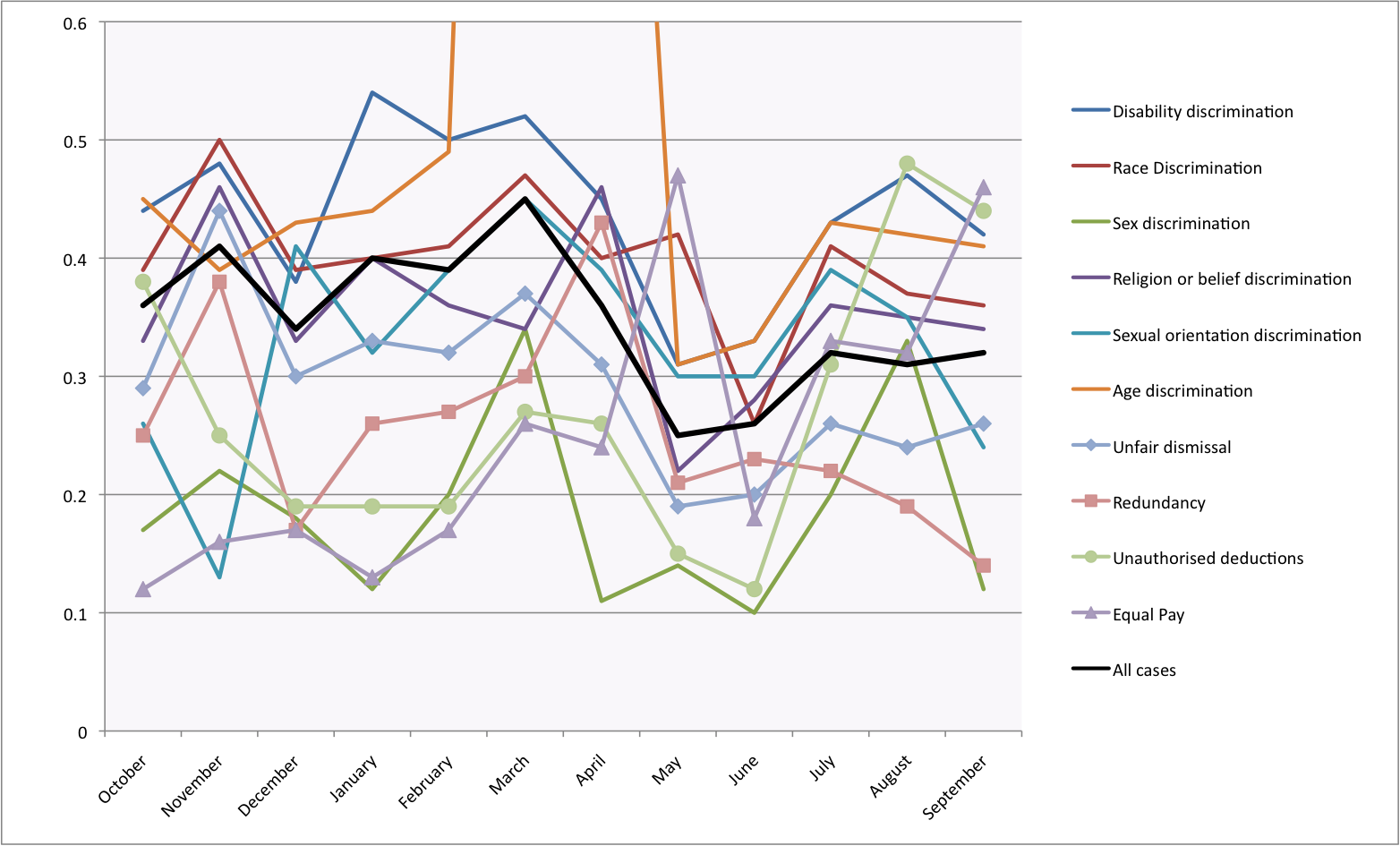
As for the “impacts on equality groups”, the substantial fall in the number of discrimination claims since July 2013 is well documented, with the figure for sex discrimination claims most commonly cited by MPs and others. But I thought it might be illuminative to apply the exercise I undertook in my last post – plotting claim numbers in the 12 months up to September 2014 as a percentage of the average over the 12-month period July 2013 to June 2013 – for the main jurisdictions. And this chart is the result.

disabilityratio

Note that, apart from the black line, which is all cases (i.e. singles + multiple claimant cases), the figures used here are for jurisdictional claims, with an average of about 2.1 jurisdictional claims per case. And yes, age discrimination claims really did shoot off the scale in March and April 2014, presumably due to one or more large multiple claimant cases (or data entry errors by HMCTS).

So, apart from “urgh what a horrible mess”, what can we say about this chart? I hesitate to say too much, and would be very interested to hear the views of others (post a comment!), but I think it confirms what we already knew: that women have been big losers under the fees regime, with both sex discrimination and equal pay claims depressed markedly more than those in other jurisdictions.

That said, there has been something of a recovery in equal pay claims, and in claims for unauthorised deductions, since the introduction of Acas early conciliation in April 2014. I leave it to my clever long-lost twin, Michael Reed of FRU, to explain what that’s all about.

Is there any comfort to be drawn from this chart by, say, a Parliamentary Under-Secretary of State for Justice? I guess such a person might note that the number of claims in most discrimination jurisdictions other than sex discrimination has been depressed a little less than in some of the other main jurisdictions, such as unfair dismissal and unauthorised deductions. But I really don’t think that’s anything to crow about. The number of claims in those jurisdictions has always been relatively small (and is now very small indeed), and at such a low level of claims we might expect a slightly lower price elasticity of demand in those jurisdictions. We can think of this as the ‘How low can you go’ theorem.

And of course, as shown by this excellent new report from Citizens Advice Scotland, every time a valid claim is not brought due to the cost of fees, an employer gets away with unlawful discrimination. What the chart really confirms is the shallowness of the Coalition government’s stated commitment to tackling the discrimination that remains all too rife in UK workplaces. In a new Government Equalities Office guide to tackling sex discrimination in relation to pay, for example, equalities minister Nicky Morgan states: “I want women to feel able to hold employers to account if they feel they are not being paid the same as their male colleagues.” Yet, as the guide quietly acknowledges, “if your employer still refuses to pay you equally,” then the only way to ‘hold your employer to account’ is to issue and purse an ET claim.

Limit access to that means of holding employers to account with ET fees, and the unequal pay that feeds the gender pay gap will take even longer to eliminate, to the detriment of all.


ET fees & ET judges: the regional winners and losers

Last week, as I was reading through the Hansard record of a House of Lords grand committee debate on the Small Business, Enterprise & Employment Bill, my eye was drawn to a comment made by shadow BIS minister Lord Young, during an exchange with BIS minister Baroness Neville-Rolfe on ET fees.

Surely there ought to be some concern about a situation where, in some regions, the number of employment tribunal [claims] has dropped by 80 per cent? Surely that is not an indication that 80 per cent of claims were vexatious. Does [the Minister] really not have any concern in this situation that fees are deterring people from bringing what could be completely fair and justifiable cases before an employment tribunal?

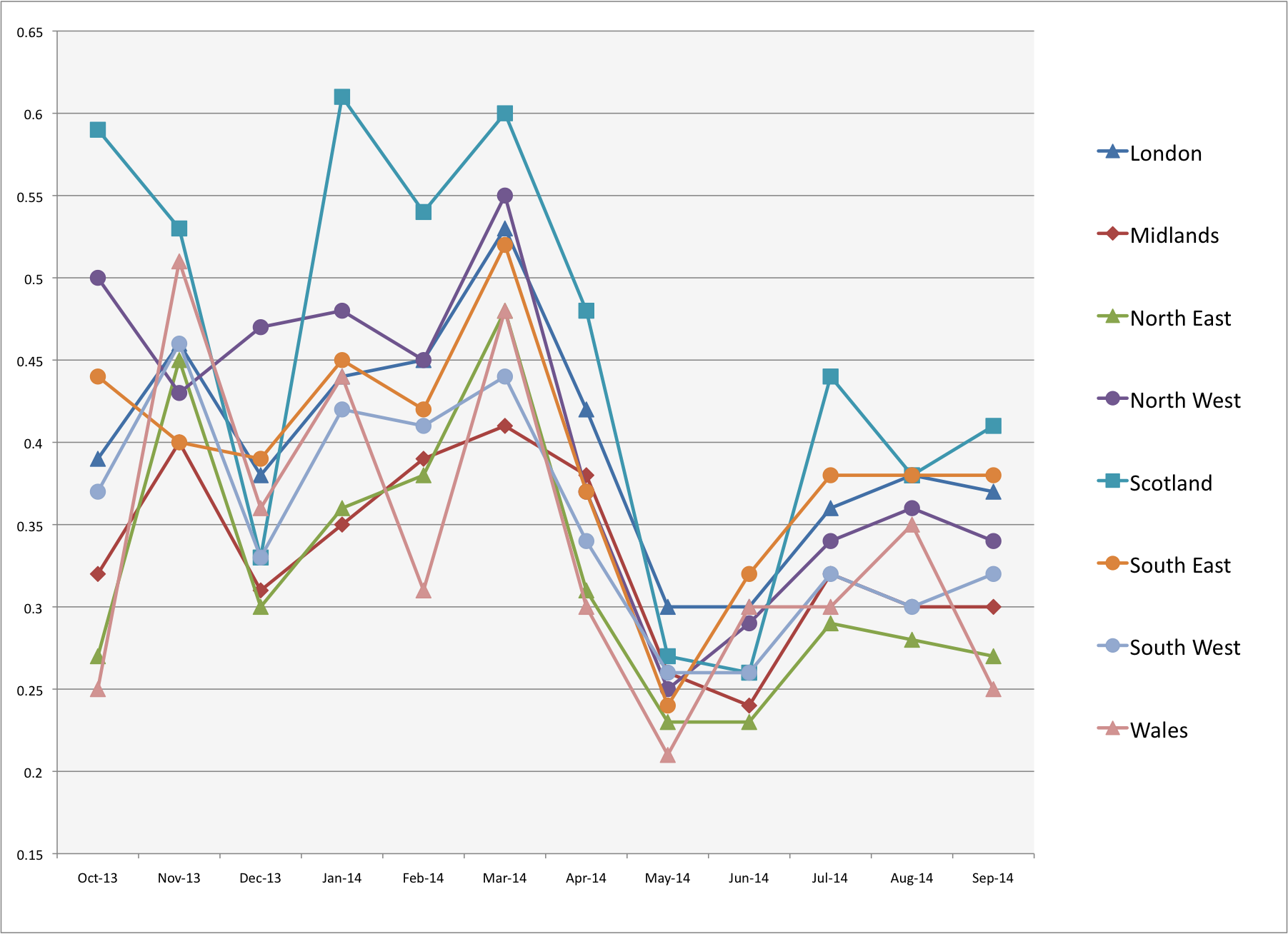
Shockingly but not surprisingly, as President Josiah Bartlet would say, the Minister turned out not to have any great concern, but Lord Young’s use of the qualifier “some regions” reminded me of a conversation I had a few weeks ago with an adviser to a shadow minister. The adviser said he had been told that, while claim/cases were sharply down in some ET regions, in other regions the employment judges were almost as busy as ever. I said that was news to me, and made a mental note to look into the matter. And the chart below is the result.

For this chart, I have focussed on single claims/cases, as that is (currently) the Ministry of Injustice’s favoured measure of ET receipts. And, for each ET region, I have charted the monthly number of new single claims/cases over the 12-month period October 2013 to September 2014, as a fraction of the average over the 12-month period July 2012 to June 2013. So, for example, where claims/cases are down by 60 per cent on the pre-fees average, they are plotted at 0.4 in the chart. All source data is from the Ministry’s quarterly tribunal statistics. There would be little point including the figures for all the claimants in multiple claimant cases in this exercise, and sadly the Ministry does not give a breakdown by region of the number of multiple claimant cases (which I would otherwise include).

Winners

I could be wrong (I often am), but to my mind the chart suggests either that the shadow minister’s adviser was misinformed, or that he or I somehow got the wrong end of the stick. For there is remarkably little variation between the ET regions, and all have followed much the same pattern over the period up to September 2014. Scotland has remained a little bit busier than the North East and Wales, it’s true, but not really busier enough to induce any work-shy Scottish ET judge to check out the Newcastle or Cardiff housing markets. Then again, the ET judges in Newcastle or Cardiff perhaps have a little more reason than most to be checking out the jobs market.

Interestingly, the chart suggests that, in March 2014, there was a bit of a rush to get claims issued before the coming into force of Acas early conciliation on 6 April, much as there was in July 2013 to beat fees.

The chart also confirms that Lord Young was somewhat over-egging it when he said that claims are down in “some regions” by 80 per cent. While Wales came very close, at the peak (or depth) of the Acas early conciliation ‘pause’ in May 2014, the truth is that no region has fallen quite that far (at least, not in terms of single claims/cases). However, by September 2014, single claims/cases were down by more than 60 per cent in all but one of the eight ET regions, the exception being Scotland, down a mere 59 per cent. And not even the nuttiest employer lobby group has ever claimed that, pre-fees, 60 per cent of all single claims were vexatious.

So, who are the real winners from the situation revealed by this chart? They are not the ET judges in Cardiff and Newcastle, but the dinosaur and rogue employers throughout England, Scotland and Wales who have breached the statutory employment rights of their workers with impunity. And the losers include not just the abused workers in question, but the great majority of law-abiding employers denied a level playing field. Just ask Tory MP Sir John Randall, who is closing his family business after being undercut by rivals lowering costs by employing staff on zero-hours contracts and “brutal” working conditions.


At remission control, the lights are on but nobody’s home

Previously on this blog, I have examined parts of a rather grand dismissal of concern about the impact of ET fees by the Parliamentary Under-Secretary of State for Justice, Shailesh Vara. Responding to a question by Diana Johnson MP, in which Ms Johnson noted the drop in ET sex discrimination claims of some 84 per cent since July 2013, Mr Vara said:

The situation is a lot more complex than the honourable Lady makes out. First and foremost, anyone who does not meet the financial criteria has a waiver and can go to court. Secondly, there have been a lot of pre-determinations by Acas. Employment is going up and there are fewer applications. There are a lot of factors and she does herself no credit by simplifying matters.

In this post I’m going to focus on the hapless junior minister’s reference to what he calls ‘a waiver’, but which most of us know as fee remission.

Now, as The Smiths sang, it is easy to laugh and to hate, but it takes guts to be gentle and kind. So let’s be gentle and kind to Mr Vara, and recognise that – terminology aside – what he says on fee remission is all of a piece with what other ministers have said on many occasions. Here, for example, is business secretary Vince Cable in November 2011, during the speech in which he announced the Coalition Government’s intention to exploit a legal power slipped through by Labour ministers in 2007, in order to shamelessly introduce ET fees without any parliamentary debate on the principle of doing so:

I want to make it very clear that for those with a genuine claim, fees will not be a barrier to justice. We will ensure that there is a remissions system for those who need help.

And, most recently, here is BIS minister Baroness Neville-Rolfe in the House of Lords earlier this week (during debate on the Small, Business, Enterprise & Employment Bill):

It is important to emphasise that the Government have been very careful to ensure that fee waivers are available for those people of limited means in order that they are not excluded from seeking redress through tribunals.

Unfortunately, anecdotal evidence from employment law practitioners, and the very limited amount of statistical data released by Mr Vara’s Ministry of Injustice to date, indicates that fee remission has done very little indeed to protect the access to justice of “those of limited means” since July 2013. As described elsewhere on this blog, until this week pretty much the only published data was that on grants of remission set out in the Ministry’s partial reply in October last year to a parliamentary question by shadow business secretary Chuka Umunna. Together with a bit more information on grants of remission included in the written evidence of a Ministry official in defence of UNISON’s second application for judicial review of the fees regime, that PQ reply told us that just 1,946 (10.4 per cent) of all 18,660 single claimants in the 11-month period 29 July 2013 to 30 June 2014 obtained some remission (full or partial) in relation to their case.

However, this week, in reply to a further parliamentary question by shadow BIS minister Ian Murray, the Ministry provided figures on grants of remission for July to December 2014. This tells us that there were 3,459 remission grants to single claimants in that period. However, we know from the breakdown given in the Ministry official’s evidence to the High Court that some 10 per cent of those grants will have been in relation to the appeal fee. And as a claimant granted remission for the appeal fee is also very likely to have received remission for the issue fee, those grants are double-counted. So we need to reduce the figure of 3,459 by 10 per cent, to 3,113. (Yes, the ’10 per cent’ may have gone up or down in recent months but, as there’s no way of telling from the Ministry’s reply, let’s just run with it).

I imagine Mr Vara would want us to dwell on the fact that, applying this 10 per cent reduction to the most recent quarter for which both the ET claim and remission grant figures are available – July to September 2014 – about 1,400 (33 per cent) of the 4,252 single claimants obtained full or partial fee remission. Which is a lot more respectable than the 10.4 per cent figure above.

To my mind, there are three possible explanations of this increased respectability: the number of remission applications has increased in recent months; or the Ministry’s decision-making has become less severe in recent months; or the extent of double-counting of claimants granted remission in respect of both the issue and the appeal fee has increased in recent months.

Indeed, we do know that the Ministry relaxed the evidence requirements for fee remission applications at the end of June 2014, and we can expect that to have increased the success rate, even if only slightly. And I would’t be surprised if the extent of double-counting has increased, but we won’t know until the Ministry provides a breakdown of remission grants to single claimants by issue fee and hearing fee.

Unfortunately, we also have no idea how many applications for fee remission were made, and how many were refused, in any of these time periods, because the Ministry of Injustice paid some £2m for a new ‘ET fees & remission’ database that, thanks to a lack of functional reporting tools, has yet to produce any reliable data, almost 18 months after it went live on 29 July 2013. (The above figures on remission grants are taken from a separate, finance system database). It seems we have to wait at least until publication of the next set of quarterly tribunal statistics, in early March, for the first figures on fee remission applications, grants, and refusals from that database.

dilbertproject

Whatever, the latest figures on remission grants are more meaningfully judged not against the actual number of claims in that period, but against the number of claims we might have expected to see, had fees not been introduced in July 2013. In my previous post on the other parts of Mr Vara’s reply to Diana Johnson, I set out two alternative (but ultimately very similar) projections for the number of single claims we might have expected to see in 2013/14.

Applying the most recent remission grant figures (for the six months July to December 2014) to the average of those two projections, we get a figure of 12.4 per cent of the single claimants we might have expected over a full year obtaining remission in relation to their case. Which is not so respectable, and certainly still well below the 31 per cent that the Ministry predicted in late 2013, in its final impact assessment of the (revised) remission scheme.

So, as with the rest of Mr Vara’s reply to Diana Johnson, the Parliamentary Under-Secretary of State for Justice does himself no credit by claiming that “anyone who [meets] the financial criteria has a waiver and can go to court”. The fee remission scheme appears to be protecting access to justice for only one in eight of the workers we could expect to be issuing a (single) tribunal claim, had fees not been introduced.

Which is entirely to be expected, given the complexity and narrowness of the eligibility criteria – the fee remission application form and explanatory notes run to 30 pages. Perhaps most significantly, any claimant in a household which has been prudent enough to build up modest savings of £3,000 or more will not qualify for any remission. So much for all those ministerial speeches about the need for people to take personal responsibility and put money aside for rainy days. If you and your partner have saved up £4,000 to help with the cost of the baby you’re soon to have, and then your employer unlawfully selects you for redundancy because you are pregnant, you’re probably not going to risk £1,200 of those precious savings pursuing a tribunal claim.

Finally, if you’re wondering why I haven’t included a nice little graph charting the number of remission grants in each month from July 2013 to December 2014, it’s because the figures for July to December given by the Ministry in its reply to Ian Murray are not compatible with the figures for the 11 months up to June 2014 given by the Ministry in its reply of 15 October to Chuka Umunna. The former include grants in multiple claimant cases (just 31 in six months), whereas the latter include all the claimants in multiple claimant cases (1,530 in 11 months), though we only know this from the Ministry official’s evidence to the High Court.


The complex life of a Parliamentary Under-Secretary of State for Justice

Unlike his boss, the book-banner and serial law-breaker Chris Grayling, junior justice minister Shailesh Vara is rarely seen or heard in public. But every now and then he pops up in the House of Commons to deny that the dramatic decline in employment tribunal cases since July 2013 is more than tangentially related to the ET fees regime introduced by the recidivist Grayling in, er, July 2013. Most recently, on 16 December, during the ‘topical questions’ session immediately following oral justice questions, the Parliamentary Under-Secretary of State for Justice grandly swatted away a question from Labour MP Diana Johnson:

Diana Johnson: Since the Government introduced employment tribunal fees, there has been a drop of 84 per cent in the number of women who have been able to bring discrimination claims. Does the Minister accept that, because of the up-front fees of £1,200, many women are being denied justice under his Government?

Shailesh Vara: The situation is a lot more complex than the honourable Lady makes out. First and foremost, anyone who does not meet the financial criteria has a waiver and can go to court. Secondly, there have been a lot of pre-determinations by Acas. Employment is going up and there are fewer applications. There are a lot of factors and she does herself no credit by simplifying matters.

We might ask just how much credit the PUSS for Justice does himself by wrongly referring to fee remission as ‘a waiver’, to the tribunal as the ‘court’, to Acas early conciliation as ‘pre-determination by Acas’, and to claims/cases as ‘applications’. But that would be harsh. Since joining the Ministry on 7 October 2013, Mr Vara has had only 15 months in which to master his complex brief. And he’s only a solicitor.

So, let’s just concentrate on the “lot of factors” that make the situation so complex. But before we do so, let’s remind ourselves of the situation, which is that, immediately following the introduction of fees on 29 July 2013, the number of new ET cases (single claims/cases + multiple claimant cases) fell off a cliff, and in recent months has settled at about one-third of the pre-fees level. Here’s a chart with which you may be familiar (so, to keep your interest going to the next paragraph, I’ve changed both the colours and the chart style).

monthlyVara

So, what might be the “lot of factors” explaining the fall in ET case numbers shown in this chart?

Possible Factor #1: “There has been a lot of pre-determination by Acas”

It is indeed true that a system of early conciliation of potential ET claims by Acas came into force on 6 April 2014. And, as that system was intended to reduce the number of ET claims/cases, it is fair to say that the picture does get a bit complicated from 6 April 2014 onwards.

So, let’s just ignore the ‘new case’ figures for the months April to September 2014. That way, we can dispense with Mr Vara’s Possible Factor #1 entirely.

And, whilst we’re at it, let’s ignore the three months July to September 2013, which saw a big spike in July as claimants and claimant representatives lodged claims earlier than they would have done in order to beat the introduction of fees, followed by a compensatory cliff-like drop in August and September. Such an atypical period does not really help us with explaining the shape of the chart above.

That leaves us with the six-month period 1 October 2013 to 31 March 2014, otherwise known as Q3 and Q4 of 2013-14, to compare with earlier periods. And, as the number of multiple claimant cases is relatively very small, let’s also focus on single claims/cases. As noted elsewhere on this blog, this is in any case the measure of ET claims favoured by the Ministry of Injustice itself in the High Court, in the two unsuccessful applications for judicial review of the fees regime brought by trade union UNISON.

Possible Factor #2: “Employment is going up and there are fewer applications”

What Mr Vara was trying to say here, I think, is that the economy has been picking up in recent years, so the number of ET claims/cases was already in decline before the introduction of fees. And it’s certainly true that the number tends to rise during times of economic crisis, and decline when the economy is doing better. So this is a thesis not as patently daft as Mr Vara’s ‘pre-determination by Acas’.

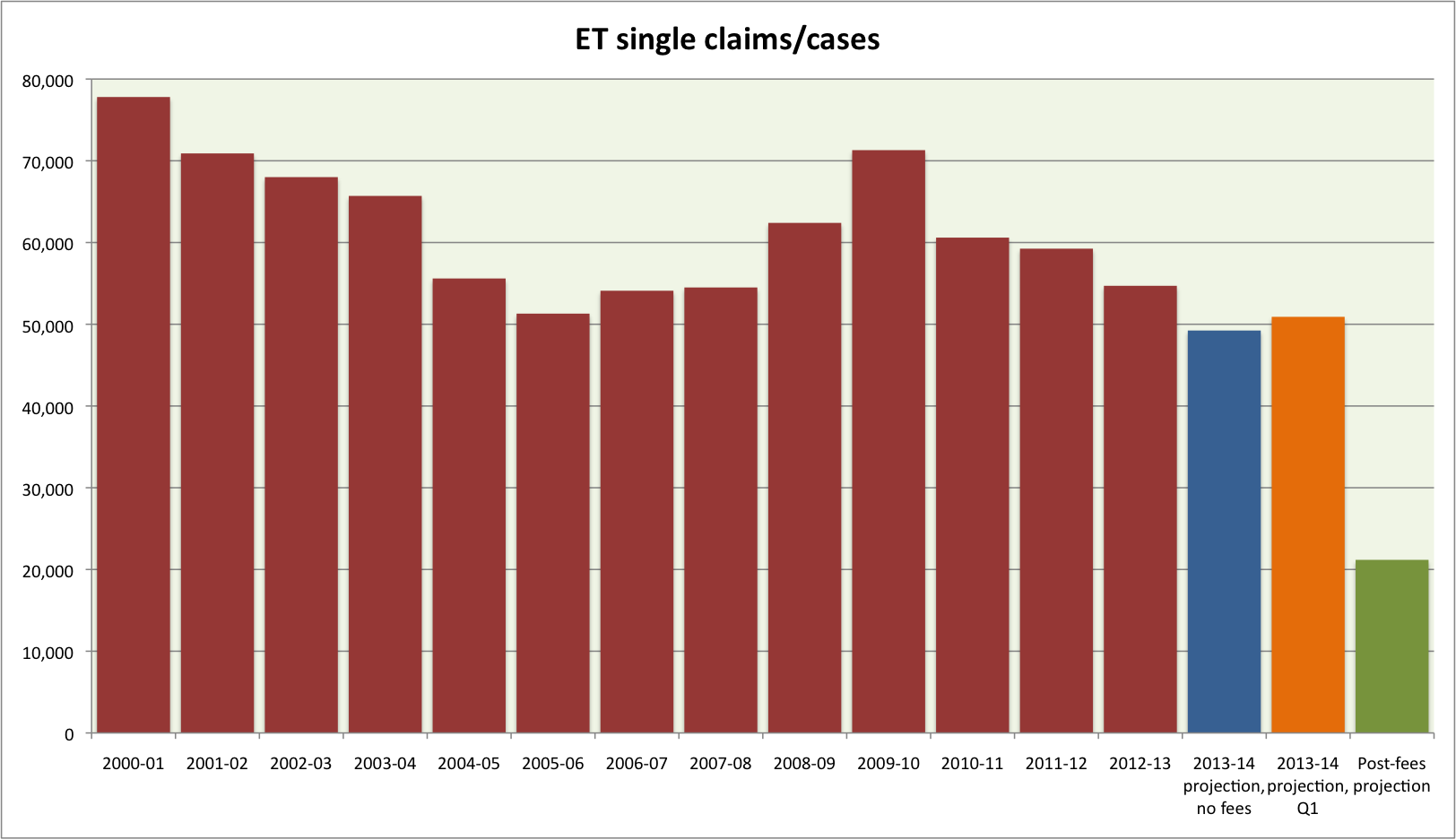
Now, unemployment has been declining since October 2011, when it peaked at 2.7 million. So we might expect the number of ET cases to have been declining from about the same time. And – lo! – that is indeed what we find when we chart the annual number of ET single claims/cases.

annualVara

From this chart we can see that, having peaked in 2009-10 at the height of the economic turmoil and wave of redundancies that followed the global financial crisis of 2008, the number of ET single claims/cases declined slowly but steadily from 2010-11. By 2012-13 – the last full year before the introduction of fees – the number of single claims/cases was pretty much back to its pre-recession level. And it is at this point that we should pause to admire the masterful comic irony of Mr Vara’s Possible Factor #2.

In late 2011 and throughout 2012, ministers justified their plans to introduce hefty, upfront tribunal fees by stating – repeatedly and in cataclysmic terms – that the number of claims/cases was not just increasing, but going through the roof. Here, for example, is business secretary Vince Cable in November 2011: “Workplace disputes are increasingly being settled through tribunals [and] we are in danger of getting away from the principle that they should be the last resort, not the first option.”

In fact, even as Dr Cable uttered those words, the number of ET single claims/cases was going down, and it continued to decline as the Ministry of Injustice finalised and then implemented its fees regime in July 2013. And now that decline is used by Mr Vara and others to haughtily dismiss concern about the impact of the fees regime on access to justice. Yes, I’m lovin’ that irony.

But back to the chart above. In 2012-13, the number of single claims/cases was down 7.7 per cent on 2011-12. Clearly, we don’t know how many such claims/cases there would have been in 2013-14, had fees not been introduced one-third of the way through the financial year, but the blue column in the chart is a projection based on a further decline of 10 per cent on 2012-13. That would have brought the number of single claims/cases to its lowest level this century. So much for the “danger” imagined by Dr Cable in 2011: ministers could have ‘achieved’ a record low in ET case numbers without even going into the office.

And, if you don’t feel comfortable with me plucking a 10 per cent decline in case numbers out of thin air, the orange column is a projection for 2013-14 based on Quarter 1 of that year (April to June 2013). This still sneaks under 2005-06 to set a record low this century, despite equating to just a 6.9 per cent decline on 2012-13.

The final, green column is a projection based on the six-month period 1 October 2013 to 31 March 2014, scaled up to 12 months. Is it credible that the slow rate of decline evident in the red (and blue or orange) columns, which certainly appears to fit with Mr Vara’s Possible Factor #2, suddenly accelerated – just as fees were introduced in mid-2013 – so as to reduce the number of single claims/cases to a level less than half that in every other year this century?

To put it another way, does the PUSS for Justice do himself any credit by suggesting that the rate of decline in ET case numbers due to the slowly recovering economy increased from 2.3 per cent in 2011-12, to 7.7 per cent in 2012-13, then leapt to 61.3 per cent in the months immediately following the introduction of fees? Despite no corresponding great change in the rate of fall in unemployment? I do not think he does.

I suggest that Mr Vara would do himself more credit by accepting that the recovering economy is no more than a relatively minor factor in the dramatic fall in ET case numbers since July 2013, most likely accounting for less than one-tenth of the drop-off. And on we go to Mr Vara’s Possible Factor #3 and the other nine-tenths of the fall in ET case numbers since the introduction of fees.

Possible Factor #3: Er ….

Oh. Mr Vara didn’t say what Possible Factor #3 is. Let alone Possible Factors #4, #5 and #6. He just left Diana Johnson, the rest of the House of Commons, and us dangling with the suggestion that there are “lots” of Possible Factors. So, what might these other Possible Factors that Mr Vara chose not to mention be?

Possible Factor #3: “Lots of tribunal applications have gone to the Shire Courts”

Mr Vara might well have said this, had he bothered to suggest to Ms Johnson that the introduction of tribunal fees has displaced some claims/cases to the County Court, where the claimant fees are (currently) somewhat lower. Unfortunately, the official County Court statistics are so primitive that, short of someone conducting some in-depth research, there is no obvious way of knowing for sure how significant this displacement factor might be. But some people – not least the former President of the Employment Tribunals, David Latham – believe there has been at least some displacement due to fees.

However, we can at least estimate the maximum possible influence of such displacement on overall case numbers, because only a few types of tribunal claim can be brought in the County Court. In fact, of the 20 main jurisdictions identified by the Ministry of Injustice in its tribunal statistics, just four can be brought in the County Court: breach of contract; unlawful deductions from wages (UDW); equal pay; and breach of the national minimum wage. (The ever helpful Michael Reed of the Free Representation Unit advises me that, technically, a UDW claim cannot be brought in the County Court but, in practice, almost all such claims can instead be brought in the County Court as a breach of contract claim).

The Ministry’s tribunal statistics tell us that, in 2012-13, these four transferrable jurisdictions accounted for 32.3 per cent of all ET jurisdictional claims. (Note that here we are back not just to all claims, including all those in multiple claimant cases, but to all jurisdictional claims, of which there were 332,859 in 2012-13, due to each claim including an average of 1.7 jurisdictions). So, even if every such claim/case had been displaced to the County Court by fees, that would still only account for about one-third of the overall fall in ET case numbers.

Now 32.3 per cent is not an insignificant proportion – equal pay and unlawful deductions from wages are two of the most commonly claimed jurisdictions. But it is very unlikely indeed that anywhere near all of those jurisdictional claims would disappear off to the County Court, not least because many are brought in conjunction with other jurisdictional claims – such as unfair dismissal, and discrimination – that can only be brought in the tribunal. And, indeed, the Ministry’s tribunal statistics show that, in our six-month period October 2013 to March 2014, the four transferrable jurisdictions accounted for 29.8 per cent of all 48,283 jurisdictional claims. (We can even extend our period to September 2014, because the impact of Acas early conciliation is largely irrelevant here, and then we get a figure of 33.6 per cent).

Were a significant number of tribunal claims/cases disappearing off to the County Court to take advantage of the lower claimant fees there, we could expect the proportion of all jurisdictional claims accounted for by the four transferrable jurisdictions to have headed down towards zero. So, whilst the fact that it has remained constant does not prove that tribunal claims/cases are not being displaced to the County Court in significant numbers, it certainly doesn’t help anyone – such as a PUSS for Justice – wanting to suggest that such displacement is a significant factor in the dramatic fall in ET case numbers from July 2013 onwards.

Possible Factor #4: “Only weak or unfounded tribunal applications have been deterred by the fees”

Again, Mr Vara didn’t say this. But he might have done, because it’s a line of argument that’s been trotted out by BIS minister Matthew Hancock and his pals in the press. However, were it a well-founded line of argument, we could expect to see the proportion of successful claims/cases rising towards 100 per cent. And, as set out elsewhere on this blog, the Ministry’s tribunal statistics show it going down, not up, whichever way we measure ‘success’. So, we can dispense with Possible Factor #4.

Possible Factor #5: “Thanks to the Employer’s Charter launched by our fabulous Prime Minister in 2011, most bad employers disappeared from the UK economy in a puff of purple smoke early in the morning of 30 July 2013”

There’s not really anything to say here, other than: Why do we never hear from ministers about the Employer’s Charter, on which David Cameron really did spend hard-working taxpayer’s money in 2011?

And … well, that’s it. I really can’t think of any more Possible Factors. But maybe next time the PUSS for Justice leaps to his feet in the House of Commons, he will enlighten us further. Or, assuming he knows how to use a computer and access the interweb thingamajig, he could post a comment on this blog.

Meanwhile, in my next post I will examine Mr Vara’s somewhat convoluted assertion that “anyone who does not meet the financial criteria has a waiver and can go to court”.


Do BIS & HMRC care about the care sector?

There was much ministerial self-satisfaction in evidence yesterday, as BIS named & shamed a further 37 employers for breaches of the national minimum wage. This brings the total number of firms named since the scheme was rebooted in October 2013 to a less than impressive 92. Or just 90, if you allow for BIS wrongly naming, so not actually shaming, two of the 25 firms it named in June last year.

“Paying less than the minimum wage is illegal, immoral and completely unacceptable,” said BIS minister Jo Swinson. “If employers break this law they need to know that we will take tough action by naming, shaming and fining them as well as helping workers recover the hundreds of thousands of pounds in pay owed to them.”

Or the average of £4.82 in pay owed to them, in the case of the 540 workers to whom retailer H&M failed to pay a total of some £2,600. It was this case that – no doubt to the delight of press officers at BIS and the chagrin of those at H&M – most national media chose to focus on, presumably because H&M were unlucky enough to be the first (and so far only) household-name retailer to be shamed by BIS. Never has so little been owed to so many by “time-logging errors in some stores”.

Of course, household-name corporations like H&M – which, according to the Independent, made profits of “more than £600m in the last quarter alone” – could avoid the risk of such adverse publicity by paying their staff a living wage, rather than just the legal minimum.

However, it was another of the 37 shamed employers that caught my eye. Ultimate Care UK Ltd, in Ipswich, became the first of Britain’s 35,000 adult social care employers (i.e. both residential and domiciliary care providers) to be named & shamed by BIS, for failing to pay a total of £613.79 to seven workers. With just 15 care staff, and having won a National Home Care Employer of the Year (< 250 employees) award in 2011, Ultimate Care are probably feeling as aggrieved as the corporate fat cats at H&M at being shamed by BIS when there are clearly a great many bigger fish in Britain’s pool of minimum wage rogues.

Indeed, just two days before BIS dumped on Ultimate Care, Jo Swinson’s Liberal Democrat colleague Paul Burstow – a former health minister (2010-12), and chair of a Commission on Home Care – used a Westminster Hall debate to highlight a number of challenges in the adult social care sector, including “the low pay, low status culture that pervades the sector.” Noting that the National Audit Office estimated in early 2014 that as many as 220,000 (15 per cent) of the sector’s 1.5 million workers are illegally paid below the minimum wage, and that “the problem is getting worse, not better”, Mr Burstow called for action to ensure that “those who are exploiting their workers” are “properly and vigorously pursued.”

Mr Burstow is far from alone in contrasting the evidence of systemic flouting of the minimum wage in the sector, with the apparent lack of effective enforcement action against the employers in question. In March 2013, a number of MPs – including Simon Hughes, Liz Kendall, and Alison McGovern – expressed concern about the exploitation of their constituents during a Westminster Hall debate initiated by Labour MP Andrew Smith. And in August that year, a report by the Resolution Foundation think tank highlighted the “national scandal” of care workers being illegally paid as little as £5 per hour:

While headline pay rates for care workers who visit clients at home are set at or above the national minimum wage of £6.19 an hour, in practice those workers often lose at least £1 an hour because they are not paid separately for the time spent travelling between appointments and because providing decent care often takes longer than the time allocated by the employer for each visit. This would mean that over the course of a year, a care worker who spent an average of 35 hours a week at work for 48 weeks would lose out on more than £1600.

In November 2013, an evaluation by HMRC of its enforcement work in the social care sector in 2011/12 and 2012/13, including both complaints made via the Pay & Work Rights Helpline and targeted enforcement against 40 residential care providers and 40 domiciliary providers, concluded that inspectors had “identified higher and increasing levels of non-compliance with minimum wage legislation than has been previously found in the sector.” HMRC noted:

[We] are concerned that many employers had failed to keep sufficient records of working time to demonstrate that workers are being paid at least the national minimum wage, particularly given that non-payment of travelling time for workers in domiciliary care was commonplace [sic].

In May 2014, the Kingsmill Review – a report into working conditions in the sector by Baroness Denise Kingsmill, commissioned by Labour leader Ed Miliband – concluded that “the low status of care work and poor treatment of workers has led to a vicious downward spiral, with widespread exploitation.” Two months later – in response to the March 2014 NAO report cited by Paul Burstow – the Public Accounts Committee of MPs said they were “astonished that up to 220,000 care workers earn less than the minimum wage and little has been done to rectify this.”

In November 2014, Andrew Smith initiated a second Westminster Hall debate, during which Labour MPs queued up to express their concern at the lack of government action on the issue. And, last month, launching a campaign and petition calling on ministers to “end the scandal of illegally paid care workers”, the trade union Unison noted that:

In 2011 and 2013, HMRC investigated the care sector and found that only half of care providers were paying [at least] the minimum wage. Thanks to those investigations, several companies were forced to pay care workers the money that they were owed.

Now, because of the ongoing cuts to care budgets and a lack of follow-up action from HMRC, the situation has become worse. This is in part because most care workers are on zero-hours or temporary agency contracts, with the employers cutting out paid time wherever they can. A full day on the job can translate into only a handful of paid hours.

In short, pretty much everyone who has considered the issue has concluded that exploitation, including non-compliance with the minimum wage, is rife in the social care sector. So why were investigations completed in relation to just 70 residential care homes in the four-year period 1 April 2010 to 31 March 2014? Why has the overall number of investigations by HMRC (i.e. not just the care sector) fallen in each of the past three years, from 1,140 in 2010-11, to 680 in 2013-14? And why does the Government say, in its recent evidence to the Low Pay Commission, that “non-compliance as a result of gross exploitation is very low”? Something’s not right here.

In response to Paul Burstow’s Westminster Hall debate, BIS minister Jo Swinson said:

Proactive investigations happen. There was a particular period of targeted enforcement in the care sector, from 2011 to 2013. We recognise that the issue is important and are returning to the care sector for proactive work. That process is now under way, so more will happen. Currently, 94 employers in the care sector are being investigated for national minimum wage issues, and when those investigation conclude, we will see whether they have broken the law. If so, there are tough penalties, including naming and shaming, and we have taken steps to increase the resources available to HMRC for that vital work.

Presumably, one of those 94 care sector firms is the former employer of Debra Claridge, who made a complaint to HMRC about prolonged payment below the minimum wage (due to non-payment for travel time between appointments) as long ago as November 2012, but – astonishingly – has still not had her case resolved.

Ms Swinson has (laudably) made a habit of including the phone number of the Pay & Work Rights Helpline in her contributions to House of Commons debates and replies to written parliamentary questions, but it makes a mockery of the minimum wage enforcement system for those who follow the Minister’s advice and call the Helpline – as Mrs Claridge did – to then wait two years or more for HMRC to conclude its investigation and recover the arrears owed (or close the case and explain why).

All in all, there is a clear need for a step-change in enforcement of the minimum wage, not least to tackle the “commonplace” but unlawful practice in the domiciliary care sector of not counting travel from one work assignment to another as working time. In a letter to Jo Swinson co-signed by 36 other MPs, Andrew Smith has now requested an urgent meeting to “discuss how BIS, in tandem with HMRC, the Department of Health, and the Department for Communities and Local Government, can ensure that care providers operate within the law and that all care workers are legally paid.”

The £3 million increase in HMRC’s enforcement budget for 2015-16 that BIS announced alongside the naming & shaming of H&M, Ultimate Care and 35 others – an increase not to be sniffed at in these days of austerity and cuts – is clearly welcome, and will no doubt make a difference. But even £12.2 million per year is a piddling sum, given the (growing) size and nature of the challenge. The next government is going to have to do a lot more than name and shame a single social care employer.


BIS, you had one job!

Previously on this blog, I have noted how the revamped BIS scheme for naming & shaming employers found to have breached the National Minimum Wage has struggled to get beyond second gear since it came into force 15 months ago, with only 55 (mostly small) firms being named to date.

Now – after months of side-stepping questions by MPs Caroline Lucas and Stephen Timms – BIS has finally conceded that, in June last year, it somehow managed to wrongly name & shame two long-dissolved firms. Among the 25 firms named & shamed by BIS on 8 June, Michael at Zoom Ltd (company registration no: 08311831) was wrongly named as Zoom Ltd (04906202, dissolved in April 2010), and Masterpart Distribution Ltd (04153440) was wrongly named as Master Distribution Ltd (06878211, dissolved in November 2010).

Unfortunately, because NMW-flouting firms are named & shamed only by means of a BIS press release, with no central on-line register of those named, there is no way for BIS to publicly correct these elementary errors, other than to include the two right names in the next press release – whenever that might be. Until then, the number of ‘NMW rogues’ actually named & shamed stands at 53.