Have your say on the Small Business, Enterprise & Employment Bill

After a slow start – nothing much happened until early 2011 – the Tory-led Coalition has kept us employment policy wonks pretty busy over the last four years. We’ve had one significant piece of primary legislation – the Employment & Regulatory Reform Act 2013 – and several pieces of secondary legislation providing for extensive reform of both employment law and the employment tribunal system. We’ve had an overhaul of the employment tribunal rules of procedure, some tinkering (yet to come fully into force) with the law relating to parental leave, and a major consultation on how to tackle the proliferation and abuse of zero-hours contracts. And, last but not least, we’ve had the introduction of hefty, upfront fees for tribunal claimants that have demolished access to justice on workplace rights.

However, with the Tories and Liberal Democrats having arranged for the nation to enjoy a full five years of coalition government, irrespective of what the nation might want, ministers have decided there’s still time for a tad more employment law reform.

Well, I say ‘reform’, but the handful of clauses on employment law in Part 11 of the Small Business, Enterprise & Employment Bill – which starts its committee stage in the Commons on 14 October – are more tidying-up than fundamental change. And at least three of them are likely to make little if any practical difference, however sensible and welcome they might seem at first glance.

Given the scope and arguably more fundamental nature of the rest of the 142-clause Bill, it seems unlikely that these employment provisions will receive more than limited scrutiny by MPs and peers. But the Committee of MPs that starts work next week is keen to receive external input, and if you have the time and the inclination you can submit your views and comments up until 6 November.

I urge you to do so. And, for what it’s worth, the following is what I have submitted to the Committee, covering clauses 136, 138, and 139.

Clause 136: Financial penalties for non-payment of an ET award

Clause 136 provides for the imposition of a financial penalty of up to £5,000 on an employer who fails to pay a tribunal award (or Acas-conciliated settlement), the aim being to discourage such non-payment.

During my time at Citizens Advice (2000 – 2013), I researched and wrote three reports on the widespread non-payment of tribunal awards: Empty justice (2004); Hollow victories (2005); and Justice denied (2008). So I warmly welcome the financial penalty mechanism provided for in clause 136, not least because it is pretty much the same mechanism that I proposed to ministers in 2012, during the passage of the then Enterprise & Regulatory Reform Bill. Ministers were not (sufficiently) impressed by the idea then, but pressure from the opposition front bench did lead to BIS minister Jo Swinson commissioning further research on the issue (replicating the research commissioned by the Ministry of Justice, in direct response to Justice denied, in 2009). And the damning findings of that BIS-commissioned research have evidently led to a ministerial change of heart.

Some have been quick to note that clause 136 would not solve the problem of non-payment of awards and Acas settlements. Indeed it would not, but then no single measure would, as the problem is extremely complex. There are other steps that BIS and the Ministry of Justice could and should take, such as ‘naming & shaming’ those employers who fail to pay up. But, by creating a meaningful financial disincentive to non-payment of an award, clause 136 could be expected to at least reduce the rate of non-compliance.

Except that, the kind of relatively low-value claim for e.g. unpaid wages, holiday pay and/or notice pay that has in the past often culminated in a hollow victory for the claimant when the employer fails to pay up, is also the very kind that has been eviscerated by the hefty, upfront tribunal fees introduced by the Ministry of Justice in July 2013.

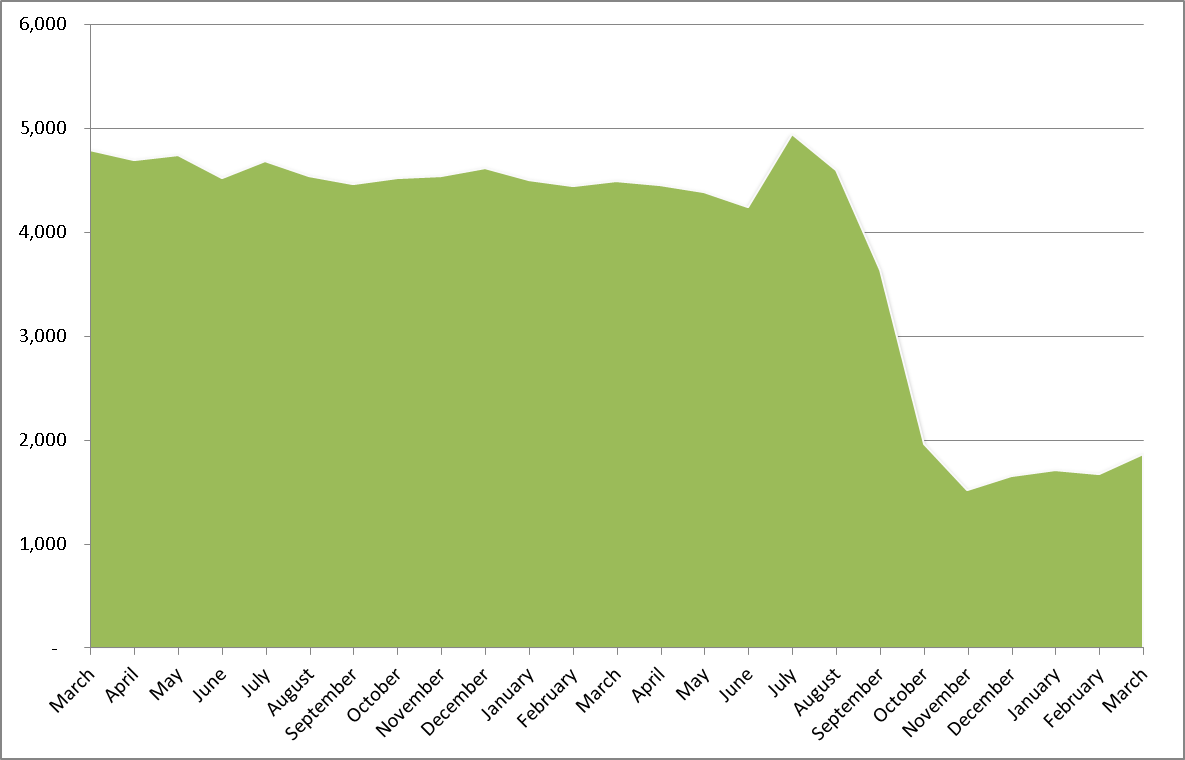
Not surprisingly, vulnerable workers subjected to wage theft by a rogue employer have proven to be reluctant to throw up to £390 of good money after bad. So the number of claims for unpaid wages etc. has tumbled, from an average of 4,587 per month in the nine months immediately before the introduction of fees, to an average of just 1,073 in the nine months up to June 2014.

In short, thanks to the tribunal fees introduced in July 2013, the longstanding problem that clause 136 seeks to (partly) address is no longer quite the problem that it was. So, while BIS might now seek credit for trying to close the stable door, most of the horses have been galloping around the fields since July 2013, and will continue to do so until such time as the tribunal fees regime is substantially reformed.

Clause 138: Maximum financial penalty for breach of the NMW

Clause 138 provides for an increase in the maximum financial penalty that can be imposed by HMRC for breach of the national minimum wage, from £20,000 per employer (technically, £20,000 per Notice of Underpayment), to £20,000 per underpaid worker.

On the face of it, clause 138 is welcome. Fifteen years after its introduction, there can be no excuse for not paying the NMW. But the practical impact of clause 138 would be negligible, for two reasons.

Firstly, as the average underpayment (and penalty imposed) per worker was just £205 in 2013-14, the number of employers who pay even the current maximum penalty of £20,000 is small: just 52 (eight per cent) of all 652 employers penalised in 2013-14. So the number liable to receive a penalty anywhere near the proposed maximum of £20,000 per underpaid worker would be even smaller.

Secondly, HMRC already can in effect impose a penalty of up to £20,000 per underpaid worker, by the simple expedient of issuing more than the normal one Notice of Underpayment to the employer. This practice was adopted in March 2014, when the penalty percentage was increased from 50 per cent to 100 per cent of the total underpayment, and the maximum penalty was increased from £5,000 to £20,000. (I am not aware of any published figure for the number of employers issued with more than one Notice of Underpayment since March 2014, but the Minister may be able to provide that figure to the Committee).

In short, all that clause 138 would do is align the statutory power to set the maximum penalty with the practice adopted by HMRC in March 2014 (in order to meet the Prime Minister’s announcement in November 2013 that penalties would be both increased and imposed on a ‘per worker’ basis). According to the associated BIS Regulatory Impact Assessment, this would save HMRC some £250,000 per year in administrative costs associated with serving a small number of employers with more than one Notice of Underpayment.

However, that would be the sum total of the impact of clause 138. And, as it is not clear from the Regulatory Impact Assessment how HMRC (or BIS) arrived at the total costs figure of £250,000, even that figure might well be an over-estimate.

Clause 139: Banning exclusivity clauses in zero-hours contracts

According to a BIS facts sheet on the Bill, clause 139 would “make exclusivity clauses in zero-hours contracts invalid and unenforceable,” the aim being to address the abusive use of zero-hours contracts.

Such exclusivity clauses – which prevent an individual on a zero-hours contract from working for a second employer, even when no work is on offer from the first – are easily labeled as unfair. But even if clause 139 achieved its aim of making such clauses “invalid and unenforceable” – a rather large ‘if’ – it would still have little if any impact on the abusive use of zero-hours contracts, for the simple reason that such exclusivity clauses are far from essential to that abuse.

In practice, all that an abusive employer has to do is let it be known that taking work with another employer will result in no further work being offered. Employment law specialist Mark Tarran has put it this way:

Zero-hours contracts before [clause 139]: “If you work anywhere else you will be in breach of contract and I won’t give you any more work.”

Zero-hours contracts after [clause 139]: “If you work anywhere else you will not be in breach of contract but I still won’t give you any more work.”

It is worth noting that, according to BIS, only 125,000 – about one in ten – of the estimated 1.2 million zero-hours workers have an exclusivity clause in their contract. And why would employers not have bothered to insert such a clause into nine out of ten zero-hours contracts? They didn’t, because they don’t need to. Take away the exclusivity clause, and the worker is still on a zero-hours contract, with no guarantee of work from one week to the next. And that is what makes them vulnerable to abuse.

To my mind, zero-hours contracts are best viewed as one (very nasty) symptom of a killer disease: the abuse of vulnerable workers by exploitative employers. That disease has become more prevalent and more virulent in recent years. But treating a symptom will not cure the disease, even if it makes the doctor feel more comfortable.

[Postscript: my submission has now been published by the Bill Committee]
So, just how radical is Labour’s ‘£8 by 2020’ minimum wage pledge?

At the weekend, on the eve of the Labour party conference in Manchester, Ed Miliband used an interview in the Observer to reveal that, if elected in May 2015, a Labour government will raise the National Minimum Wage (NMW) rate to £8.00 per hour “by 2020” – which most observers have interpreted to mean from 1 October 2019, when the last annual uprating under the next government will take place.

Reaction has been mixed. Conservative Central Office was quick to claim that the pledge amounts to a slower rate of increase than that between 1999 and 2007.  At a conference fringe meeting, the right-wing commentator Iain Dale suggested that “£8.00 by 2020 is hardly a radical policy”, and the Fabian Society’s Andrew Harrop tweeted that “we need to go further and faster than £8 per hour by 2020”. On the other hand, the move was welcomed by the TUC and the trade union UNISON.

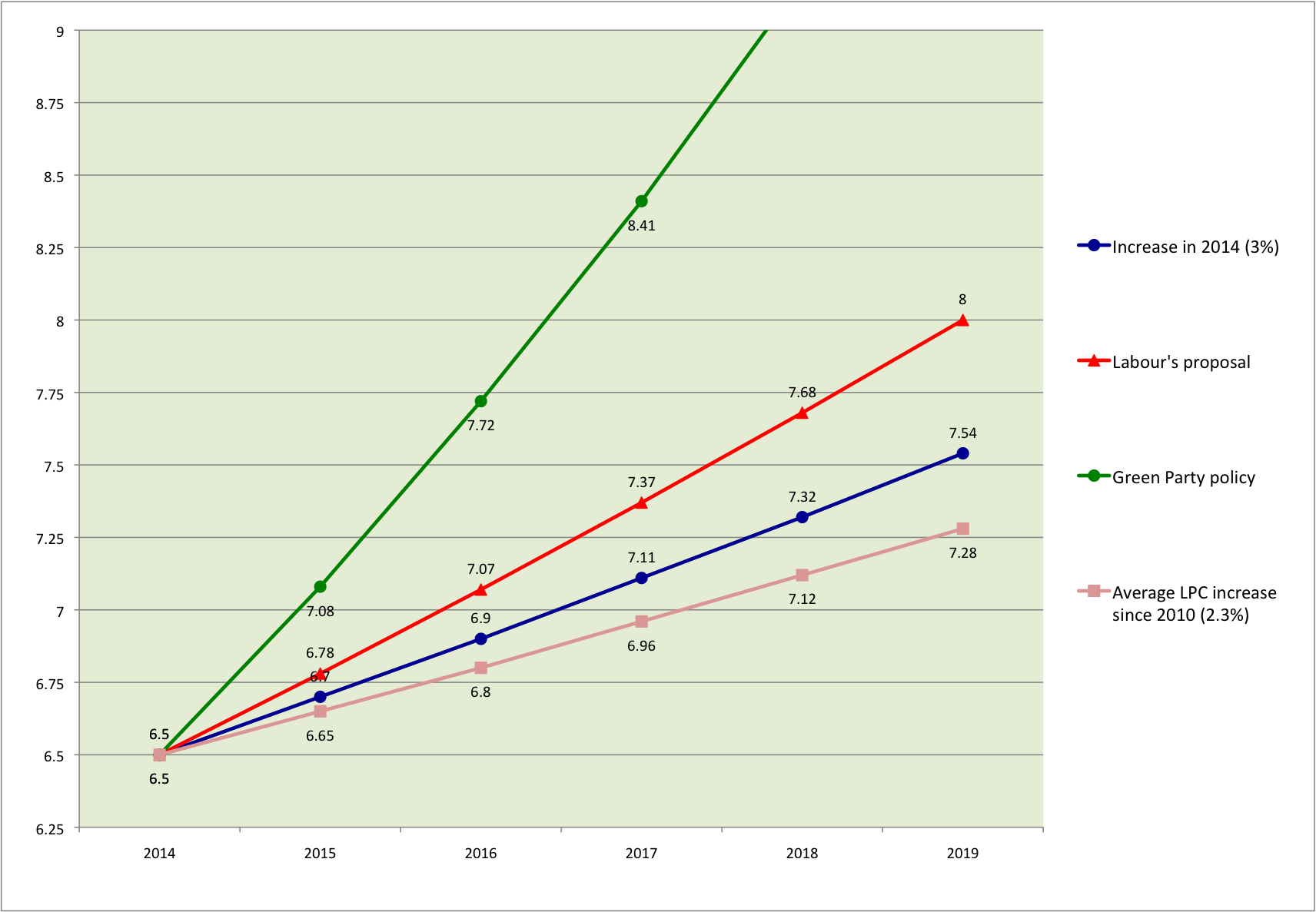
On the question of the rate, I find myself agreeing strongly with Andrew Harrop and – quite possibly for the first and last time ever – Iain Dale. With the NMW at £6.50 per hour from next month, the pledge of £8.00 per hour by 2020 equates to a steady annual increase of 4.25 per cent. Which is not massively above this year’s increase of 3 per cent, or even (what I’m told is) the average annual increase since 2010 of 2.3 per cent.

As the following chart shows, if this year’s slightly more generous increase of 3 per cent were to be replicated in each of the next few years – that is, the sort of rate of increase that George Osborne has said he would be happy with – the NMW rate would be £7.54 from October 2019, just 46 pence per hour below what it would be under Labour’s new proposal. Indeed, at that rate of increase, the NMW rate would reach £8.00 per hour in October 2021, just two years later than Labour now proposes. And Labour’s proposal looks rather pathetic against the Green Party’s far more ambitious policy of an NMW rate of £10.00 per hour by 2020. (I don’t think anyone knows what the Liberal Democrats would like the NMW rate to be in 2020).

NMW2

So, while certainly nothing to be sniffed at, the ‘£8.00 per hour by 2020’ pledge is hardly radical. At least, not in terms of the NMW hourly rate.

However, Miliband’s announcement does represent a radical break away by Labour from the long-standing political consensus that the NMW rate is set not by politicians, but by the ‘independent’ Low Pay Commission. George Osborne crudely tossed this 15-year-old political pact aside in January, when he let it be known that he would be content with a rate of £7.00 per hour. But, presumably out of fear of upsetting the TUC and trade unions, Labour has stuck with it. Until now.

This more radical aspect of the move seems to have gone unnoticed by most commentators, with the notable exception of the CBI which, together with the TUC, has dominated the Low Pay Commission (and therefore the NMW rate) since 1999. “A move to a politicised US-style system is not in the interest of companies or workers”, said the CBI in its response. Well, that depends. But it’s probably fair to say that the move is not in the immediate best interests of the CBI, which would no longer have quite the say on the setting of the NMW rate that it does now.

Like Andrew Harrop, I’d like to see Labour go a lot further and faster than £8.00 per hour by 2020. More particularly, I’d like to see the NMW rate brought up to at least 60 per cent of median earnings by 2020 at the very latest, not some time afterwards (as the detail of Labour’s proposal suggests). And I’d like to see Statutory Maternity & Paternity Pay raised to parity with the NMW by 2020.

But at least now we are talking openly about what the NMW rate should be, rather than leaving it to be fixed by TUC and CBI officials behind closed doors. And, believe me, that is pretty radical. The TUC may have publicly welcomed Miliband’s announcement this week, but I suspect it did so through gritted teeth. Certainly, the CBI is by no means alone – as this blog post by the New Policy Institute illustrates.

So, over the coming months, Miliband and his team are likely to come under intense pressure – from both sides.

With many thanks to Ravi Subramanian of UNISON, whose tweet of his own graph prompted me to write this post.

MoJ’s new line on ET fees as spurious as the old one

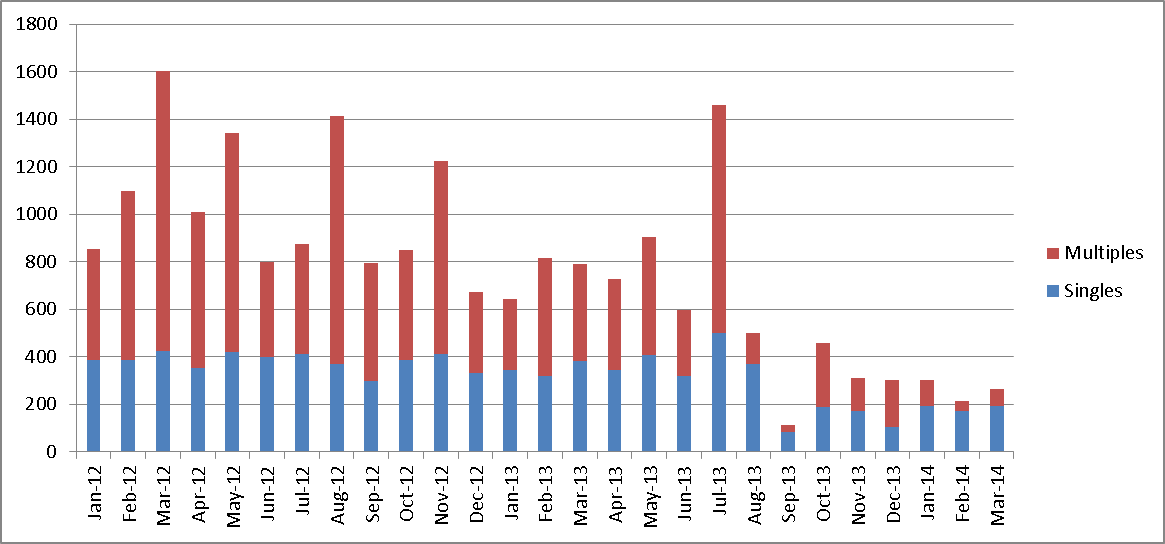
As if further proof were needed, the latest set of quarterly tribunal statistics – released by the Ministry of Justice on Thursday – confirm the dramatic impact of the employment tribunal (ET) fees introduced in July last year. For the third quarter in a row, the number of new ET cases is down by 65 per cent or more, compared to the same quarter a year ago. Over the nine months immediately prior to the introduction of fees, 44,000 employers had an ET case brought against them. But over the nine months up to June 2014, just 15,750 did.

As can be seen from the following chart, this is unquestionably a sudden and dramatic decline. Back in March 2013, the Department for Business, Innovation & Skills (BIS) noted that ET cases are “relatively rare”. They’re a lot rarer now.

Chart 1: Single claims/cases & multiple claimant cases (= total number of respondent employers), April 2012 to June 2014

casesSource: Table C1 of Annex C to Tribunal Statistics: April to June 2014, Ministry of Justice, September 2014.

Think of it this way: on average, each of the UK’s 1.21 million employers now faces an ET case just once every 58 years.

In the face of such evidence, the Ministry of Justice now seems to have abandoned its laughable initial line that this pattern is no more than a long-term downward trend. Conservative ministers such as Matt Hancock now proudly acknowledge the scale and suddenness of the decline, but seek to suggest it is no cause for concern as all the thousands of cases ‘lost’ to fees since July 2013 are simply vexatious or spurious claims that should not have been brought anyway.

Until the release of this week’s set of tribunal statistics, this was not an argument that was readily susceptible to disproof by analysis or chart, as that requires data on claim/case outcomes and – due to the time taken to process cases through the system – such outcome data lags at least two quarters behind that on new claims made. But the latest quarterly data – relating to the period April to June this year, so up to almost one year after the introduction of fees – allows us to start putting the new ministerial line to the test. For we can be reasonably confident that the great majority of the claims resolved in this quarter will have been issued after July 2013, not least because the dramatic fall in the number of cases has reduced the average time taken to resolve most types of claim.

If ministers are right, and fees have simply cut out all the vexatious and spurious claims, but have had no effect on access to justice by workers with meritorious claims, we would expect to see substantial shifts in the proportion of cases that are ultimately successful (whether at a hearing, by a default judgment, or through settlement), or unsuccessful. Indeed, we would expect successful claims to be heading towards 100 per cent, and unsuccessful claims towards zero.

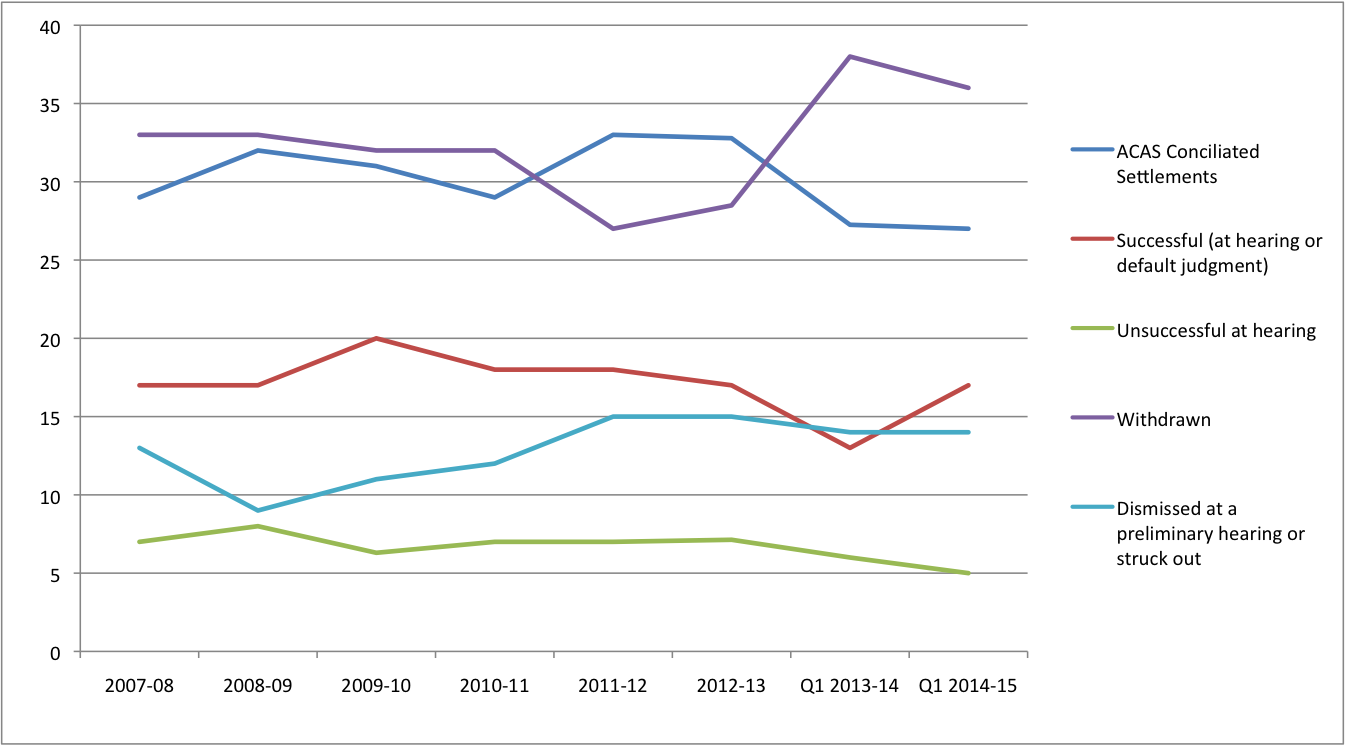
So, what does the this outcome data tell us? Well, the following chart compares outcomes in the period April to June 2014, to the same quarter a year ago (i.e. immediately prior to the introduction of fees), and to previous full years. And from this it is clear that the introduction of fees has had no significant impact on outcomes (at least, not yet). Whilst the proportion of successful claims has increased slightly since the same quarter a year ago, from 13 per cent to 17 per cent, it’s still no higher than in any full year since 2007-08. And the proportion of unsuccessful claims is down, but only marginally so. (Note that the only significant changes evident in the chart – those in the proportion of cases settled by Acas, and withdrawn – not only cancel each other out, but pre-date the introduction of fees in any case).

Chart 2: Outcomes of ET claims (singles & multiples).

outcomesSource: Table 2.3 in Tribunal Statistics: April to June 2014 (Tables), Ministry of Justice, September 2014.

In short, not only is there no evidence whatsoever to support the new ministerial line – hardly a unique occurrence under this evidence-averse government – but the only available evidence shows it to be a pile of pants.

I imagine that some in government (and elsewhere) will try to claim that it is still too early to tell. But that is a weak argument that will get ever weaker with the release of each new set of quarterly tribunal statistics.

Or, as Alice might have said, spuriouser and spuriouser.

Equal pay audits: the wrong tool in the box?

Once upon a time, a long, long time ago, a newly-elected Prime Minister claimed to have invented a wondrous thing: joined-up government. From now on, the purer-than-pure premier said, ministers and their departments would work together to ensure both that an initiative in one policy area would not have unwanted consequences in another, and that only the best and most effective policy tools were selected and prioritised to tackle any particular policy problem. But the years passed, a number of wars were launched, and Tony Blair gradually lost his enthusiasm for joined-up policy making.

This was unfortunate, as ‘joined-up government’ was undoubtedly one of Blair’s better ideas. For decades if not centuries, far too much government policy has been made in silos, with ministers in one department giving little if any thought to how policy ‘owned’ by other departments (or even just by other ministers in the same department) might be reformed or developed to help them achieve their own policy objectives. And, frankly, much the same can be said of many of the campaigning and lobby groups that seek to influence government policy.

This fundamental flaw in the policy process came to mind in recent weeks, with a set-piece speech on the gender pay gap by Gloria De Piero MP, Labour’s shadow minister for women and equalities, and a survey report on the gender pay gap among senior managers by the Chartered Management Institute and XpertHR, setting off a wave of outraged comment pieces and renewed calls for the introduction of mandatory equal pay audits for large employers (i.e. of the sort promised by Ms De Piero).

In the Guardian, noting that, at the current rate of change, it will take 60 years to close the current gender pay gap of 19.7 per cent, columnist Lauren Laverne posed the question: “we have to wait a hundred years for the 1970 Equal Pay Act to work? Are you on glue?” Meanwhile, over on the paper’s Women in Leadership pages, the first of Harriet Minter’s five proposals “to end the gender pay gap” was: “make reporting on pay data mandatory”. According to Minter, this would “bring an end to the madness” of “women being paid less than men”, and “guarantee a fair and equal wage for all”. And, noting the CMI/XpertHR finding that male company directors take home £21,000 more each year than their female counterparts, the Work Foundation’s Professor Stephen Bevan found it “hard to resist the conclusion that equal pay audits should now become mandatory”.

Hmmm. The problem with that line of argument is that it assumes – or, at least, conveys the message – that (a) the gender pay gap is all about women being paid less than men to do the same job; and (b) this is all due to wicked employers having gender discriminatory rates of pay. Accordingly – or so the argument runs – all you have do to close the gender pay gap is shame all those wicked employers into paying their staff equally by making them conduct and publish equal pay audits.

In reality, it’s a lot more complicated than that. Discriminatory pay by employers is just one of many factors behind the gender pay gap, and is quite possibly one of the least influential, overall (which is no consolation if you are one of the all too many women subject to such discrimination). As Professor Bevan notes, “a range of factors are frequently shown to have strong explanatory power, including occupational segregation (and a lower societal value placed on so-called ‘women’s work’), [and] the impact of part-time working both on pay itself and the life-time accumulation of ‘human capital”, as well as “both direct and indirect discrimination”. In 2012, research commissioned by the Government Equalities Office could find only 13 successful ‘equal pay’ employment tribunal claims against employers other than the NHS and local authorities in the three-year period 2009-11, and only 41 such claims between 2004 and 2011.

Furthermore, most if not all of those calling for mandatory equal pay audits are in fact proposing only that they be mandatory for large employers – that is, those with more than 250 employees. Yet such companies employ less than 10 million (40 per cent) of the national workforce of some 24.3 million. So equal pay audits wouldn’t bring any benefit to 60 per cent of the workforce.

Accordingly, as supportive as I am of gender equality and of tackling sex discrimination in the workplace, it’s never been entirely clear to me how or why mandatory equal pay audits would effectively address such a complex range of factors. Furthermore, even if such pay audits did eliminate gender discriminatory pay rates, a gender pay gap would still remain, due to the influence of other, arguably more powerful factors – not least the significant impact on women’s earnings of taking time out of the labour market to have and care for children.

As FlipChartRick demonstrates this week in a must-read blog post, the gender pay gap is not spread evenly among women of all ages and all pay brackets. Far from it. Citing analysis by David Richter of Octopus HR, FlipChartRick argues that “the full-time pay gap at the median has almost disappeared for those in their twenties, with women earning slightly more than men [on average] in recent years”. And “there has been a significant fall in the gender pay gap for those in their thirties”.

Moreover, while “the pay differential for those in their twenties is fairly narrow, even at the very top level [of pay], the pay gap for those over 40 is significant at all levels of the pay distribution but much higher at the top”. In short, “age and position in the earnings distribution has a significant effect on the gender pay gap. Women over 40 and/or in the upper income bracket earn significantly less”. That is, “the gender pay gap appears just at the point in the age distribution when many women have children” and “children have more of an impact on women’s pay than men’s” because it is women “who take on most of the childcare responsibilities”.

FlipChartRick concludes that introducing mandatory equal pay audits “might yield some interesting information for pay data geeks to pore over, but I doubt that it [would] tell us much that we don’t already know, or even whether it [would] reveal some major employers to be significantly worse than others. It is unlikely that the gender pay gap will disappear until equal proportions of women and men take equal responsibility for childcare”.

Which brings me back to my point about joined-up government policy-making. In recent weeks, as part of her “mission to promote shared parental leave”, a policy reform intended to make the proportions of women and men taking responsibility for childcare more equal, the BIS minister Jo Swinson has given a number of major media interviews – including in the Independent, the Evening Standard, and with Family Networks Scotland.

However, while Ms Swinson used these interviews to make much of “recognising that dads want to have a bigger role in their child’s life from the first days” and boosting parental choice, she signally failed even to mention the gender pay gap and the central role that shared parental leave (and more shared parenting) might play in closing it. And the Minister’s omission is even more surprising when one considers that, in the middle of her media push on shared parental leave, she also launched the Liberal Democrats’ campaign to “deliver equal pay in the workplace”. Which consists entirely of – you guessed it! – “plans to require large companies [i.e. those with over 250 employees] to publish the difference in pay between male and female workers”.

Of course, the nine months before a General Election is not the best time to find joined-up thinking within a government made up of two competing political parties, or even just within each political party. But perhaps after May 2015 both elected politicians and the relevant campaign and lobby groups will pay greater attention to the (rather obvious) link between the gender pay gap and the need for more shared parenting. And then we might just see progress on policies – such as increasing the shockingly low rate of statutory maternity and parental leave pay – that would help close the former while facilitating the latter.

Ministry spinning out of control on ET fees

While last month’s anniversary of the introduction of employment tribunal fees passed without the comment we might reasonably have expected from shadow ministers such as Sadiq Khan and Chuka Umunna, two articles in the Daily Mail and Sunday Express kept the #ukemplaw community busy debating which of the two is the worst thing ever written about the origin and impact of the fees regime.

Both articles are indeed wondrously dreadful, but their greater significance lies in what they tell us about the spin we can expect from the Ministry of Justice in the coming weeks, as it completes and announces the conclusions of its long-planned Post-Implementation Review (PIR) of the fees regime.

In the Daily Fail – under the headline “Hallelujah! The gravy train’s derailed: as workers are made to pay £1,200 fee, discrimination cases plunge by 75%” – Steve Doughty trilled that “the multi-billion pound industry built on vexatious discrimination claims against employers has virtually collapsed … with sex discrimination claims down 80% and race claims by 60%”. And “the spectacular decline follows a simple reform introduced by Justice Secretary Chris Grayling last summer – the charging of fees to workers who want to make a claim against their employer”.

Don’t you just love that ‘simple’, and the implication that only someone with the intellect of Chris Grayling could have come up with such a straightforward policy solution? Presumably, Doughty was still at journalism school in 2011, when the fees regime was in fact dreamt up by Grayling’s predecessor as Justice Secretary: the now much-lamented (by some) Kenneth Clarke.

“In the first six months of the new fees system”, Doughty continued, “the number of claims dropped from 109,425 to 20,678. The fall is a major boost for businesses, which were previously spending around £1.6 billion a year in defence costs. There were 191,000 employment claims in the financial year to March 2013”. And the article ended with two photos of unsuccessful ET claimant Stella English, who just happens to be female and blonde.

Meanwhile – under the headline “An end to abuse of the employment tribunal system” – Leo McKinstry informed readers of the Sunday Express that “a gigantic racket fuelled by whingeing trade unions, parasitical lawyers and money-grabbing litigants” has been “dramatically transformed by a reform introduced by Justice Secretary Chris Grayling, in a move distinguished by its simplicity”. Ah yes, the simplicity.

“At a stroke”, McKinstry continued, “the compensation gravy train has been sent into the buffers. Before Grayling’s reform, the flood of employment litigation was unceasing. In 1998, there were 80,000 [ET] cases, an annual total that had risen to over 200,000 in recent years. Yet in the first six months since fees were imposed the number of cases plummeted to 20,678, compared to 109,425 in the previous two quarters”. And, naturally, the article included a nice big photo of the female and blonde Stella English.

These stunning examples of journalistic garbage would be best ignored and quickly forgotten, were it not for their remarkably similar wording, their use of identically precise figures for the number of claims in six-month periods before and after the introduction of fees (109,425 and 20,678) that I cannot match up with any of the figures set out in the Ministry’s most recent statistical bulletin (see endnote), and their misplaced crediting of Chris Grayling.[i]

To my mind, these curious coincidences suggest the articles were based on private briefing by none other than Chris Grayling (or a junior minister, special adviser, or press officer acting on his behalf). And, if I am right, that in turn betrays a 180° change of direction in the Ministry’s spin on fees.

In March this year, when the Ministry’s quarterly tribunal statistics revealed a 79% fall in ET claims in the period October to December 2013, compared to the same quarter in 2012, ministers spun the line that this cliff-shaped decline was in fact no more than the anticipated continuation of a “longer term downward trend” in the number of claims. In other words, the introduction of fees had had little if any impact on the number of claims.

But with the next set of quarterly tribunal statistics, released in June, confirming a similar evisceration of ET claims of all types and jurisdictions in the period January to March 2014, and the Ministry’s patently bogus line being easily blown apart by a few simple charts, ministers appear to have changed tack.

In short, the Ministry’s original line of ‘nothing to see here, move along please’ has given way to a story in which clever Chris Grayling has saved the nation from an ‘unceasing flood’ of (vexatious) ET claims with a ‘simple’ but highly effective reform. And I imagine we are going to hear much more about Grayling’s heroics over the coming weeks. So it is worth taking a few moments to note the flaws in the Ministry’s new spin, which is no more credible than its old spin.

Firstly, there have never been “over 200,000” ET cases a year, as McKinstry suggests in the Sunday Express. Nor were there 191,000 cases in the financial year to March 2013. There were some 191,000 claims in 2012-13, but that headline figure includes all the claimants in the relatively small number of multiple claimant cases, each of which is brought (on the same grounds) against one employer. And, if the concern is the overall impact of ET claims on businesses, then it is the total number of cases (single claims/cases and multiple claimant cases) that is most meaningful, since that is also the number of employers affected.

In 2012-13, for example, the headline total of 191,541 claims consisted of 54,704 single claims/cases brought against 54,704 employers (or slightly fewer than that, in fact, as some claims would have been against the same employer), and a total of 136,837 multiple claimants in just 6,104 multiple claimant cases brought against 6,104 employers. Furthermore, many – perhaps most – of those 6,104 multiple claimant cases were equal pay claims brought by trade unions and law firms against local authorities and other public sector bodies. So they didn’t impose any burden at all on ‘businesses’.

So Doughty’s “£1.6 billion a year in defence costs” for businesses in 2012-13 – which he calculates by multiplying his (or Chris Grayling’s) average cost per claim figure of £8,500 by 191,000 – was more like £0.5 billion (£8,500 x 60,808 cases) spread across just 60,808 employers in both the private and the public sector.

Secondly, the number of ET cases was not an ‘unceasing flood’ until Grayling’s heroics in July 2013. On the contrary, there was a long(ish)-term downward trend in the number of cases, and especially the number of single claims/cases – though that trend does not explain the sudden drop-off since the introduction of fees. Indeed, as the following chart shows, not only had there had been a steady decline in the number of cases since a recession-induced peak in 2009-10, but by the first quarter of 2013-14 (i.e. April to June 2013) the rate of new cases was at its lowest level for more than a decade. So, hardly a situation requiring heroic (and drastic) ministerial action.

Chart 1: Single claims & multiple claimant cases, 2000-01 to 2013-14*

cases

Source: Ministry of Justice. *The figure for 2013-14 is a projection based on Quarter 1 (April to June 2013) only.

Now, it is true that, in the late-2000s, the average number of claimants involved in each multiple claimant case increased significantly, largely due to trade unions and law firms trawling for claimants to join equal pay claims brought against local authorities and other public sector bodies. So the headline, total number of claims grew accordingly. But the number of such multiple claimant cases (the red area in Chart 1, above), and therefore the number of employers affected, remained relatively small. But in any case, as the following chart shows, since peaking in 2009-10 even the number of multiple claimants has been in decline.

Chart 2: Multiple claimants, 2000-01 to 2013-14*

multiples

Source: Ministry of Justice. *The figure for 2013-14 is a projection based on Quarter 1 (April to June 2013) only.

The third – and perhaps most significant – flaw in the Ministry’s new spin, of course, is the assumption that every single one of the tens of thousands of claims lost to fees since July 2013 was a ‘vexatious’ claim. That is not an assertion that is susceptible to proof (or disproof) by chart – you are either stupid and/or gullible enough to accept it, or you are reasonably intelligent and know that it is wholly implausible. Prior to the introduction of fees, not even the wackiest of the employer lobby groups ever suggested that 80% of all ET claims were vexatious.

The real test of Grayling’s new spin will be not whether he can feed willing journalists at the Daily Mail and Sunday Express – any idiot can do that – but whether he can bamboozle Parliament on this point when he announces the conclusions of the Ministry’s Post-Implementation Review.

Time will tell. But at least now it is common ground that the ET fees regime has had a dramatic impact on the number of claims/cases. In these grim days of evidence-free, ideological policy-making, that has to count as progress.


[i]             According to Table C.1 of the quarterly tribunal statistics published by the Ministry of Justice in June 2014, there were 21,809 ET claims (singles and multiples) in the six-month period October 2013 to March 2014; 32,292 such claims in the period September 2013 to February 2014; and 36,399 such claims in the period August 2013 to January 2014. Similarly, there were 102,066 such claims in the six-month period February to July 2013; 108,049 such claims in the period January to June 2013; and 94,937 such claims in the period December 2012 to May 2013.

Beware of Douceurs

On the 30th July, the Unison website carried news of a successful tribunal claim against Bromley Council under the headline

“Tribunal orders council to compensate workers offered cash to sign away rights”.  

This got my interest.  I read on.

“Bromley Council has been ordered to pay more than £64,000 in compensation to 18 of its staff after an employment tribunal had offered cash incentives to sign new contracts that took them out of existing collective bargaining agreements.”

A frisson of deja vu.  Were these not the exact same facts as in Wilson & Palmer & others v Associated Newspapers & Associated British Ports, a case with which I was very familiar.  This had led to the European Court of Human Rights case of Wilson and Palmer and others v UK [2002] IRLR 568.  That in turn had led the then Labour government to pass a series of amendments to the Trade Union and Labour Relations (Consolidation) Act 1992 including section 145B which provides;-

Inducements relating to collective bargaining

(1) A worker who is a member of an independent trade union which is recognised, or seeking to be recognised, by his employer has the right not to have an offer made to him by his employer if—

(a) acceptance of the offer, together with other workers’ acceptance of offers which the employer also makes to them, would have the prohibited result, and

(b) the employer’s sole or main purpose in making the offers is to achieve that result…

Unison kindly put a link to the decision at the end of the report. It is here:-

https://www.unison.org.uk/upload/sharepoint/Toweb/3683_001%5B2%5D.pdf

It makes very interesting reading.  Bromley made a series of concessions so the only issue for the tribunal was whether their sole or main purpose in making the offers was to achieve the prohibited result.  The prohibited result is defined thus:-

(2) The prohibited result is that the workers’ terms of employment, or any of those terms, will not (or will no longer) be determined by collective agreement negotiated by or on behalf of the union…

The tribunal had little difficulty in finding that Bromley’s purpose was prohibited as their own documentation and witness evidence confirmed that they intended to do away with the existing collective bargaining of terms of employment and to achieve this workers had to be induced to sign new contracts of employment where pay was not determined by collective bargaining.

Paragraph 54 of the decision is very revealing.

The Tribunal was surprised that neither the officers of the London Borough of Bromley, nor the officers of the unions involved, were aware of the provisions of section 145B of the Act during the course of the events described above.  Both parties may well have conducted themselves very differently had they been aware of these provisions…”

There is still a debate to be had as to the width of the term “purpose” in Section 145B.  On 7th March Eversheds published a briefing about Section 145B of the 1992 Act and a tribunal case in which they successfully acted called Wyer v Pembrokeshire County Council.    It is referred to in the Unison case.  http://www.eversheds.com/global/en/what/articles/index.page?ArticleID=en/Education/Education_HR_e-briefing_572_Do_trade_unions_have_a_monopoly_position

They boast that the Council was able to adduce detailed witness and documentary evidence to persuade a tribunal to take a broader view of the Council’s “purpose” in seeking to implement a new pay and grading structure outside the collective bargaining process.  However they caution that on similar facts another tribunal  in a case called Whitaker v Buckinghamshire County Council, accepted the trade union submission that you take a narrow view of the “purpose” and once the employer seeks individual worker’s agreement to changes to terms and conditions outwith the collective agreement, then Section 145B engages.

In Unison case, Bromley had the additional hurdle of offering to workers a financial incentive (or “Douceur” as the Court of Appeal referred to them in the Wilson & Palmer case) to sign the new contract giving up the right to have their terms of employment determined by collective bargaining.

With the Government encouraging the breakup of national collective bargaining arrangements and the recent changes to TUPE referred to in a previous article on Hard Labour by Jim Wright

https://hardlabourblog.wordpress.com/category/tupe/

we can expect a lot more discussion about the intricacies of section 145B and the other provisions introduced following the ECtHR decision in Wilson & Palmer.

Qualifying Armed Service

There was much (well some) fanfare following Redfearn v UK [2012] ECHR 1878 when the qualifying period for unfair dismissal was removed where the sole or principal reason for dismissal was due to a person’s political affiliation. It didn’t become “automatically unfair” so could still be an “ordinary” unfair dismissal on normal principles, although presumably it would have to be argued as some other substantial reason; the sole or principal reason not being one of the usual list of conduct, capability etc.


Whilst not entirely overlooked, a similar provision is likely to be quietly introduced in respect of members of the Reserve Forces – something that was envisaged by craighrb on my last blog on the subject.


Section 48 of the Defence Reform Act 2014 introduces an identical right in respect of dismissals where the sole or principal reason for the dismissal of an employee:

is, or is connected with, the employee’s membership of a reserve force…

 The provision is not yet in force. The only commencement order currently made does not apply to the new right. There has been discussion about how much further the employment rights of reservists could be extended. In the second reading debate, the then Shadow Secretary of State for Defence raised the prospect of what would appear a right not to be subjected to detriments on the same grounds. There was a proposal in committee to amend section 39 of the Equality Act 2010 so that discrimination in employment on the basis of membership of the reserve forces would become unlawful. That proposal. as well as a proposal to give the right to time off for training, were both defeated; the latter both in the Commons and in the Lords.


What could have been a wide ranging change has remained quite narrow. It’s also of questionable value bearing in mind the right to reinstatement contained in the Reserve Forces (Safeguard of Employment) Act 1985. In practice, any member of the reserves is going to be much better off getting what is (in most cases) going to be a guaranteed return to a job. Bearing in mind that on average fewer than 10 employees are reinstated each year, and bearing in mind that there are no fees to start a Reinstatement Committee case, the new change to the qualifying period seems to be very much the poorer relation.

ET fees income: don’t spend it all at once, Chris

In recent months, faced with a strong aversion to transparency and openness on the part of the Ministry of Justice, there has been much speculation about just how much money the Ministry is making from its justice-denying ET fees regime. Well, there has been in my house. Back in 2012, officials indicated that they were looking to receive at least £10 million a year in ET fees, whilst the Ministry’s original ‘cost recovery’ target of 33 per cent implied an annual fee income nearer to £25 million. But, with the startling drop in the number of claims since the introduction of fees in July last year, even the lower of these two figures has looked increasingly unrealistic.

In May, the justice minister, Shailesh Vara, declined to answer a parliamentary question by shadow justice minister Andy Slaughter seeking a fee income figure to date, on the grounds that “financial information relating to fees and remissions in the ET system will be published [in July] by HMCTS in its Annual Report and Accounts”.  Well, that 108-page report, covering the financial year 2013-14, has now been published by HMCTS.  And, buried away on page 85, there are some interesting figures on ET fee income and remission up to 31 March 2014.

In the eight-month period 29 July 2013 to 31 March 2014, gross income from ET fees was £5.149 million, of which £0.680 million (13.2 per cent) was foregone in fee remission.  That represents an actual ‘cost recovery’ of just 6.7 per cent of the ET system’s total cost of £76.364 million, well below the Ministry’s original target of 33 per cent.

The proportion of fee income foregone in fee remission (13.2 per cent) is also strikingly low, given that, as late as September 2013, the Ministry was predicting that 31 per cent of all ET claimants would qualify for full (25 per cent) or partial (six per cent) fee remission.

Furthermore, we already know, from one of the parliamentary questions by Andy Slaughter that the Minister did deign to answer in May, that the Ministry spent £4.4 million on new IT systems to “support the processing of fee receipts and remission applications across the ET system”. Take that away from the net fee income (gross income – remission) of £4.469 million, and Chris Grayling was left with just £69,000 to cover the staff and other operational costs associated with processing fees and remission applications over the eight months up to 31 March 2014.

In short, it seems highly likely that the Ministry made a net loss on ET fees in 2013-14. Clearly, things can only get better from now on, as most of that capital expenditure of £4.4 million will not be repeated in 2014-15 and beyond. And, of course, the above figures take no account of the operational cost savings to the Ministry associated with tumbleweed blowing through near-empty ET hearing rooms – the real policy intention. As recent speeches by BIS minister Matt Hancock and others have indicated, the Conservative side of the Coalition Government, at least, appears to be very pleased with the overall impact of the ET fees regime, including the 80 per cent drop in claims.

So I don’t expect Chris Grayling to be the least bit bothered about the somewhat less than impressive financial figures noted above. To my mind, their primary significance lies in the implications for any alternative fee regime that might be brought in by any alternative government elected in May 2015. Assuming the number of claims remains at much the same (low) level as now, a net fee income over eight months of £4.469 million implies an annual net income of some £6.7 million. Unless that £6.7 million can be found from savings made elsewhere in the Ministry’s budget, any alternative fees regime is likely to have to generate at least most of it.

Then again, the Lord Chancellor may be humiliated by UNISON in the Court of Appeal later this year, and this blog post will not even rate a footnote in history. I’ll settle for that.

Does the hand that rocks the cradle get the pay?

One of the perils of being an employment lawyer is sometimes you spend time thinking about a conundrum caused by changes to the law before concluding it probably ultimately does not matter. The rights a man might have to any enhanced pay during shared parental leave is probably another one of those situations. If an enhanced maternity pay scheme provides for full or enhanced pay for, say, the first 26 weeks of maternity leave, what rights does a man who takes shared parental leave have to the same benefit when his time off is during that period?

The father could argue he has been directly discriminated against on the basis the mother would have received the enhancement. But I am not so sure. Is the correct comparator in this situation a woman on maternity leave, or a woman on shared parental leave? If a man on shared parental leave cannot compare himself to a woman on maternity leave his direct discrimination claim stops there. It is clear that there is nothing in the Equality Act to prevent a comparison being made between a man on shared parental leave and a woman on maternity leave; as the EAT said in de Belinwe see no conceptual objection to a man bringing a sex discrimination claim by reference to the more favourable treatment of a colleague on account of her being pregnant or on maternity leave. Those are, as the Claimant says, gender-specific criteria, and discrimination by reference to them is, other things being equal, sex discrimination“. It is arguable, however, that the more appropriate comparator is a woman on shared parental leave. But as the ECJ in Roca Alvarez commented, the positions of male and female parents of a young child are comparable with regard to their possible need to reduce their daily working time to look after the child, which lends support to the argument that there is no reason why a woman on maternity leave could not be an appropriate comparator.

Assuming that comparison can be made, section 13(6) of the Equality Act comes in to play. It specifically states where it is a man complaining of discrimination “no account is to be taken of special treatment afforded to a woman in connection with pregnancy or childbirth.“.
The scope of that special treatment is, however, restricted as the EAT in de Belin and the ECJ in Roca Alvarez made clear. Shared parental leave allows either parent to take time off to care for the baby once the two week compulsory maternity period is at an end that suggests a distinction between maternity leave (time off to recover from the physical trauma of childbirth and to breast feed) and parental leave (time off to care for the child); at some point after the birth, maternity leave must be more akin to Roca Alvarez/ Makin parental leave. Arguably therefore the special treatment exception cannot allow an employer to treat women on maternity leave more favourably than, for example, a father who takes time off to be the primary childcarer when his child is 3 months’ old. There may be arguments to be had about the point at which ‘special treatment’ is no longer necessary, but I suspect any judicial attempt to define the exact point as being anything other than the 2 weeks immediately after the birth might be as laughable or as concerning as the old cases on a maternity comparator.

Ultimately, however, the reason all this may end up being legally interesting (if you’re a geek) but largely irrelevant is that presumably the man’s claim succeeds in any event as one of indirect discrimination. If the enhancement is paid to anyone on “maternity leave” (as most policies describe it) this is a provision, criterion or practice for the purposes of Section 19 of the Equality Act with which a man cannot comply. A man is clearly put at a disadvantage as he does not receive the enhanced maternity pay. I do not consider that an employer could sustain a justification for the different treatment for the same reason that the special treatment argument fails; at some point after the birth, maternity leave is actually more akin to Roca Alvarez/ Makin parental leave and there is no reason for treating women on maternity leave more favourably than men on shared parental leave which does not rely on the very gender stereotypes regarding care of children which shared parental leave is intended to work towards eradicating.

Comments and thoughts welcome. I have not seen anything where anyone nails their colours to the mast on the direct/indirect point.  But query whether that’s because it doesn’t matter.

ET claims & fees: a few more charts (sorry)

If you feel that you’ve already seen enough charts detailing the evisceration of the employment tribunal system by fees in recent days, then this post is not for you. Go and watch some football or something.

For those still with me – Hi Mum! – I’ve been looking at the regional breakdown of single and multiple claims included in yesterday’s statistical release by the Ministry of Injustice. And they make for some striking charts that put in context all those anecdotes from employment lawyers of tumbleweed blowing through the corridors and hearing rooms of regional ET centres.

This is the North East, where the average monthly number of claims (singles and multiples) has fallen by 85.5 per cent, from 1,561 in the 18 months prior to the introduction of fees in July 2013, to just 227 in the six-month period October 2013 – March 2014:

ET North East

And this is the South West, where the average monthly number of single claims has fallen by 63 per cent, from 445 in the 18 months prior to the introduction of fees, to just 166 in the six-month period October 2013 – March 2014:

ET South West

This is Scotland, where the average monthly number of claims (singles and multiples) has fallen by 67.4 per cent, from 945 in the 18 months prior to the introduction of fees in July 2013, to just 308 in the six-month period October 2013 – March 2014:

ET Scotland

And this is Wales, where the average monthly number of claims (singles and multiples) has fallen by 71 per cent, from 404 in the 18 months prior to the introduction of fees, to just 117 in the six-month period October 2013 – March 2014:

ET Wales

And even London – with all those high-value discrimination claims from the City – is pretty much a wasteland, with the average monthly number of claims (singles and multiples) having plummeted by a staggering 88.5 per cent, from 7,952 to just 912:

ET London

But no need to worry as, according to the Ministry of Justice, this is all just a long-term trend, nothing to do with the fees regime introduced last July.

A long-term trend? Really? Let’s do a couple more charts. As suggested to me by Daniel Barnett, these show the rolling three-month average number of claims over the period March 2012 to March 2014. That is, each month’s figure is the average of that month and the previous two months. Such a rolling average smooths out the inevitable ups and downs from month to month, to give a more reliable indication of any longer-term trend.

And this is what we get on single claims:

ET rolling singles

Does that look like a long-term trend to you? It looks more like a cliff-edge to me. And applying the same approach to multiple claims, we get this little shocker:

ET rolling multiples

Again, if that’s a long-term trend, then I’m a banana.

But if anyone in the Ministry of Injustice is reading this – unlikely, I know – and would like to send me or Sean Jones some alternative charts showing their long-term downward trend, we would be very happy to reproduce them here on Hard Labour. I have of course seen Figure 3 on page 8 of the Ministry’s commentary on the quarterly statistics, which purports to show a long-term downward trend in both single claims and multiple claims encompassing the drop in claims since July 2013, but actually shows no such thing.

First of all, by cramming five years of data into one very small chart, the Ministry makes it difficult to distinguish very long-term (but shallow) trends from shorter-term, steeper movements such as that since July last year. Viewed from the moon, the Great Wall of China looks like a smoothly curved line, but viewed from a helicopter it clearly wiggles all over the place.

In any case, in terms of multiple claims, the Ministry’s pathetic little chart simply shows a mountain range of fluctuations, with no discernible trend whatsoever since as long ago as early 2011 until … the autumn of 2013. Sure, there were a couple of higher peaks in 2009 and 2010, not replicated since, but then there was a little difficulty in the economy at that time.

As for single claims, yes there was a steady but shallow decline from the peak in mid-2009, right the way through 2011 and 2012.  Indeed, some of us tried hard (but failed) to get ministers to acknowledge that steady decline in 2012, when they were pushing through employment law and tribunal reforms predicated on allegedly explosive growth in the number of claims. But that shallow, long-term trend since 2009 does not begin to explain the cliff-edges shown in my (green) chart above.

Ironically, the Ministry’s chart leaves out the only type of case in which there was a significant downward trend in the 12 months prior to the introduction of fees: multiple claimant cases.  But, as the following chart shows, even that downward trend cannot conceal a marked acceleration of the fall in July 2013.

ET rolling multiple cases