ET fees: ball back in Lord Chancellor’s court

In February, when rejecting UNISON’s judicial review of the employment tribunal fees regime introduced last July – on the grounds that it was simply too early to reach a firm conclusion on the impact of the fees, the only available statistics being provisional figures for the month of September – the High Court noted that “if [these provisional figures] are anything like accurate, then the impact of the fees has been dramatic”. And the judges suggested that, should the Lord Chancellor’s optimism that the number of ET claims would soon bounce back to more ‘normal’ levels prove unfounded, then they would “expect the Lord Chancellor to change the [fees regime] without any need for further litigation”.

Within weeks, the accuracy of those provisional figures was confirmed, with tribunal statistics for the three-month period October to December (Quarter 3 of 2013/14) showing a dramatic fall in the number of ET claims by individual claimants, from an average of 4,460 per month in the nine months before the introduction of fees in July 2013, to just 1,000 in September, 1,620 in October, 1,840 in November, and 1,500 in December.

UNISON has since been granted permission to appeal to the Court of Appeal, but as of today the ball is back in the Lord Chancellor’s court, with the latest set of quarterly tribunal statistics – for the period January to March 2014 (Quarter 4 of 2013/14) – showing no significant rebound in the level of ET claims since December.

The headline number of ET claims, which includes both single and multiple claims and which was down 78 per cent in Quarter 3, was down again in Quarter 4, by 83 per cent compared to the same quarter a year ago. Based on past experience, this is the figure that will dominate reporting of the new set of statistics. However, as is clear from the following chart, this figure is arguably not the most reliable indicator of the impact of fees, given its evident volatility over time due to large variations in the monthly number of multiple claims (that is, the total number of claimants in multiple claimant cases). That said, the impact of fees seems reasonably clear.

Chart 1: ET claims (singles & multiples), July 2012 to March 2014.

Chart 1

The impact of fees since July 2013 is much clearer when we look at the number of single claims by individual workers, which was down 64 per cent in Quarter 3, and was down again in Quarter 4, by 58 per cent compared to the same quarter a year ago. While the Ministry of Justice will no doubt be highlighting the 13 per cent increase from Quarter 3 to Quarter 4, at 1,763 the average monthly number of claims in Quarter 4 is still just 39 per cent of the average over the nine months prior to July 2013 (4,460).

Chart 2: ET claims (singles), October 2012 to March 2014

Chart 2

Somewhat surprisingly – to me at least – the number of multiple claimant cases, which in theory should be less affected by fees, has also fallen dramatically since July 2013. Down by 65 per cent in Quarter 3, from 1,390 to 485, the number of such cases was down again in Quarter 4, by 68 per cent compared to the same quarter a year ago.

Chart 3: ET multiple claimant cases, October 2012 to March 2014

Chart 3

Given that claimants in the very largest multiple claim cases each pay only a tiny fraction of the fees, the most obvious explanation for this fall in the number of multiple claimant cases would be that fees have cut out those cases with relatively small numbers of multiple claimants. However, this would imply a significant increase in the average number of claimants in multiple claimant cases. And, as the following chart shows, with the exception of September (when, presumably, there were one or two very large cases), the average number of claimants in multiple claim cases has not only not risen, but has actually fallen since July 2013.

Chart 4: Average number of claimants in multiple claimant cases, July 2012 to March 2014

Chart 4

So, something else would appear to be going on here. Have the unions run out of equal pay cases?

Indeed, for me the main story from this latest set of statistics is that fees have had a dramatic impact not just on the number of single claims by individual workers, but also on the number of multiple claims and multiple claimant cases – which, in theory, should have been much less affected by fees.

Chart 5: ET claims (multiples), October 2012 to March 2014
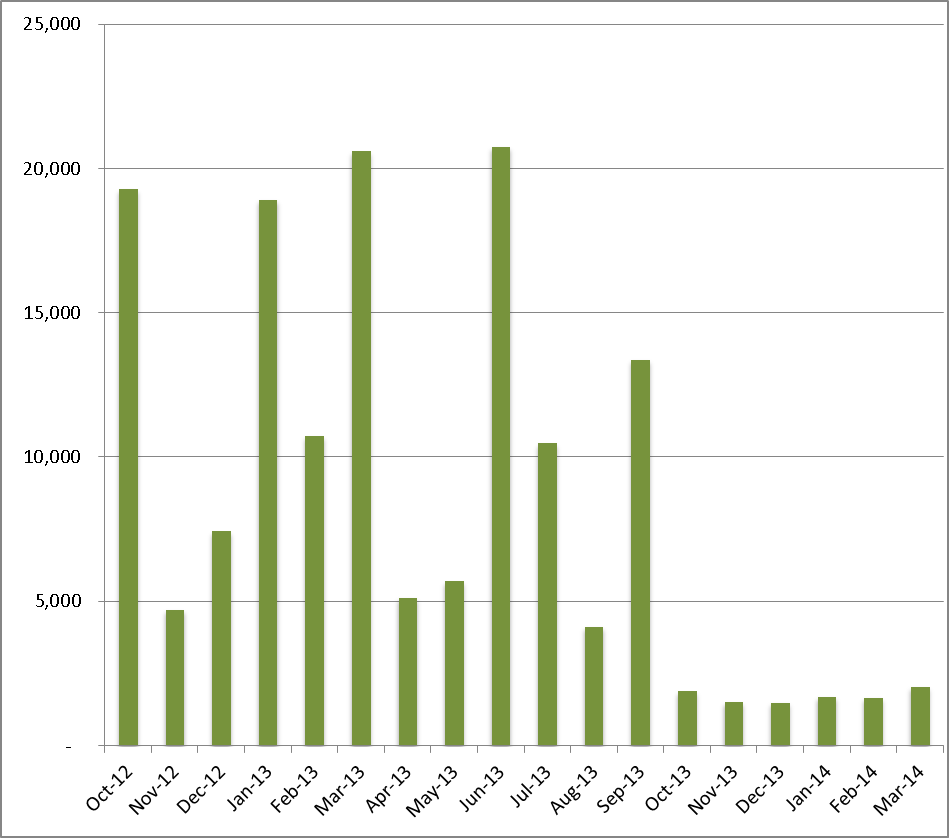
Chart 5

All in all, it’s hard to see how the Lord Chancellor can credibly deny that the introduction of hefty, upfront fees in July 2013 has had a dramatic impact on the number of claims – both singles and multiples. Which means, if he does not now reform the fees regime (and substantially reduce the level of fees), he is likely to have to do so following an embarrassing defeat in the Court of Appeal at the hands of UNISON later this year (the appeal is currently scheduled for hearing sometime between 10 September and 10 December 2014).

The incredible shrinking fee remission fig leaf

In response to extensive criticism of the fees regime since July 2013, ministers have argued that access to justice is protected for low-income claimants by the associated fee remission scheme. However, the only figures on fee remission applications that the Ministry of Justice has been willing to release to date – covering the period up to 31 December – suggest that only about six per cent of all ET claimants obtain any fee remission.

According to these figures, provided by the Ministry in response to a series of parliamentary questions by shadow justice minister Andy Slaughter MP, just 600 “individuals or groups of individuals” were granted fee remission between 29 July and 31 December, while 1,800 fee remission applications were rejected. And in that period there was a total of 10,208 single claims (9,305) and multiple claim cases (903). So remission was applied for in just 23 per cent of all cases, and three out of four of those applications were rejected.

Yet as recently as September 2013, in its final Impact Assessment on the revised fee remission scheme, the Ministry of Justice suggested that 31 per cent of all ET claimants would be eligible for full (25 per cent) or partial (six per cent) fee remission.

In short, the fee remission scheme has so far proven to be a very small fig leaf indeed, and seems unlikely to provide the Lord Chancellor with much cover in the Court of Appeal.

Queen’s Speech: “May government will achieve grayth in hollow cable”

So, going by their breathless blog announcements earlier today, the most exciting legislative measure that the Liberal Democrats have been able to come up with for this week’s Queen’s Speech is … [drum roll] … an increase in the maximum penalty that can be imposed by HMRC for non-compliance with the national minimum wage.

Not only is this not news – the increase was formally announced by Vince Cable’s department in January, and was then re-announced in February – but in practical terms it’s next to meaningless, for the simple reason that very few if any of the minimum wage rogues caught by HMRC will receive financial penalties anywhere near the new maximum.

Until March this year, employers found by HMRC to have breached the minimum wage had to pay the unpaid wages, plus a financial penalty calculated as 50 per cent of the total underpayment for all workers found to have been underpaid, subject to a maximum of £5,000. However, following January’s announcement and the tabling of new Regulations, on 7 March the financial penalty percentage increased from 50 per cent to 100 per cent of the total unpaid wages owed to workers, and the maximum penalty increased to £20,000.

Now we’re told that, in line with the January and February announcements, a Bill in the Queen’s Speech will increase that maximum penalty to £20,000 per underpaid worker. Which will have all those minimum wage rogues running for cover! Er …won’t it?

Well, possibly, but I very much doubt it. In 2012/13 – the most recent year for which the relevant HMRC data is available – the average amount of underpaid wages was just … £300 per worker. Which means that, even under the new Regulations that came into force in March, the average financial penalty is in the region of £300 per worker – or just 1.5 per cent of the £20,000 per worker maximum that the Liberal Democrats, at least, seem to see as their jewel in the Queen’s Speech crown.

Indeed, we also know that, in 2012/13, just 51 (seven per cent) of the 708 minimum wage rogues caught by HMRC received the then maximum penalty of £5,000.  From which it seems reasonable to assume only a very small number of employers will receive the current maximum penalty of £20,000 that came into force in March, let alone the £20,000 per worker for which Vince Cable is now set to legislate.

In any case, if even the current maximum penalty of £20,000 is considered inadequate, why does Vince Cable not simply increase it to £50,000, or £100,000? That wouldn’t require a new Bill – the financial penalty percentage and maximum penalty can be increased at the flick of a minister’s pen, as they were in March.

The answer, of course, is that this measure has little if anything to do with ‘enhancing enforcement of the national minimum wage’. It’s a political move, intended to capture a few headlines and shoot one of Labour’s low pay foxes: Ed Miliband and other shadow ministers have repeatedly indicated they would increase the minimum wage financial penalties if elected in 2015.

While politicians play these meaningless games, back in the real world the bottom line is that better enforcement of the minimum wage requires a bigger chance of rogues getting caught by HMRC. And that means more HMRC boots on the ground. Which no political party is (yet) offering.

Postscript

Since I write and posted the above on Sunday, HMRC has issued a press release with key figures on enforcement of the minimum wage in 2013/14. This shows that, in 2013/14, the average  amount of underpaid wages was just … £205 per worker. Which means that, even under the new Regulations that came into force in March, the average financial penalty is just £205 per worker – or just one per cent of the proposed £20,000 per worker maximum. Interestingly, unlike last year, the press release does not include a figure for the number of employers who received the maximum penalty (of £5,000). Why could that be, I wonder?

Update (19 June):

BIS has today, in response to a parliamentary question by Caroline Lucas MP, confirmed that in 2013/14,  just 52 (eight per cent) of the 652 minimum wage rogues caught and issued with a financial penalty by HMRC received the then maximum penalty of £5,000.

Is it possible to have a Business Secretary that is too flexible?

Last week, Vince Cable grabbed a few headlines with a notably insightful speech about labour market flexibility. In what looked suspiciously like a significant attempt to differentiate Cable’s Liberal Democrats from their Coalition partners, the Business Secretary quickly got to his point by posing an interesting set of questions:

“Is it possible to have labour markets that are too flexible? Are we in that position now in the UK? If so, how do we maintain the advantages of flexibility – for workers and firms – while reducing the costs?”

As is often the way with politicians, Cable had some ready answers to his own questions. Noting that, due to welfare reform and other Coalition policies, “the incentives to work, particularly in low skilled jobs, have never been sharper”, he suggested that “we need to ensure is that this doesn’t produce an entrenchment of low pay, low productivity jobs”.

Now, this may be the right time for me to advance my theory that Cable actually wrote this speech in 2010, but was never allowed to deliver it. So the speech languished at the bottom of his filing cabinet until last week, when he dusted it down and sneaked off to the Resolution Foundation without telling Dave, Nick or George. Had he delivered it in 2010, the speech might have enhanced his reputation as an avant-garde thinker on economic issues. Now, it just sounds rather too much like the rusty hinges of a dilapidated stable door swinging shut, several years after the horse has bolted.

Whatever, Cable had a number of specific ideas on how to prevent the entrenchment of low pay, low productivity jobs. You know, the entrenchment that hasn’t yet happened.

The most headline-grabbing of these was the suggestion that workers on a zero-hours contract should have a “right to request a fixed-hours contract, building on the model we already have for flexible working”. This is so left-field that I can’t decide whether it’s a stroke of brilliance or just plain daft. Perhaps some kindly #ukemplaw person could put me right on this.

Rather more mundanely, Cable suggested that, alongside “encouraging companies to invest in training their workforces”, the government should be ensuring “a strong structure to protect the minimum wage and strengthen [its] enforcement”.

Now it just so happens that Cable is the government minister in charge of protecting the minimum wage and strengthening its enforcement. So this is one area where he could really crack on with preventing the entrenchment of low pay, low productivity jobs.

And, to his credit, Cable has recently (if somewhat belatedly) increased the financial penalties for non-compliance. Furthermore, not only has the HMRC minimum wage enforcement division escaped the worst of the Coalition’s austerity cuts, but at 180 the number of NMW enforcement staff is actually some 20 per cent higher than when Labour left office in 2010 (though the number of compliance officers is much the same).

On the other hand, since Cable and his Coalition colleagues took office in 2010, not one employer has been prosecuted for criminal non-compliance with the minimum wage. And, since Cable introduced a process for ‘naming & shaming’ employers found by HMRC to have flouted the minimum wage in early 2011, just six employers have been so ‘named & shamed’ by Cable’s Department for Business, Innovation & Skills (BIS).

As recently as October last year, that ‘naming & shaming’ scheme was revamped, with Cable’s then junior minister, Jo Swinson, boldly asserting that the new, streamlined process would “give a clear warning to rogue employers who ignore the rules, that they will face reputational consequences as well as a fine if they don’t pay the minimum wage”.

However, since that ministerial fanfare, just five (small) employers have been ‘named & shamed’ by BIS. Yet HMRC tell me (in response to a FoI request) that about 270 employers were issued with a Notice of Underpayment – the trigger for ‘naming & shaming’ under the revamped process – between 1 October and 28 February. Even allowing for the appeal process that Cable has indicated takes “roughly 150 days”, with the end of May approaching it is deeply puzzling why fewer than two per cent of those 270 “minimum wage rogues” have so far been ‘named & shamed’ by Cable’s department.

Has the process of ‘naming & shaming’ employers proved more difficult than Cable and Swinson envisaged? Or is their department simply being too flexible when it comes to tackling the entrenchment of low pay jobs?

Update (8 June): BIS has today named & shamed a further 25 (small) employers. But this still means that only 30 of the 270 minimum wage rogues caught by HMRC between 1 October and 28 February have been named & shamed under the new scheme. What about the other 240? How many have successfully appealed against being named & shamed? We really should be told. As the Independent notes, the 25 small employers named & shamed this week between them accounted for just £43,000, or less than one per cent, of the more than £4.6 million in underpayments identified by HMRC in 2013/14. And not one of the 25 firms will have paid anywhere near the current maximum penalty of £20,000, let alone the proposed new maximum of £20,000 per underpaid worker that Vince Cable seems to think is needed.

Update (16 June): Brilliant detective work by Michael Reed of the Free Representation Unit has uncovered the surprising fact that at least three of the 25 businesses named & shamed by BIS on 8 June were dissolved several years ago, in one case as long ago as 2009. Is BIS padding out its lists of those named & shamed with some ancient cases from the HMRC archives?

Acas early conciliation and time limits: let the confusion begin

Nothing gets employment lawyers going like a vigorous argument over tribunal time limits, and the new system of mandatory Acas early conciliation (EC) has provided the ideal excuse for several arguments. Here’s just one of them.

Where a prospective claimant has filed an EC form with Acas, the time limit for bringing a tribunal claim is paused on ‘Day A’ (the date the claimant submits the form) and restarts on ‘Day B’ (the date they receive an EC certificate). However, if the original time limit would have expired less than a month after Day A, there is a further extension so that the last day for lodging a claim is extended to ‘one month after Day B’. In short, you should never have less than a month after you receive the EC certificate to get your claim in.

HM Courts and Tribunals Service states, in its information leaflet Making a claim to an Employment Tribunal, that if the EC certificate is sent by email on 5 June (and presumably received the same day), Day B is 5 June and the last day for bringing a claim (under the one month extension rule) would be 4 July. Acas are apparently in agreement, on the basis that this is how the ordinary time limits in tribunal cases work (e.g. an employee dismissed on 5 April would normally only have until 4 July to bring a claim: three months less one day).

But is the HMCTS leaflet right? It ignores the ‘corresponding date rule’, a rule of interpretation used for calculating the start and end point of notice periods and other periods of time expressed in months. Under that rule, one month after 5 June is the ‘corresponding date’ in July, i.e. 5 July. This is the approach adopted by Practical Law (OK, I have to declare an interest there), Lewis Silkin (according to the excellent time limits calculator they posted on Twitter a few days ago), and Camilla Palmer who has written an article in ELA Briefing this month about early conciliation. I’m also informed that lawyers at BIS support the corresponding date approach.

Who’s right?

Acas are certainly right in their approach to the primary time limits (three months minus a day) according to the case law, and it would arguably make a lot of sense if there was a common approach to the one-month extension. However, there are good reasons, based on differences in the wording of the relevant statutory provisions, why tribunals should use the corresponding date rule.

The EC legislation requires the claim to be submitted within the period ‘ending one month after Day B’, whereas the primary limitation date in (let’s say) an unfair dismissal case is ‘before the end of the period of three months beginning with the effective date of termination’. The difference is that ‘one month after Day B’ means you start counting on the day after Day B (a rule of interpretation that, according to Lord Diplock in Dodds v Walker [1981] 2 All ER 609, has been ‘consistently applied by the courts since Lester v. Garland (1808) 15 Ves. Jun. 248’). On the other hand, ‘three months beginning with the effective date of termination’ means you start counting on the EDT. This crucial difference was explained by the EAT, in an admirably short judgment, in University of Cambridge v Murray [1993] ICR 460It’s worth a read.

Acas have highlighted that it’s safer to adopt a cautious approach. That, of course, takes no account of the fact that some employees may, if they leave it until the last minute, believe they are one day out of time when they are in fact still within time, so cannot present a claim. An employment judge could conceivably, without the benefit of contrary legal argument (and who can afford legal advice these days?), be led down the same path by the HMCTS leaflet.

Don’t get caught out

In view of this very unfortunate difference of interpretation, claimants should really adopt the cautious line followed by Acas and lodge a claim no later than one month less one day after Day B (4 July in the example above) and not risk leaving it until 5 July. Ultimately it will be for the appellate courts to decide, although ending up in the EAT over this is probably not in anybody’s interests.

With many thanks to Camilla Palmer for our email correspondence over this issue, from which I’ve shamelessly borrowed some of the wording for this post.

Labour’s contract killing

Earlier this week, I was offered a contact. Which, sadly, doesn’t happen as often as my bank manager or my family would like. And, in any case, there wasn’t any money involved. At least, not for me.

On the plus side, the contract was offered to me by none other than the leader of the Labour Party, Ed Miliband. Yes! Me and Ed, bound together by a contract signed in brotherly blood. Well, me, Ed and a few thousand other people. Maybe tens of thousands. Quite a lot of brotherly and sisterly blood, then. Ed might need a transfusion.

As contracts go, it’s quite short – just ten brief clauses, each one a policy pledge by Ed. And, being a workplace rights nerd, I was pleasantly surprised to find that no fewer than three of the pledges relate to workplace rights. However, the wording of those three clauses left me with both a sinking feeling in my stomach, and a strong desire to bash my head against the nearest wall. Let’s take each of the workplace rights pledges in turn.

Ban exploitative zero-hours contracts

Well, I’ve already written elsewhere about Labour’s fumbling towards a credible position on the exploitative use of zero-hours contracts, so I’m not going to add much here. Suffice to say, Ed and his team are going to have to wake up to the fact that, whilst it’s very easy to make speeches criticising the exploitative use of zero-hours contracts, in practice (and in law) it is not so easy to distinguish between the exploitative and the fair use of such contracts. The very same paper zero-hours contract could be used entirely differently by two separate employers – one in a way that benefits both the employer and the employee, and one in a way that benefits only the employer and simply exploits (and quite possibly brings severe hardship to) the employee. That’s a conundrum that won’t be solved by sloganeering.

Make work pay by strengthening the Minimum Wage

Well, yes, but what does ‘strengthening’ the NMW actually mean? In the hope that someone in Labour might provide an answer, earlier this week I put the question out on Twitter. And Antonia Bance – a former Labour parliamentary candidate – promptly responded by suggesting that it means “raising & enforcing [the NMW]”.  Well, yes, but raise it by how much, and better enforce it how? To which Antonia’s response was: “I don’t think we ‘ll know the answers to questions of detail unless Labour get into government”, and “broad promises that show direction of travel & values are thought more effective than detailed pledges”.

So it would seem. But to my mind, the votes of the more than one million workers paid at or just above the NMW rate are much more likely to be captured by a specific promise of a new, higher rate than they are by a ‘broad promise showing direction of travel’. George Osborne is on record as saying he believes Britain can ‘afford’ a rate of £7.00 per hour, without any significant negative labour market consequences, and if George Osborne thinks that then it’s surely not too much to expect a Labour government elected in May 2015 to go at least that far. Furthermore, from £7.00 per hour it’s really not that far to the Living Wage rate (outside London) of £7.65 per hour. So why not make an explicit commitment to an immediate hike in the NMW rate to £7.00 or even £7.50, and to achieving parity with the Living Wage by 2020?

Yes, that would imply making the Low Pay Commission redundant. But perhaps the Commission’s budget would be better spent enforcing the NMW, rather than just talking about it and (mostly) recommending below inflation increases. Government ministers routinely make decisions with far greater economic implications than what the NMW rate should be, and the long-term future of the NMW rate could be secured by writing into legislation an annual uprating at least as great as inflation. It’s really not rocket science.

Tackle the abuse of migrant labour to undercut wages, by banning recruitment agencies that only hire foreign workers

This is the one that really made me want to bang my head against a brick wall. For, leaving aside (for Jonathan Portes and others) the question of whether migrant labour does actually  ‘undercut wages’, the proposed ban is so patently nuts that this clause of Ed’s contract looks like nothing more than a shameful case of dog-whistle politics. Because, if hiring only foreign workers were to become illegal, what proportion of indigenous workers would a recruitment agency have to hire to be legal? One per cent? Ten per cent? Fifty per cent? Fifty-one per cent?

And, were any such arbitrary figure to be (foolishly) enshrined in law, who would police it? Under the Coalition, the BIS Employment Agency Standards Inspectorate has been reduced to a rump of just two inspector-level staff. Would Ed’s contract deliver any more human and other resources for enforcement of new (and the existing) rules?

Again, earlier this week I put these questions out on Twitter, in the hope that someone in Labour might be willing to provide some answers. When they didn’t, I put my questions direct to John McTernan, the fearsome Labour thinker and strategist with the self-appointed task of keeping Tony Blair’s halo shiny and bright. And, whilst first noting that he is “not my brother or sister’s keeper”, John was frank enough to say: “I think there are worse things than foreign workers. Like non-enforcement of [the] NMW”. Hear hear to that.

So, I will keep on posing these (and other) questions, in the hope that someone in Ed Miliband’s team might stop and think these silly contract promises through before they find their way into the manifesto for May 2015. Because, to my mind, that would be a serious mistake that might just blow up in some shadow minister’s face at some point during what is clearly going to be a tough and dirty election campaign. Or maybe Antonia is right when she says the party manifestos “will be meaningless this time because of possible coalition”.

Now that really is a depressing thought.

An alternative Employment Tribunal fees regime: let’s do the maths

The week before last, a ripple of excitement ran through some of the #ukemplaw Twitter community when one of its leading figures – I will spare them their blushes – mistook a blog post of mine in which I had set out some things I think the government elected in 2015 should do, including reform the ET fees regime introduced last July so as to reduce claimant fees to a nominal level, for an official policy pledge by the Labour Party. And, before the error could be corrected by its perpetrator, the fabulous Sean Jones QC (founder of this blog) had laid into the workers’ party in robust terms:

“Labour will reduce ET fees to ‘nominal’. If they do, costs of collection and remission [applications] will exceed income. Bizarre. Just abolish them.”

Which presented me with something of a dilemma. Because to suggest that Sean might be wrong is not a step taken lightly, especially by a humble policy wonk. Indeed, the very idea is so preposterous that, according to Sean, it recently caused Mrs Jones to “snort wine out of her nose”. [Actually, I think that was the opposite idea. Ed]

But … *takes big gulp of air* … I do think Sean might be wrong. Because I believe an alternative regime of nominal fees for both claimants and respondents could restore access to justice, without creating the kind of hole in the Ministry’s budget that would result from outright abolition of the current fees regime.

That hole would not be enormous: in 2012, Ministry officials indicated that they were looking to generate an annual income from fees of some £10 million. And, whilst we do not know how much the fees regime has actually generated since July – the Ministry has recently declined to answer my Freedom of Information request on that very point, on the grounds that to do so would “disrupt the [Ministry’s] consistent approach to communicating this information to the public” and might “lead to comments being taken out of context which as a result may lead to an inaccurate and misleading indication of the performance of the [Ministry]” – as if! – we can be certain that it will be somewhat less than £10 million over the first year of the fees regime, and perhaps as little as £5 million.

However, in the current fiscal environment, which we are told is likely to continue well beyond 2015, even £5 million would be hard for newly installed ministers to find from elsewhere in the Ministry’s budget (as the Treasury would no doubt insist upon, whoever is Chancellor). So, to my mind, outright abolition is simply not a realistic option and, if the current fees regime is to go – as it must – then we have to come up with an alternative way of raising up to £10 million, and probably at least £5 million, from a fees regime that does not obstruct access to justice.

So, let’s start with a nominal issue fee for single claimants of just £50. Over a full year, that would generate £1 million from  20,000 single claimants, based on the official claim statistics for Q3 of 2013/14.  But we know that the current fees regime has seriously depressed the number of claims. So let’s make a conservative assumption that the lowering of the issue fee to such a nominal level would increase the number of claims by 50 per cent. In that scenario, a nominal issue fee of just £50 would raise £1.5 million.

And, if the 30,000 claimants in the 3,000 multiple claim cases each paid a reduced fee of just £25, that would generate another £0.75 million. And why shouldn’t they each pay such a fee, if they are using the tribunal system? The trade unions and the TUC might protest, but that would be pure self-interest.

Next, a nominal fee of £50 for respondents to defend a claim would generate £1.65 million from 33,000 employer respondents (30,000 defending single claims, and 3,000 defending multiple claim cases). Perhaps slightly less, if the prospect of having to pay a £50 fee caused some employers to settle the case before doing so. Let’s say £1.6 million. And, with the introduction of Early Conciliation by Acas earlier this month, such a ‘defend’ fee for respondents would be entirely justifiable, as any employer who fails to resolve the claim via Acas is from that point on as much a ‘user’ of the tribunal system as the claimant(s).

All relatively small sums, granted, but together they add up to a fairly tidy £3.85 million.  And the cost of collecting this total sum would be relatively negligible, as the Ministry of Justice has already spent £4.4 million on the database and infrastructure for doing so. Furthermore, with claimant fees set at such a low level, it would be possible to dispense with fee remission or, at the very least, to have a much simplified remission scheme covering only the very poorest would-be claimants and/or the most simple wages claims.

Furthermore, if just one in three of the single claims, and one in two of the multiple claim cases proceeded as far as a hearing, a nominal hearing fee of just £50 for each party would generate another £1.15 million. Which brings the total to £5 million – probably sufficient to plug the hole that would be left by dispensing with the existing fees regime, and certainly well in excess of any costs associated with fee collection and administration.

However, if even this sum were not considered sufficient, then the final element in my alternative fee regime would be a ‘losing’ fee for those employers found by a tribunal to have breached the law – that is, those employers that create the need for an employment tribunal system.  Each year, about 12 per cent of all claims are successful at a hearing or result in a default judgement in favour of the claimant. That’s about 4,000 losing employers, based on the figures and assumptions above.

So a moderate ‘losing’ fee of just £250 would generate another £1 million, whilst a more hefty fee of £500 (still well below what many claimants have to pay now) would double that.  And if the employer lobby groups don’t like that, there’s an easy answer: don’t breach the law (and, if you do, at least have the sense to settle the ensuing tribunal claim before it gets to a hearing).

Yes, my figures (and assumptions) are crude. But they are no more crude than those in the Ministry’s voluminous final impact assessment (issued in May 2012) of the current fees regime, which have turned out to be way wide of the mark. And no one can predict with any accuracy what effect such a lowering of claimant fees, and the introduction of respondent fees, would have on the number of claims, hearings and judgments.

There are, of course, any number of variations on this theme. For example, if a remission scheme exempting, say, the poorest 20 per cent of claimants were considered essential, the £0.3 million in lost issue fees, and the associated administrative costs, could very easily be covered by upping my proposed ‘losing’ fee for employers found to have breached the law.  Indeed, applying the ‘polluter pays’ principle, there is a very good case for setting this ‘losing’ fee at a level far greater than the £500 suggested above.

And so, I humbly rest my case: Sean Jones might just be wrong. Another glass, Mrs Jones?


Whatwhyhowwho? RBS Mentor

In a segment shamelessly stolen borrowed from the ill-fated BBC Four programme The Late Edition I look at RBS Mentor, their advice on zero hours contracts and why they’re in the news.

What’s the deal with RBS Mentor and Zero Hours Contracts?

RBS Mentor are part of the RBS Group and offer legal advice to businesses based on an annual payment calculated on the size of the business. The RBS Group has the UK Government as it major shareholder following a bail out of the bank in the late 2000s. The Independent reported that they are helping “hundreds” of these businesses to draft zero hours contracts and describes the story as a “storm”.


Why are Zero Hours Contracts  controversial?

Some people are concerned that zero hours contracts can be used as a tool by unscrupulous employers to keep a low-cost workforce with limited employment rights and on low pay. The Department for Business, Innovation and Skills were concerned enough about this to launch a consultation to see if there are changes that should be made to the law regulating them; in effect this is currently none.

How come RBS Mentor advising on this is news?

In short, the concern is that because RBS is owed by the government it should not be involved in advising on contracts which are seen as driving down wages and increasing welfare spending according to some. It is debatable whether or not this is actually the effect as there is very little evidence. There is also some suggestion in the article that RBS Mentor is foisting the contracts on businesses. There is no evidence at all presented in the article to support this however.

Who should be concerned about this?

In short, no one. This is (at least in my view) a complete non story. In essence the headline to the article could be written as “Lawyers give advice to their clients who have asked for it and paid for it” or “There might be some illicit behaviour going on but we really don’t have any evidence beyond one case and even then we’re not really sure what happened”.

A lot of the concern about this centres on the fact that in some way a publicly owned company should not do something that people disapprove of. To put this the opposite way round, assume that the much maligned Public Defender Service was advising someone accused of a crime. The defendant did it and knows that he did, but his representative sees a problem with the identification evidence which could and eventually does secure an acquittal. Very few people would be happy that a “guilty” person had got off, but even fewer when confronted with the same situation if they were in it would suggest that the lawyer should somehow hold back advice that they know could benefit their client.

Leaving aside professional duties to act in a client’s best interests, something very dangerous happens when people’s ability to get the best advice available to them is curtailed based on whether other people approve of it or not. I like to avoid sounding like Richard Littlejohn where possible, but if this right to obtain legal advice is curtailed, it’s not a long step to other more important areas being closed off.

So my take on this is, yes disagree with the concept of zero hours contracts, but so long as they’re legal let’s not demonise people giving legitimate advice on them; at least until there’s some proof that the advice is being given in bad faith.

Disputed penalty: should ETs have the power to impose financial penalties on employers?

Well, it had to happen eventually. After many years as the Tweedledum and Tweedledee of the employment policy (under)world – virtually indistinguishable in our views on any number of policy initiatives and legal reforms – Michael Reed, of the Free Representation Unit, and I have had a policy disagreement. And not just a slight difference of opinion, but a full-blown parting of the ways. To quote Michael – something I will be doing a lot less of from now on, obviously – we are “complete opposites” in our view.

What? Complete opposites, after all those years of “I agree with Michael” and “I agree with Richard” in meetings with BIS and Ministry of Justice officials? Has one of us lost our marbles? Or taken the Beecroft shilling?

Our story

All was hunky dory with Michael and me, until last week. But then Acas went and tweeted a news article of theirs about the coming into force, on 6 April, of the new power for employment tribunals to order any employer found to have made a breach of the rules with ‘aggravating features’ – whatever that means – to pay a financial penalty of up to £5,000 (section 16 of the Enterprise & Regulatory Reform Act 2013). And, somewhat unthinkingly, I retweeted it. I’m like that, you see. Impulsive.

Almost immediately, my universe began to crumble. “Leaving aside the implementation, do you think financial penalties are a good idea”, demanded a tweet from Michael.

Through a veil of tears, I tweeted my pathetic reply: “Yes, though I doubt ETs will ever have the information they need to use the power effectively. I can see it being used very little”. Because, whilst I would have much preferred to see the power more narrowly framed and targeted at, say, repeat offenders and those who have failed to pay a previous award, I do think it a good thing that life might become a little harder (or, at least, a little more expensive) for rogue employers. And, let’s face it, since 2010 rogue employers have done rather well out of all the Coalition’s other reforms of employment law and the ET system.

And then he – Michael – said it: “Interesting. We’re complete opposites. I think it’s wrong in principle. And I think it’ll be used reasonably often”. Yep, you don’t get much more completely opposite than that. But enough from me. Let’s hear what Michael has to say.

Michael says:

First of all, Tweedledum and Tweedledee? I protest! We are the Butch and Sundance of employment law. Or, at the very least, the Laurel and Hardy.

But, through a veil of tears, I turn to the substance of our tiff. Should employment tribunals impose financial penalties on employers, separately to awarding compensation to employees? I start from the position that there’s a name for imposing a financial punishment on people because they’ve acted unlawfully. That’s called a fine.

And a fine is properly the province of the criminal justice system. Basically, I don’t think that the State should be extracting money from people in this way without the full paraphernalia of the criminal law — including proper legal aid and proving things beyond reasonable doubt. I realise that, in all sorts of areas, we’ve slid into this sort of civil penalty charge, but I disapprove of all that too.

The State, whatever its protests, is a 1000-tonne gorilla. It has immense resources and a monopoly on the use of force as a means of coercion. It has to be self-denying and self-limiting — willing to shackle itself to the rule of law. Or we’ll all end up in unpleasantness.

Now, of course, introducing employer penalties does not inevitably lead to a totalitarian dystopia. It’s not even on the top 10 things this government has done which might lead to a totalitarian dystopia.

In fact, I think it’s very unlikely to have any real negative impact in the wider sense at all. But the nature of this sort of principle is that it’s important enough that you follow it, even when pragmatically the danger seems non-existent.

Even if all of this is wrong, I just think the employment tribunal is the wrong place to be dealing with this sort of fine. A criminal sanction should be applied consistently. Which is why the police and CPS have guidelines about when to take cases to court. Shackling the sanction to unconnected civil litigation means that who gets fined will depend on who gets sued (and who settles). It’s built-in inconsistency.

Furthermore, shoehorning a criminal sanction into a civil trial isn’t likely to do either of them any favours. Tribunals have challenges enough dealing with all the issues of party vs party litigation, without bolting on a bit of party vs State for them to address as well. Does no one think of the poor judges?

Finally (and this might not be a matter of principle at all), I simply can’t stomach a government that imposes a draconian cap on the compensation that claimants can receive, while attempting to trouser a wedge of cash for itself.

The average UK salary is £27,000 (and therefore so is the unfair dismissal cap for the average employee). The maximum penalty is £5,000. The government position is that the cap is needed so people don’t have false perceptions of their likely award. This cannot be reconciled with trying to grab up to 18% of the value of the maximum award for the State. The government’s position on this is contemptible. Sufficiently so that my emotions run high and I couldn’t bring myself to support the financial penalty, even if I could put aside my virtuous principles.

To which Richard says:

Yes but no but yes but … darn it, you’ve convinced me. The section 16 penalties are wrong in principle, and employment tribunals the wrong arena. Can we be friends again?

However, I still think the power to impose a penalty will be rarely used, not least because the often low-value claims brought against the kind of exploitative employer at which the power is supposedly aimed, are precisely those claims that have been barred from the tribunal system by the outrageous fees introduced last July. Vulnerable workers subjected to ‘wage theft’ of a few hundred pounds are simply not going to gamble £390 on trying to extract the unpaid wages from a rogue employer.

Even where such claims do make it as far as the tribunal, I suspect the average employment judge will be no more minded to impose a penalty than they have been to date to impose a costs order. And, whilst the number of costs orders – and especially orders against claimants – has crept up in recent years, it is still very small.

Time will tell. As would the quarterly and annual tribunal statistics, were the good people at HMCTS to take the necessary steps to record use of the power. Unfortunately, it seems they have no plans to do so.

To which Michael says:

Darn it, I was hoping you’d turn me around. Then I could urge tribunals to award large penalties against my opponents with a merry heart (although one of the many minor issues with the scheme will be what, if anything, claimants and their lawyers should say about all this). But at least we’re friends again.

I’m much less dogmatic on the issue of how much the new power will be used. It’s really about our gut feelings on how judges will react. And, as anyone will tell you, judges are an unpredictable lot. But, from a judicial perspective, I see the financial penalties as looking more like an uplift for breach of the Acas Code than a costs order.

I think judges regularly get a sense of whether they think an employer is a proper wrong’un who has acted maliciously or just a bit of a ninny who made a mess of things. And the principled argument against the whole idea we’ve discussed above don’t bear on sitting judges. They may think the law shouldn’t be there but, since it is, they’ll have to consider it.

My guess is that, if they peg someone as a wrong’un and can point to something to describe as an aggravating feature, they’ll be willing to impose a financial penalty. In part, I think this is because it won’t require a lot of additional reasoning or fact finding for the tribunal. One of the reasons that costs are rarely awarded is that they often require everyone to embark on a new set of evidence and submissions right at the end of the case, when everyone just wants to go home (or already has).

In the case of financial penalties, things are much easier. All the evidence will be in as part of the liability trial. If, at the end of submissions, a judge thinks a penalty might be appropriate they can flag it with the parties and hear what they have to say. Which probably won’t be much, beyond the respondent arguing that, even if they lose, they haven’t gone as far as aggravated breach. Then the tribunal can cover it in a paragraph or two in their judgment. No muss, no fuss.

Of course, you’re right that the reduced number of claims will hold down the number of these penalties (which, come to think of it, is yet another reason why the tribunal is the wrong venue for this sort of thing). But I think, proportionally, we’ll see a reasonable number of these awards.

As you say, time will tell (particularly if we get the stats). Shall we schedule a follow-up post for about a year’s time?

One of us can crow and the other can explain why they weren’t really as wrong as it looks.

Please feel free to endanger the conscious recoupling of Michael and me by taking sides – leave a comment.


The one chart that shows the MoJ is talking out of its a**e on ET fees

Unless you’ve just come back from a trip to Mars, you’ve probably seen the quarterly tribunal statistics issued by the Ministry of Justice yesterday, showing a dramatic, 79 per cent fall in the number of employment tribunal claims. (But if you need to catch up, this outstanding blog post by Gem Reucroft tells you all you need to know).

In fact, it’s not quite as bad as that, but it’s still very, very bad.

The overall number of claims in the three-month period October to December 2013  is down 79 per cent, compared to the same period a year ago.  But the overall number of claims includes all the multiple claimants in the relatively small number of multiple claim cases, which are much less affected by the fees regime, not least because the fees paid per multiple claim case are capped at six times the fee for a single claim, regardless of the number of claimants in the case, which can be as many as several thousand.  And most multiple claims are brought by a trade union, with the biggest unions now paying such fees for their members.

What really matters here is the number of single claims by individual workers. And, compared to a year ago, that is down by 67 per cent. Which is plenty bad enough.

In response, the Ministry of Justice does not appear to have issued any formal statement on the matter (other than the statistical bulletin itself). But the justice minister, Shailesh Vara MP, is quoted in both the Financial Times and Personnel Today as saying:

“We think that the fees are not the only reason for the fall in the number of employment tribunal receipts; there has been a longer term downward trend as the economy has strengthened, and some of the big [multiple claim] cases involving airlines are now being concluded.”

Which, as the following chart shows, is utter hogwash.  The chart shows the number of single claims by individual workers, so the issue of the ‘big multiple claim cases involving airlines’ is irrelevant.  And I challenge Mr Vara and his officials to identify any significant ‘longer term downward trend’ going on here.

Chart: single ET claims, January 2012 to December 2013

ET single claims, monthly 14 03 14

(Yes, I’ve left out the months of July, August and September 2013, because they tell us nothing other than that there was a predictable rush to submit claims in July, before the fees came into force on 29 July, followed by a balancing out in August and early September.)

The simple fact of the matter is that ET claims have fallen off a cliff since the introduction of fees.  But if anyone in the Ministry of Justice can produce a chart or graph showing a longer-term downward trend behind the figures for October, November and December 2013, we’d be very happy to reproduce it here on Hard Labour.

So, exactly how much does it cost to make an employment tribunal claim?

You might be wondering – no, I’m sure you’re wondering – how much it costs to make an employment tribunal claim these days. It’s a good question. And who better to answer it than Jenny Willott, the Liberal Democrat MP for Cardiff Central and current BIS employment relations minister?

Just a few weeks ago, in the House of Commons, the Minister rather testily insisted to MPs that “it does not cost women [who have been subject to pregnancy discrimination] more than £1,000 to go to a tribunal. It costs only £250 to start a claim, and most cases are finalised well before a hearing”.

Well, thank goodness for that!  We wouldn’t want excessive cost obstructing workers’ access to justice.

However, somewhat confusingly, last week the Minister wrote that it costs “on average £1,800 to present a claim at tribunal” for, say, pregnancy discrimination. It does?

Yes, it does. It says so in Annex A of the BIS final regulatory impact assessment on Acas early conciliation, quietly published by BIS last week.  This shows how the Minister’s £1,800 figure consists of three elements, each one calculated in 2012: there’s £714 for “time spent on case”, £23 for “travel & communication”, and a whopping £1,017 for “costs for advice & representation post ET1”. (Yes, I know. But who are we to question figures approved by the BIS employment relations minister?)

That comes to a total of £1,754, which BIS then rounds up to £1,800.  So, the Minister’s figure of £1,800 does not include anything for the hefty upfront tribunal fees introduced in July 2013.

Which means it costs, on average, £2,050 to issue and pursue a tribunal claim for pregnancy discrimination. Which, according to both Maternity Action and the equalities minister, Maria Miller, is a serious and growing problem.  And, where the case goes to a hearing, for which a fee of £950 is payable, that average cost rises to £3,000.

So now we know.  Thank you, Jenny.