Rough justice: the intellectual incoherence of Michael Gove

Over the past couple of months, more than one legal commentator has painted the new(ish) secretary of state for justice, Michael Gove, as a bit of a good thing. Admittedly, Attila the Hun would have seemed a breath of fresh air after the not exactly cerebral Chris Grayling. But, since his appointment in May, Gove has won plaudits for swiftly reversing the ludicrous prison book ‘ban’, for highlighting the need to modernise our ridiculously antiquated court procedures, and for hinting he may be something of a penal reformer. Even I have found myself in solidarity with him on decriminalisation of TV licence fee evasion.

So far, however, I have not been tempted to join the emergent Michael Gove Fan Club. Because Gove’s few comments to date on employment tribunal fees, and their devastating impact on workers’ access to justice, suggest his approach to the issue is no more intelligent than that of his predecessor.

In July, when giving oral evidence on the work of his Ministry to the justice select committee of MPs, Gove chose not to deploy any of the Ministry’s lame excuses for the precipitous fall in ET case numbers that followed the introduction of upfront fees of up to £1,200 in July 2013 (“historic downward trend” in case numbers, improving economic conditions, and the introduction – nine months after fees – of ‘mandatory’ Acas early conciliation). However, the supposedly clever justice secretary indicated he will only “revisit” the decision to introduce such prohibitively high fees if “one can point to examples of rough justice – a simple reduction in the numbers of people going to employment tribunals is not in itself proof that there’s been any injustice visited on anyone.” Pressed on this point, Gove responded by saying:

I think that I’d have to see whether or not there was an example of people – or an individual – who’d been dismissed, who hadn’t had appropriate access to justice as a result, and that hard case – or those hard cases – would lead me to think again. But at the moment, what I think is likely to have been the case, is that the bar has been set at a high level, absolutely, but there is no evidence yet that the bar being set at a high level has meant that meritorious claims by people who feel [sic] they’ve been discriminated against aren’t being heard.

Tantalisingly, this suggests that Gove could be persuaded to think again by just one single example of ‘rough justice’, but we all know that’s not the case. The justice secretary would of course say ‘well, that’s only one example, I’m not changing the fees on the basis of just one case. I need to see more.’

But it’s the final part of Gove’s comment that gives away the real intellectual incoherence of his position. For there is in fact no shortage of evidence of people who feel that they’ve been discriminated against (or otherwise unlawfully treated) by an employer, but who say they have been deterred from seeking justice through the tribunal system by the fees. As long ago as July 2014, Citizens Advice published an analysis of 182 potential tribunal claims dealt with by its local offices (formerly known as Citizens Advice Bureaux), showing that 34 potential claimants assessed by their employment law advisers as having a better than even chance of success in the tribunal were put off from pursuing a claim by the fees.

In a recent blog for Working Families, I myself cited the example of ‘Martha’, from the casework of the Working Families legal helpline in (late) 2013. The helpline’s advisers considered ‘Martha’ to have very good grounds for a tribunal claim, but ‘Martha’ was adamant that paying fees of up to £1,200 was not a practicable option for her: “I simply don’t have that sort of money – I’ve just been on maternity leave!” And the report of the helpline’s casework in 2014 includes the following example of apparent ‘rough justice’:

‘Denise’, employed on a zero-hours contract, had had her regular working hours substantially cut since she had taken time off for a pregnancy-related illness. When she had challenged her employer, pointing out that several new staff had been taken on recently, she was told “we need people we can rely on”. The helpline team advised Denise that her treatment amounted to pregnancy discrimination, but Denise said there was no way she could afford to pay the fees of up to £1,200 to pursue a tribunal claim.

Maybe Gove himself has never seen such examples of apparent ‘rough justice’. But we know his Ministry officials and legal counsel have, and we know their response. The 34 Citizens Advice cases they dismissed out of hand, stating – in October 2014, in their detailed grounds of defence of UNISON’s application for judicial review in the High Court – that “the methodology of the study is such that one cannot be confident of its reliability”, and that “whilst the advisers doubtless make a conscientious assessment of the likely prospects of success for their clients, the fact is that, ultimately, the advisers’ assessment is not the most objective one as they have only heard their client’s viewpoint, without the input of the defending employer.” And no doubt they would say the same of the Working Families helpline advisers, and their clients ‘Martha’ and ‘Denise’.

And the fact is, the Ministry mandarins are right. Because, as noted just last month by no less an authority than the Department for Business, Innovation & Skills, “only an employment tribunal can determine whether unlawful discrimination or unfair dismissal has occurred”. And, by definition, the potential but ‘deterred by fees’ claims of ‘Martha’, ‘Denise’, the 34 Citizens Advice clients, and any number of others whose cases have been highlighted over the past two years will never go near an employment tribunal.

So, dozens, hundreds or even thousands of examples of apparent ‘rough justice’ could be put before the justice secretary, but he will always be able to say, in each and every case, ‘but we don’t know that the claim is meritorious, as we haven’t heard the employer’s side of the story’. So he will never have to accept that there has been even one case of genuine ‘rough justice’, and he will never be placed in a position where he has to “think again” about fees. In short, the evidential bar for the Ministry’s post-implementation review of the fees has been set impossibly high, and not even an Olympian case study-gathering effort by critics such as myself (and an awful lot of employment lawyers) would make any difference to the ideology-driven outcome.

And of course, unless Gove is a lot less cerebral than his reputation suggests, he must realise this himself. Which means his response to the justice select committee in July was not just intellectually incoherent. It was grubbily dishonest.
 

BIS/EHRC research prompts a pregnant silence in Westminster

On 24 July, as I was busy lying on a beach in Portugal, the Department for Business Innovation & Skills (BIS) and the Equality & Human Rights Commission (ECHR) published the first findings of their joint, £1 million research study into pregnancy and maternity discrimination at work. Though you could be forgiven for not realising, from the associated press and media coverage, that the study was very much a joint enterprise between BIS and the EHRC. For the current crop of ministers exhibited no desire to associate themselves with the outcome of an initiative announced with some fanfare by their Conservative colleague and then minister for women and equalities, Maria Miller, in October 2013.

Mrs Miller – now chair of the newly-formed women and equalities select committee – did at least manage to tweet a call for ministers to “act to stop employers flouting [the] law protecting pregnant women”. And former BIS minister Jo Swinson – seemingly the driving force behind the 2013 decision to commission the research – went further, describing the findings as “sobering” and using a blog for Mumsnet to call for “a zero tolerance approach to [such] discrimination”. But from prime minister David Cameron, current minister for women and equalities Nicky Morgan, justice secretary Michael Gove, and BIS ministers such as Sajid Javid and Nick Boles, there was not a peep.

This is, to put it mildly, disappointing. For the BIS/EHRC research findings are not just sobering, but shocking. Despite the vast majority of the more than 3,000 employers surveyed for the research reporting that the statutory legal rights relating to pregnancy and maternity are reasonable and easy to implement, the 18-month study found that:

  • Unlawful maternity and pregnancy discrimination is now more common in Britain’s workplaces than ever before, with as many as 54,000 pregnant women and new mothers – one in nine – unfairly forced out of their job every year. This is almost twice the figure of 30,000 suggested by the then Equal Opportunities Commission in 2005, and very close to the figure of “up to 60,000” suggested by Maternity Action in its December 2013 report Overdue;
  • Single mothers, and young mothers (under 25), are at particular risk;
  • One in three women feel their needs during pregnancy or as a new mother are not supported willingly by their employer;
  • One in six new mothers suffer a negative impact on their health or stress levels because of poor treatment at work; and
  • Only one in 12 (8%) of those women who raise a concern about their treatment at work obtain legal advice from an external advice provider such as Maternity Action or a CAB.

You’d think ministers first elected (in 2010) on a manifesto promising to make Britain “the most family-friendly country in Europe” and positioning themselves as the ‘true party of workers’ might have something to say about such authoritative research findings.

However, as Ros Bragg of Maternity Action noted in the Guardian, they might then have to explain not only why they’ve done nothing to address what amounts to a significant deterioration in the position of pregnant women and new mothers in the workplace over the past decade, but also why they have acted to make it far more difficult for women to challenge their employer and obtain justice. In particular, they might have to explain why, since July 2013, women wishing to pursue a tribunal claim for pregnancy, maternity or other discrimination have had to pay up to £1,200 in upfront tribunal fees.

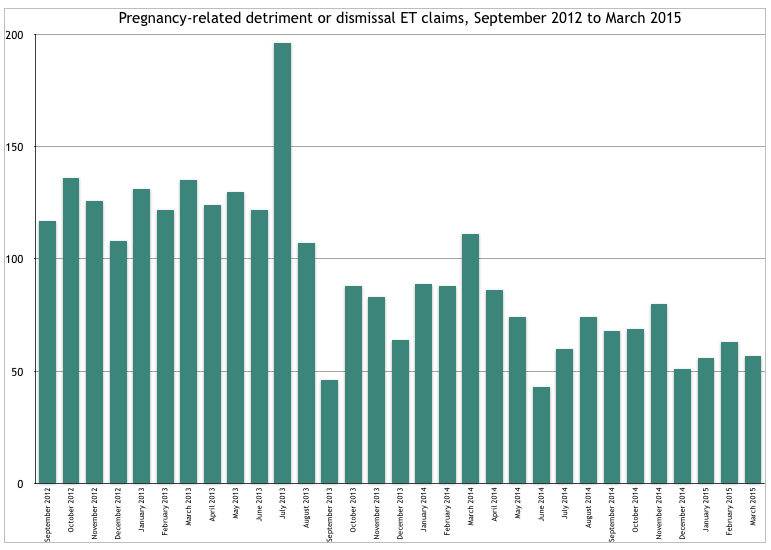
Pursuing a tribunal claim has always been a daunting prospect, especially for pregnant women and new mothers, and – as the following chart shows – the number of claims for pregnancy-related detriment or dismissal has never been huge. But the number of such claims has fallen by 40%, from an average of 126 per month before fees, to just 75 per month in 2014.

Screen Shot 2015-07-30 at 12.52.49

In other words, in 2014 just 893 (1.6%) of the 54,000 women who, according to the meticulous BIS/EHRC research, were forced out of work on account of their pregnancy or maternity leave issued a tribunal claim against their former employer. Not so much a ‘zero tolerance approach to discrimination’ then, as a charter for dinosaur and rogue employers. Yet, as noted by Sally Brett of the TUC, this is hardly surprising when one

“pauses to consider what a new mother is dealing with: sleepless nights, a newborn baby demanding round-the-clock attention, a significantly reduced income, and increased expense. No wonder so many women find it so hard to find the time or energy to research the law, seek advice and lodge a well drafted legal claim within three months of the discrimination they have suffered. No wonder that so few feel ready to stump up £1,200 to get a case lodged and heard at tribunal.”

That government ministers should have nothing at all to say about this is troubling enough. But Cameron, Morgan, Gove and Javid were hardly put to shame by their ministerial shadows. Labour’s press office did put out a brief statement by shadow equalities minister Gloria De Piero – “It’s time to look at how we can strengthen the law and scrap tribunal fees so cost is never a barrier to justice” – but otherwise the silence from Labour MPs, including the four leadership candidates, was almost as deafening as that from government ministers. As far as I can tell, neither Yvette Cooper nor Liz Kendall considered the issue worthy of their comment, despite their (laudable) record of highlighting such discrimination, and the pink bus stayed locked away in its garage.

Such reticence from the party that Liz Kendall describes – in a campaigning piece issued just five days after the launch of the BIS/EHRC research – as “the greatest champion of equality and opportunity that our country has ever known” is mystifying and, it must be said, deeply depressing. It may well be time, in the words of Maternity Action’s Ros Bragg, for ministers to “move beyond family-friendly rhetoric to delivering practical solutions to this persistent and growing problem”, but shadow ministers have yet to deliver any credible rhetoric. It’s not as if the issue is that complex – tens of thousands of women are being forced out of work simply for having babies. And if the Labour opposition really has nothing to say about that, then it’s no surprise that government ministers feel able to sit on their hands too.

The secret of Acas’s success

Just weeks after erroneously informing us that employment tribunal case numbers are “bouncing back following the slump after the introduction of fees”, on Friday the Law Society’s Gazette trumpeted that Acas early conciliation has “cut tribunal cases in half” since its implementation in April 2014.

To be fair, the (very short) news report is a lot more accurate than its headline – so much so that you have to wonder which narcotic substance the sub-editor was enjoying at the time he or she came up with the headline. And perhaps it really doesn’t really matter whether a sub-editor at the Gazette knows the difference between ‘up’ and ‘down’. But if the self-proclaimed “publication of record to solicitors in England and Wales” can get so confused about basic legal matters, we can’t really blame less specialist news outlets (and politicians) for soaking up and repeating such canards. So it’s worth setting out in detail just how wrong that headline is.

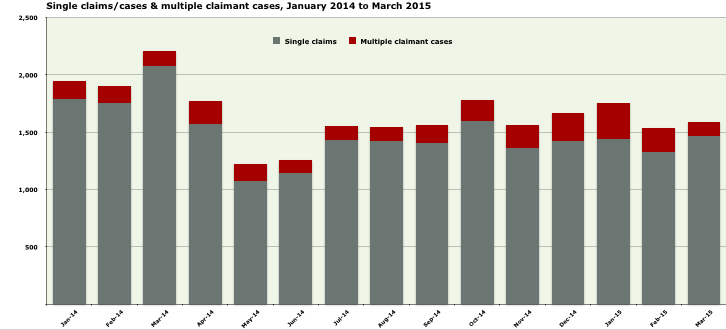
The relevant official statistics are freely available. And – especially if we put them into a chart – even Gazette journalists, with their uncritical eye, should be able to see immediately that the implementation of Acas early conciliation in April 2014 has not reduced the number of ET cases by anything like 50%.

Screen Shot 2015-07-27 at 00.03.32

In January and February 2014 – by which time ET case numbers had pretty much stabilised following the introduction of fees in July 2013 – the average monthly number of new ET cases (single claims/cases + multiple claimant cases) was 1,922. And, over the three months up to March 2015 – the most recent months for which the figures are available – it was 1,626. That’s a reduction of 15.4% – which is slightly less than the 17% reduction predicted in the then government’s final regulatory impact assessment in February 2014, and a lot less than the 50% reduction now trumpeted by the Gazette.

Furthermore, no one can say with certainty that all of that 15.4% reduction can be credited to the implementation of ‘mandatory’ Acas early conciliation. As noted previously on this blog, some ministers seem to believe there has been a significant ‘downward trend’ in ET claim numbers in recent years, as the economy has slowly recovered from the near-fatal shock administered by bankers in 2008. And, if they’re right, some of that 15.4% reduction would have happened anyway.

So, how do we square this modest reduction of 15.4% with the fact – more accurately reported by Gazette journalist Chloe Smith in the body of her news report – that Acas is “preventing” about half of the cases notified to it under the early conciliation scheme from progressing to a tribunal claim? Well, one theory, previously set out on this blog, is that Acas is now hoovering up (and conciliating) lots of workplace disputes that would never have become a tribunal claim in any case.

Which, it must be emphasised, is arguably a very good thing. It has always been clear that the overall number of workplace disputes (or potential tribunal cases) far exceeds the actual number of tribunal cases. And, even before the introduction of hefty, upfront fees, many potential tribunal claimants were deterred by the likely time, stress and cost involved – in March 2014, the then minister for employment relations, Jenny Willott, wrote: “it costs on average £1,800 to present a claim at tribunal”. And now it would seem Acas is helping to resolve some of those ‘non-tribunal’ disputes. Bully for Acas, I say.

But the evident ‘success’ of Acas in hoovering up and resolving those ‘extra’ disputes is a separate matter to the (evidently modest) impact of early conciliation on the actual number of tribunal cases. And, of all people, journalists and sub-editors at the Law Society’s Gazette really ought to understand that.


Workers of the world unite! You have nothing to lose but your promiscuity.

On Wednesday, justice secretary Michael Gove gave oral evidence to the Justice select committee of MPs on the work of his department. And, thanks to two Labour members of the committee – Nick Thomas-Symonds and Richard Burgon – we learnt a little bit about the minister’s views on the impact of employment tribunal fees. If you have the time and the inclination, you can watch the whole thing on parliament TV, and there will be a full transcript in due course. However, as it may be a few days before that official transcript appears, here is my unofficial one.

In response to a question by Conservative member Alex Chalk about the “evidential underpinning” for the recent hike in civil court fees, Gove had just stated that the government had sought to ensure that the “fees better reflect the cost of the justice system”, but “we can’t know until fees are in place what the real impact will be”. Amen to that.

Nick Thomas-Symonds: You just said, Secretary of State, in the answer to Alex, that fees better reflecting the cost of justice is the general principle, but I’m sure you’ll appreciate Secretary of State that with employment tribunals, for example, they are in a cost-neutral environment, so surely the argument can’t apply, can it, to the enormous hike in employment tribunal fees that happened? Is that something that you intend to revisit, because there clearly is an access to justice issue if people who have lost their jobs are clearly not going to be in a position to fork out the kind of fees that they now have to?

Michael Gove: Well, there are two things I’d say. First, what we’ve got to try to do is make sure that, as much as possible, the justice system overall recovers costs. So it will be the case that there will be costs in one part of the justice system which will cross-subsidise other parts as well. That’s the first thing.

The second thing is that, with respect to employment tribunals, we are committed to reviewing the impact o those changes. My predecessor entered into a commitment to review them, I think it was the former business secretary, the former member for Twickenham, who was concerned that that review should take place before the election. We are carrying out that review, and we will share with this committee and with the Commons more widely the results of that review.

And you are right, that it’s important with employment tribunals that we balance the rights of individuals who may have been dismissed, also with the need to ensure, as I think will have been the case in the past, that we don’t have – um, what’s the word? – too promiscuous use of the employment tribunals by individuals who have been fairly dismissed.

Nick Thomas-Symonds: If the evidence shows, Secretary of State, that there has been a severe and substantial reduction in the number of cases going through employment tribunals, would that be (a) a cause of concern; and (b) something that might lead you to rethink the level of fees and reduce them?

Michael Gove: Not intrinsically. Without wanting to pre-empt the review – because, by definition, there will be issues raised by the officials conducting that review that I might not be able to anticipate …

Nick Thomas-Symonds: I appreciate that.

Michael Gove: But, my view would be it’s only if one can point to examples of rough justice that one should seek to revisit it – a simple reduction in the numbers of people going to employment tribunals is not in itself proof that there’s been any injustice visited on anyone.

Nick Thomas-Symonds: One further point. The point I made was not simply whether there’s been a reduction, but a very substantial reduction. Some figures I have seen show, for example, a 79% reduction, something like that. Now, whilst in itself a reduction does not point to it, that level surely does and should be a matter of concern to you, Secretary of State.

Michael Gove: It’s certainly a cause to want to review things, yes, but it need not necessarily be the case that such a significant reduction has automatically led – automatically led – to people who should have had a particular outcome not enjoying the justice that they deserve.

Richard Burgon: My colleague did mention that there’s been figures of up to a 79% decrease in claims, particularly in relation to discrimination claims, so I’m wondering, do you think – if there’s been a decrease in employment tribunal claims of up to 80% – there has been a similar decrease in employers treating employees badly?

Michael Gove: I think that I’d have to see whether or not there was an example of people – or an individual – who’d been dismissed, who hadn’t had appropriate access to justice as a result, and that hard case – or those hard cases – would lead me to think again. But at the moment, what I think is likely to have been the case, is that the bar has been set at a high level, absolutely, but there is no evidence yet that the bar being set at a high level has meant that meritorious claims by people who feel they’ve been discriminated against aren’t being heard.

Richard Burgon: Secretary of State, it also concerns me not just that those who are seeking to bring a claim might have access to justice denied, but the effect it has on the whole workforce if employers know that the chance of an employment tribunal claim being brought against them is so much lower than it used to be that can effect the way that workers right across the field of employment are treated, including those who wouldn’t dream of bringing a claim even if they are treated badly.

Michael Gove: I absolutely understand your line of thinking. If it’s the case that it appears workers rights are eroded, then that can become a charter for tyrannical bosses to act in an outrageous fashion. But I don’t see any evidence of that. So, while its a perfectly internally coherent theoretical argument, I don’t see evidence that employers are behaving in an outrageous way. And I should say that if one looks at some of the other things that this government has done, from our proposal to increase the minimum wage to a living wage, through to the announcement yesterday by the prime minister of equal pay audits, then actually what this government has done is show that you can safeguard and enhance workers’ rights, but not necessarily in a way that a different political party would have done.


We can see the hand of Elias LJ in some of the minister’s comments, and there are several points that I intend to return to in a future post on this blog. In the meantime, please do feel free to express your own views by posting a comment.


Lies, damn lies, and Acas statistics?

One variant of the phrase usually (but erroneously) attributed to Mark Twain is that there are liars, damned liars and experts. Which is fine with me, because I claim no expertise in anything. So the first thing that struck me this morning, when casting an eye over the latest early conciliation statistics and independent evaluation report released by Acas, is that the good people in Euston Tower happily describe themselves as the “workplace expert”.

Not that I dispute that description, and it’s probably worth stating at the outset that, like most people with an interest in workplace dispute resolution, I welcomed and supported the evolution of the early conciliation regime provided for in sections 7 to 10 of the Enterprise & Regulatory Reform Act 2013 from the pre-existing, Acas pre-claim conciliation service. An employment tribunal claim should always be a remedy of last resort, and any provision by the State to help resolve disputes without recourse to a time-consuming, stressful and costly tribunal claim is to be welcomed. So I’m glad that, 12 months after implementation of the early conciliation regime, Acas feels able to proclaim the regime a “success, with high take-up and satisfaction rates”.

However (go fish, Mr Gove), the second thing that struck me this morning was the high number of early conciliation notifications (or ‘cases’) over the first year of operation – 83,423 – relative to the number of tribunal cases over the same period and, indeed, in previous years. In 2012-13, the last full year before the introduction of fees in July 2013, there were just 60,040 tribunal cases (single claims/cases + multiple claimant cases).

So – in a desperate and probably doomed attempt to keep Gem Reucroft happy – I have put the quarterly Acas figures into the following chart. The green columns show the actual number of tribunal cases (single claims/cases + multiple claimant cases), while the blue columns show my projection of the number of tribunal cases we could have expected, had both fees and ‘mandatory’ early conciliation by Acas not been introduced. As previously discussed on this blog, this assumes a continuation of the modest ‘historical downward trend’ in single claims/cases that started in 2010, and about which the Ministry of Injustice – having somehow failed to notice it in 2012 and 2013 – now has so much to say.

More controversially, perhaps, it also assumes that the sharp drop in multiple claimant cases in mid-2013 was largely coincidental to the introduction of fees, and simply reflects the slowing down (and confinement to Scotland) of what the Daily Mail would call The Equal Pay Claim Gravy Train. So it includes the actual number of multiple claimant cases.

Finally, the orange columns show: (a) the average number of Acas pre-claim conciliation referrals, in each quarter up to Quarter 4 of 2013-14 (as I can only find annual statistics); and (b) the number of early conciliation notifications (or ‘cases’) in each quarter since April 2014. And from this we can see that the number of early conciliation notifications far exceeds not just the actual number of tribunal cases, but also the number of tribunal cases we could have expected, had both fees and early conciliation not been introduced. Indeed, in each of the two most recent quarters, the number of notifications was almost twice the number of tribunal cases we could have expected.

Acas

From which we could perhaps conclude that Acas might well be hoovering up, and spending resources dealing with, a fair number of ‘disputes’ that would not have resulted in the issuing of a tribunal claim in any case. We probably need to take account of the number of voluntary pre-claim conciliation cases successfully resolved by Acas in the past before we do reach such a conclusion, but the chart suggests we may need to take a long, hard look at the assertion that the early conciliation regime introduced in April 2014 has been a “success”, at least in terms of reducing the number of tribunal cases (i.e. the principal aim of the policy).

Acas states that the independent evaluation research “found that nearly half of all claimants (48%) who used early conciliation either reached a formal settlement or were otherwise helped by Acas to avoid a tribunal claim”. But if that 48% figure is applied to the total number of notifications in the two most recent quarters (45,498), the resultant number of potential tribunal cases left over (23,659) is only marginally different to my projected number of tribunal cases over those two quarters (23,526), had fees (and early conciliation) not been introduced. In other words, take fees out of the picture, and the introduction of ‘mandatory’ early conciliation by Acas appears to have had little if any impact on the number of tribunal cases.

As noted by Darren Newman on Twitter (in response to the original version of this post), there is some evidence in the evaluation research report that Acas is indeed now hoovering up a significant number of cases that would not have resulted in a tribunal claim. The researchers found that one in four (24%) of claimants described their reason for making an EC notification as “being that they ‘Just wanted to see if a settlement could be reached, and did not have a desire to submit an employment tribunal claim'” (see page 33 of the report).

Anyway, not being an expert, I’ve probably missed something rather obvious here. So I await a gleeful email or direct message from Michael Reed, following which I will rewrite this post.

ET fees: To deter, or not to deter, that is the question

Court 72 in the Royal Courts of Justice – where earlier this week three Court of Appeal judges spent two days hearing Unison’s appeal against the High Court’s dismissal of its two applications for judicial review of ET fees – is one of the more modern courtrooms to be found in the laughably camp, Gothic Revival edifice that sits on the Strand. Not quite a 21st century courtroom, perhaps, but certainly more 1960s than 1860s. And, to this lay observer, the appeal judges’ scrutiny of the appellant and respondent’s by now well-rehearsed arguments was a tad more modern than that offered by the reputedly clever but oh-so-out-of-touch-with-2015-reality Elias LJ in the High Court last October.

On Tuesday, when Karon Monaghan QC of Matrix Chambers presented Unison’s five grounds of appeal, all three judges had asked challenging questions that, to my mind, indicated a genuine desire to understand the real nature and impact of the fees regime. But things got a little more interesting on Wednesday, when David Barr QC of Temple Garden Chambers rose to present his defence of The Devil [Shurely ‘the Lord Chancellor’? Ed].

I think it’s fair to say that Mr Barr is not one of the Bar’s most flamboyant QCs, but it often sounded to me as if even he wasn’t convinced by the arguments that he frequently struggled to locate in the voluminous bundle. In the High Court, Susan Chan had at least sounded as if she believed the garbage spewing from her mouth. The three judges – Moore-Bick LJ, Davis LJ and Underhill LJ – certainly didn’t look terribly impressed, and the tone of their questioning became ever more mocking and disbelieving. Indeed, if these things were decided on the body language and facial expressions of the judges, then I’d say Unison have their appeal in the bag.

During a lengthy and turgid section on the Public Sector Equality Duty, Mr Barr seemed to be trying to bore the judges into submission, prompting Underhill LJ to swivel maniacally in his chair with the look of someone who’s just got a whiff of the dog poo on their shoe. But it was Mr Barr’s attempted defence of the appeal ground of ‘effectiveness’ that elicited the most mocking responses from the bench.

At one point, a clearly bemused Moore-Bick LJ asked Mr Barr what the ‘problem’ was that the fees were “trying to address”. And – seemingly forgetting the official Ministry line and, indeed, his own assertion that the aim of the fees was “not to deter claimants” – Mr Barr blurted out:

The problem was that there were increasing numbers of [ET] claims and the existing model was unsustainable.

As previously explained on this blog, this is claptrap and bunkum. Leaving aside the (admittedly many) claimants in a relatively small number of multiple claimant cases – as both Ms Chan and Mr Barr asserted we (and the judges) should do when analysing the massive drop in claims since July 2013 – the number of claims/cases was in fact falling towards a record low by 2011, long before the fees came into force. But it’s also at variance with the publicly stated objectives for the fees regime of ministers, as confirmed by the recent announcement of the long-promised review.

According to that announcement, the original objectives were:

  • to transfer some of the cost from the taxpayer to those who use the service, where they can afford to do so;
  • to encourage the use of alternative dispute resolution services, for example, Acas conciliation; and
  • to improve the efficiency and effectiveness of the tribunal.

Nothing about dealing with an “unsustainable” increase in claim numbers there. Indeed, the second and third objectives are just flannel, as would-be ET claimants need no encouragement from fees to use the mandatory early conciliation services of Acas, and there is simply no way fees could by themselves “improve the efficiency and effectiveness” of the tribunal system – other than by deterring two-thirds of the annual caseload (which, as already noted above, Mr Barr assured the judges was not the aim of the fees). As for transferring some of the cost to the taxpayer, in 2014-15 the Ministry’s net income from fees (after allowing for remission and administration costs) was a mere £4.3 million.

However, the evidently confused Mr Barr isn’t the first to let the cat out of the bag. For it was none less than the then Lord Chancellor, Chris Grayling – reputedly not the sharpest pencil in the box either – who revealed to the Yorkshire Post in November last year that, by introducing fees, the Coalition government was “trying to deal with a situation where it was too easy to go to a tribunal and where employers, often good employers, were easy prey for questionable claims”.

In short, despite Mr Barr’s polished assurance to the contrary, the aim was to deter claimants. In the High Court, Moses LJ, Elias LJ, Irwin J and Foskett J all failed to see this, even as unrepentant Tory ministers such as Matt Hancock were claiming ‘success’ for the fees on this very basis. And, indisputably, the officially unstated aim has been achieved, with knobs on. But as to whether any of this means the fantabulous Unison legal team will be downing celebratory drinks a month or two from now, I have learnt to my cost to reserve judgment.

IMG_3072


ET fees: Ministry of Injustice starts hunt for the X Factor

So, the Ministry of Injustice has finally decided to launch its long-promised review of the employment tribunal fees introduced in July 2013. This is the review, you might remember, that the Ministry was busy “finalising” the timing and scope of as long ago as June 2014. And it’s no doubt entirely coincidental that, next week, the Court of Appeal will hear Unison’s appeal against the High Court’s dismissal of their application for judicial review of the fees regime.

The wording of today’s announcement provides little cause to think that work-starved employment  lawyers should hold their breath until the outcome of the review. To my jaundiced eye, the stated terms of reference suggest the Ministry will be scouring all kinds of tribunal and economic data for any factor – other than the fees, obviously – that might possibly have contributed, even just a tiny bit, to the sharp decline in ET case numbers since July 2013. So the Ministry’s finest minds will be studying the “historic downward trend” in the number of ET claims – you’ll no doubt remember how much Vince Cable and other ministers made of that trend in late 2011 and 2012 – as well as the impact from “the improvement in the economy” and “changes to employment law”.

I’ll come back to those factors in a minute, but today also saw the scheduled publication of the latest set of quarterly ET statistics. These new figures remind us just how big the fall in case numbers has been since July 2013. And, perhaps more interestingly, especially to the crack employment team at top 100 law firm Hugh James, they suggest that exploited and mistreated workers, having ‘acclimatised’ to the fees in Q3 of 2014-15, somehow de-acclimatised in Q4. I’m looking forward to reading about this in the Law Society Gazettebut meanwhile here’s a chart.

ETquarterly110615

But back to those legal and economic factors (other than the introduction of hefty, upfront fees in July 2013) that – three, six or maybe 24 months from now – the Ministry will no doubt inform us wholly explain the fall in ET case numbers since July 2013. As is evident from the above chart, and as reported ad nauseam on this blog, there was a modest downward trend in ET case numbers in the quarters immediately prior to the introduction of fees, quite possibly linked to the steady improvement in the economy in recent years. From Q2 of 2012/13 to Q1 of 2013/14 – the last full quarter before fees – the number of new single claims/cases declined by 5%, from 13,407 to 12,727.

I imagine the Ministry boffins will find no reason to assume that that modest downward trend would not have continued, had fees not been introduced in July 2013. Indeed, they may well find reasons to argue that it would have accelerated. So, let’s assume that, over the next three quarters, single claims/cases declined by 6%. In that scenario, the number of such claims/cases would have fallen to 11,963 by Q4 of 2013/14, the last full quarter before the implementation of Acas early conciliation (from 6 April 2014). And – if that 6% rate of decline continued – by Q4 of 2014/15, the quarter for which the figures were published today, single claims/cases would have fallen to 11,010. Which, it’s worth noting, would have been a record low, unseen since the passing of the first Corn Laws in 1815.

Now, that implementation of Acas early conciliation (which became mandatory in May 2014) may well be what the Ministry had in mind when referring, in the review’s terms of reference, to the impact on ET case numbers of “changes in employment law”. Because the primary aim of Acas early conciliation was to reduce the number of claims/cases by a whopping 17% (that being the figure given in the final BIS impact assessment). So, from Q1 of 2014/15 onwards, we need to reduce the number of single claims/cases in my ‘no fees’, downward trend projection by 17%. And, if we do that, we get the following chart, in which the green columns represent the number of single claims/cases we might have expected to see in each quarter, had fees not been introduced, and the red columns represent the actual number of such claims/cases.

ETprojection110615

We can total up the differences between the red and green columns, and that gives a figure of 36,210 single claims/cases ‘lost’ to ET fees between 29 July 2013 and 31 March 2015, after allowing for the ‘historic downward trend’ in case numbers and the introduction of Acas early conciliation. And that figure continues to increase by some 5,000 every quarter (so is, at the time of writing, in excess of 40,000).

Now, I can’t think of any other significant (and relevant) change in employment law since July 2013, and I have difficulty imagining what “changes in users’ behaviour” might explain more than a tiny bit of the difference in the height of the green and red columns in recent quarters (there is no evidence to suggest that displacement of single claims/cases to the County Courts has been more than negligible). So I think I’ve just about done the Ministry’s job for it. For nothing. In an afternoon.

But perhaps the Ministry’s boffins will find some X Factor I have stupidly overlooked.

ET fees: the wrong plan, in the wrong hands

Back in January, I noted on this blog that employment judges had yet to use the power, granted to them nine months previously under section 16 of the Enterprise & Regulatory Reform Act 2013, to impose a financial penalty of up to £5,000 on an employer found to have breached the claimant’s rights in a way that “has one or more aggravating features.” In late December, in response to a parliamentary question tabled by then shadow BIS minister Ian Murray (now the only Labour MP in Scotland), the then employment relations minister Jo Swinson had confirmed that no section 16 penalties had been imposed since the power came into force on 6 April 2014. And I argued that the most likely explanation for this lack of section 16 penalties is that

the hefty, upfront tribunal fees introduced by the Ministry of Injustice in July 2013 have eradicated exactly the kind of tribunal claim that [former business secretary] Vince Cable [and former BIS employment relations ministers] Ed Davey and Norman Lamb evidently had in mind when they came up with the section 16 penalty regime: a relatively low value claim (because the claimant is or was low paid) against a deliberately exploitative employer. For why would a vulnerable, low-paid worker subjected to ‘wage theft’ of a few hundred pounds gamble up to £390 on trying to extract the unpaid wages or holiday pay from their rogue (former) employer?

In response, at least one #ukemplaw luminary suggested that I was being a bit premature, given that employment judges had had the power for only nine months. And, while I countered that we could have expected at least some penalties to have been imposed, I had to concede that it would be “interesting to ask BIS the same question again in three or four months time.”

Well, five months have passed, and BIS has been asked the same question, this time by Caroline Lucas MP. BIS doesn’t seem to have an employment relations minister as such any more, but skills minister Nick Boles has now replied, confirming that the number of section 16 penalties imposed to date is … just three. Of which two remain unpaid.

As when I wrote on this issue in January, it is theoretically possible that this is simply a good news story: the threat of a financial penalty has incentivised employers to avoid breaching their workers’ rights in a way that has “aggravating features”. But it seems much more likely that my original theory holds true. That, thanks to fees, employment judges are no longer seeing many of the kind of ‘rogue employer case’ at which the section 16 provisions were aimed.

And – just for once – I am not alone. In April, Nic Elliott of respondent law firm Actons blogged about having recently spent four days in the tribunal, successfully defending his employer client against a claim with “little merit from the outset, but just enough to warrant four days with an employment judge”:

This was a claim my client thought ‘misconceived’. Perhaps the type of unmeritorious claim the [then] government was trying to weed out with the introduction of tribunal fees. However, the claimant was a high earner and could easily afford £1,200 in the hope he would make a return on this investment. It seems those employees with entirely valid claims, with little means to pursue them, may not be so lucky.

Nic concludes that “the fees regime introduced [in July 2013] really isn’t hitting the mark and preventing claims with little merit entering the system. There’s also a significant risk that those with genuine claims are being prevented access to justice because they can’t pay their way”. And, last month, top employment barrister (and founder of this blog) Sean Jones QC suggested to the CBI and others that “perversely, it is fast track, high merit, low value claims that fees have seen off”.

If we are right, this would explain why – contrary to what we could expect if fees were simply deterring ‘vexatious’ and unmeritorious claims – the overall success rate of ET claims has fallen significantly since July 2013. In short, like the protagonist in Depeche Mode’s classic “Wrong” – who answered “the wrong questions with the wrong replies” – Coalition ministers appear to have “reached the wrong ends, by the wrong means, with the wrong method and the wrong technique”.

However, if the current ET fees regime was, indeed, the “wrong plan, in the wrong hands”, then at least the new crop of ministers has an opportunity to make amends. The government’s recent reply to another parliamentary question by Caroline Lucas suggests ministers are still committed to carrying out the long-promised review. All we need now is a date.

Are ET claims going up? Yes but no but yes but no but … whatever!

On Monday afternoon, I was happily wandering through a series of dimly-lit rooms, admiring some rather fine naked bodies in all manner of unlikely poses, when a series of tweets by #ukemplaw tweeps alerted me first to one, then to another, and then to a third news report, each announcing new hope for Britain’s work-starved employment lawyers.

“Employment tribunal claims up 75 per cent in 12 months”, screamed The HR Director, which claims to be “the most respected independent resource for HR directors and senior HR practitioners in print, in person and online”.

“Employment tribunal caseload rebounds after slump”, bellowed the Law Society Gazette, which claims to be the “publication of record to solicitors in England and Wales since 1903”.

And – a little more wonkishly – the Solicitors Journal, which claims to have been “a reliable and trusted source of information for thousands of legal professionals” since 1856, helpfully explained that “Employment tribunal cases are on the up as claimants adjust to new fee system.” [NB – article since deleted, it seems]

Hallelujah! Crack open the champagne! Come back Chris Grayling, all is forgiven. Let the gravy train roll!

And then – cynic that I am – the doubts began to set in. Surely the latest set of ET statistics isn’t out until next week, I mused, while sneaking a closer peek at a chiseled pair of buttocks. So, pausing only to check out some extremely pornographic vases, I read beyond the dramatic headline of each news report.

The number of single claims in ET cases has jumped by 16 percent in just six months, rising from 3,790 in Q1 [2014/15] to 4,390 in Q3 2014/15, as the slump in cases reverses, says Hugh James Solicitors, the top 100 law firm. Hugh James Solicitors says that the number of employment tribunal cases fell from 10,900 in Q2 2013/14, after the introduction of tribunal fees. However, the number of claims is now re-bounding as disgruntled former employees adjust to the new fees and weigh the financial risks to them of pursuing a claim against the potential pay-out. Hugh James Solicitors notes that when multiple claims are included in the analysis, the increase in the number of tribunal cases is even more striking – rising by 75 percent from 10,840 to 18,940 in a year. Emma Burns, Partner, Head of Employment and HR Services Group at Hugh James Solicitors, explains: “The cost for launching a claim is between £160 to £250; when they were first introduced it was a shock, but now people are more acclimatised to these fees.” (The HR Director)

Employment tribunal cases have rebounded in spite of the introduction of fees and it is still too easy [!!!!] to bring a spurious claim, a leading law firm has said. Claims have doubled [sic], with a similar trend in Scotland, since the requirement was introduced a year ago to use the Acas mediation service before launching a case, according to Hugh James Solicitors. Tribunal cases at first slumped by almost two-thirds in response to the [fees]. But claims have rebounded “as disgruntled former employees adjust to the new fees and weigh the financial risks to them of pursuing a claim against the potential pay-out,”, the firm says. (This was The Herald in Scotland – from where things always look a lot worse, apparently.)

The number of claims in employment tribunals is bouncing back following the slump after the introduction of fees, figures obtained [sic] by a law firm reveal today. Top-100 firm Hugh James said that the number of single claims in tribunal cases has jumped by 16% in six months, rising from 3,790 in the first quarter [2014/15] to 4,390 in the third quarter. Hugh James said the number of claims is now rebounding as disgruntled former employees adjust to the new fees and weigh the financial risks to them of pursuing a claim against the potential pay-out. Emma Burns, partner, said: ‘The cost for launching a claim is between £160 to £250; when they were first introduced it was a shock, but now people are more acclimatised to these fees.’ (Law Society Gazette)

The recent and highly-publicised slump in ET cases has reversed, say lawyers, as reports emerge single claims have risen by 16 per cent over the last six months. Hugh James Solicitors observed [sic] that employment tribunal cases fell from 10,900 in Q2 2013/14, after the introduction of tribunal fees. However, the number of claims has begun to rebound as disgruntled former employees adjust to the new fees and weigh the financial risks of pursuing a claim against the potential pay-out. Emma Burns, partner and head of employment at Hugh James Solicitors, explained: ‘The cost for launching a claim is between £160 to £250; when they were first introduced it was a shock, but now people are more acclimatised to these fees.’ (Solicitors Journal)

The number of employment tribunal cases is rebounding, after falling when tribunal fees were introduced, according to research [sic] released today by Hugh James Solicitors. “The cost for launching a claim is between £160 to £250; when they were first introduced it was a shock, but now people are more acclimatised to these fees,” said Hugh James Solicitors partner Emma Burns. (This was CityAM, which clearly thinks it knows a good bit of legal research when it sees it.)

Yes – and I’m truly sorry to have to break this to you, employment lawyers – we’ve been here before. It’s the old ‘Get Our Law Firm’s Name in The Papers in The Hope of Drumming-up Some Much-needed Business by Issuing a Press Release With an Eye-catching But Rubbish Story About ET Claim Numbers’ trick. Last year, it worked rather well for GQ Employment Law, who were rewarded by the legal editor of the Times, Frances Gibb, with a very silly story about how discrimination claims were bucking the steeply downward trend under fees. And in 2013 it worked extremely well for law firm EMW, for whom publicists Mattison PR [sic] secured splashes in both the Times and Telegraph, later picked up by HR Magazine and the CIPD. (Incidentally, Nick Mattison of Mattison PR wasn’t very pleased when I wrote about EMW – he rang one of my then senior managers to complain about me).

And here – kindly provided to me (via email) by Catherine Sirikanda of Mattison PR [sic] – is the press release issued by Hugh James Solicitors on Monday (I’ve had to crop the bottom of the left hand page but – believe me – you’re really not missing anything):

Screen Shot 2015-06-02 at 13.59.19

So, just how stale and silly is the story sold to The HR Director, CityAM, the Law Society Gazette, The Herald in Scotland, and Solicitors Journal by Hugh James Solicitors (or Mattison PR)? Have mistreated and exploited workers become “more acclimatised” to ET fees?

Well, the official statistics that The Law Society Gazette reports as being “obtained” by Hugh James Solicitors were, of course, published by the Ministry of Justice on 12 March. And you really don’t have to have spent nearly three months studying those statistics to ‘observe’ that the number of single claims/cases did indeed increase by 16% from 3,792 in Q1 of 2014/15 (erroneously referred to as Q1 of 2013/14 in the Hugh James press release – an error dutifully copied out by both The HR Director and Law Society Gazette), to 4,386 in Q3 (October to December 2014). Or to ‘observe’ that the number of multiple claims increased from 4,478 to 18,943.

But can we conclude from this that would-be ET claimants have become “more acclimatised” to ET fees? Indeed, can we conclude anything at all from these figures?

Well, the short answer to both questions is: no. And the slightly longer answer is: only if you are an idiot (or a journalist at The HR Director, the Law Society Gazette, CityAM, The Herald in Scotland, or Solicitors Journal with a law firm’s press release to copy out before your deadline).

Because you only have to spend less than three minutes looking at Table 1.2 of the Ministry’s statistics – freely available even to Law Society Gazette and The Herald journalists since 12 March, remember – to see one obvious explanation for at least a large part of this counter-intuitive rise in the number of ET claims, from Q1 to Q3 of 2014/15.

We can see, for example, that equal pay claims actually fell, from 1,995 to 1,759, as did redundancy claims, from 900 to 675. Meanwhile breach of contract claims rose by a less than whopping 4.3%, from 1,928 to just 2,012. But Working Directive claims rose by 488%, from 2,171 to 10,604, and Unauthorised Deductions claims rose by 420%, from 2,545 to 10,701. And, frankly, you don’t have to be a former Pulitzer Prize winner to realise what was going on here. In short, a high-profile (and certainly well-reported) legal ruling on holiday pay in early November led to a (relatively small) tsunami of holiday pay claims in the final weeks of 2014, as workers (and their unions and lawyers) rushed to take advantage of the ruling. Do a few basic sums to take those extra holiday pay-related claims out of the picture, and the total number of jurisdictional claims increased from about 27,100, to about 38,800.

Yes, that is still a rise of some 43%, from Q1 to Q3. But you also don’t have to be a legal genius to know that the figures for Q1 were artificially (and quite considerably) depressed by the implementation, at the start of that quarter, of Acas early conciliation, which introduced a one-month delay in the registration of new ET claims (known to employment lawyers everywhere – other than those at Hugh James Solicitors, it would seem – as the ‘Acas pause’). This ‘Acas pause’ is plainly evident in the columns for May and June 2014 in the following chart, which – unless you are Emma Burns or Catherine Sirikanda – you have probably seen at least one version of before.

ET monthly 02 06 15

So an increase in the quarters immediately following Q1 of 2014/15 was inevitable, and by itself tells us nothing whatsoever about the relative inclination of mistreated workers to issue an ET claim. It is (much) more meaningful to compare Q3 of 2014/15 to Q4 of 2013/14 (i.e. the three months immediately prior to the introduction of Acas early conciliation). And when we do that, we can see that the figure for single claims hailed as a 16% increase by Hugh James Solicitors – 4,386 – was still well below the 5,619 just nine months earlier, and the 4,969 in the quarter before that. I don’t see much ‘acclimatisation to fees’ in those figures, or indeed in the above chart.

So, well done Emma Burns of Hugh James Solicitors, you got your firm’s name in the papers. But it’s a moot point whether you have acted in a way that is consistent with ensuring public trust in the legal profession. And you certainly haven’t enhanced your personal entry for Employment Law Genius of the Year.

[BTW, you can see those impressive naked bodies and pornographic vases at the British Museum, until 5 July]

Postscript (3 June): As Paul Statham has today noted on Twitter, the Law Society Gazette article may be rubbish, but the BTL comments are worth reading. So, in case the Gazette decides to follow Solicitors Journal in deleting its article, here are the best of those comments:

This has got to be one of the worst articles I’ve seen on the [Law Society Gazette] website. (anonymous)

Sounds like a desperate PR plug for Emma Burns. And considering that Hugh James are a respondent outfit, how would she know what claimants are thinking? She has come across as a bit of a wally. (Marshall Hall)

Hugh James said the number of claims is now rebounding as disgruntled former employees adjust to the new fees … Emma Burns, partner, said: ‘… when they were first introduced it was a shock, but now people are more acclimatised to these fees.’ These statements make no sense. (anonymous)

That the Gazette should publish unchallenged the PR guff of Hugh James is depressing but not surprising. Slack lazy journalism, and Hugh James should be ashamed but no doubt will not be. (Paul Jeffcoate)

How not to measure the ‘level of ET claims’. Oh, too late …

Last weekend, Giles Wilkes – who served four years as special adviser to then business secretary Vince Cable – responded to a fairly innocuous blog post of mine, in which I urge new Tory ministers to conduct their long-promised review of the employment tribunal fees regime introduced in July 2013, by tweeting back:

Was there definitely nothing wrong with [the] ex-ante level of claims?

Now, this is uncomfortably close to one of the standard responses to criticism used by political scoundrels throughout public policy history: ‘So, you would have done nothing, huh?’ To which the answer is almost always: ‘No, I just wouldn’t have done what you did’. And my tweeted retort to Giles was indeed that there was “very little” wrong with the level of claims in mid-2011, when Dr Cable and then justice secretary Ken Clarke agreed to introduce hefty claimant fees, not least because claim/case numbers were at that time going down.

However, as one of the good guys in life (and the Coalition government), Giles deserves a fuller response to his question than it is possible to give in one or two tweets. So I promised him this blog post. What a lucky chap he is.

So, what was the ex-ante level of ET claims (or cases) in 2011? Well, the answer to that question is slightly complicated by the fact that there are two different types of ET case: (a) single claims/cases brought by individual workers; and (b) multiple claimant cases involving tens, hundreds or even thousands of workers, each with an identical (or very similar) claim against the same employer. For example, in 2012-13 – the last year before fees – there were 54,704 single claims/cases, and 6,104 multiple claimant cases (involving a total 136,837 claimants), brought against a total 60,808 employers (give or take some single claims brought against the same few recidivist employers). And, as a result, there are two alternative ways of measuring the ‘level of ET claims’.

The first way is to add the number of single claims/cases to the total number of claimants in the relatively small number of multiple claimant cases. This produces the ‘headline’ measure used exclusively (and wrongly) by Coalition ministers in 2011, 2012 and 2013. Giles will know better than me why they chose to use this measure, but the number of claimants involved in a handful of unusually large multiple claimant cases (mostly equal pay claims brought against NHS trusts and local authorities) enabled ministers to make otherwise un-evidenced (and grossly misleading) statements such as:

“Workplace disputes are increasingly being settled through tribunals – over 200,000 claims last year. We are in danger of getting away from the principle that they should be the last resort, not the first option.”

The second – and far more meaningful – way to measure the ‘level of ET claims’ is to total the number of single claims/cases and the number of multiple claimant cases. This is the measure that Dr Cable and Giles Wilkes should have focused on in 2011 and 2012, for two simple reasons: (i) it’s a much more meaningful measure of the workload of the ET system (as, in most multiple claimant cases, the tribunal only has to resolve one or two lead claims, even if there are 50,000 claimants in the case); and (ii) it equates to the number of employers affected. And, if that was obvious to me – a lowly policy officer in an under-resourced charity – in late 2011 and early 2012, it should have been obvious to the business secretary, his SpAD, and the then employment relations minister, Ed Davey.

This measure of the ‘level of ET claims’ is set out in the following chart, from which we can see that, in 2008-9 and 2009-10, the number of ET cases did rise quite significantly. However, as economists, Dr Cable, Giles Wilkes and Ed Davey would have known that this was entirely to be expected, given a little local (and global) difficulty in the economy from late 2008, and the associated wave of job losses and outright business failures. Indeed, in early 2011 a regulatory impact assessment issued by Dr Cable’s department noted that there had been “a clear rise in [the number of ET claims for unfair dismissal] coinciding with the downturn in the economy and particularly the level of redundancies which peaked in the second quarter of 2009”.

annual for GW blog

We can also see that, in 2010-11 – the first financial year of the Coalition government – the number of ET cases fell by 13 per cent, from 78,700 to 68,500. These figures were published in the autumn of 2011 – several weeks before Dr Cable announced the plan to introduce ET fees on 23 November – but they would have been available to, say, a SpAD in the private office of the business secretary or the BIS employment relations minister several months before that.

So, when Dr Cable told that somewhat partisan audience at the EEF in November 2011 that “we are in danger of getting away from the principle that [ETs] should be the last resort, not the first option”, he knew – or should have known – that the level of claims was in fact falling sharply. And, later, he would (or should) have known that this downward trend continued in both 2011-12 and 2012-13, as he and Ken Clarke (later Chris Grayling) finalised the ET fees regime for implementation in July 2013 – by which time the ‘level of claims’ was pretty much back to its lowest level since the turn of the century. In short, Dr Cable and his ministerial colleagues at the Ministry of Injustice could have ‘achieved’ a record low level of ET claims without even going into the office.

Now, Giles might well say that, just because the level of claims was falling, it cannot be said that there was nothing wrong with the level of claims. I cannot actually recall Dr Cable, Ed Davey or Norman Lamb making any speeches along the lines of ‘the level of ET claims is falling to a record low, but that is still far too high so we must take radical action to reduce it by another 65 per cent, and sod access to justice’, but hey. Nor can I recall even the maddest of the employer lobby groups suggesting that two-thirds of all ET claims were vexatious.

So let’s look at that 2010-11 figure of 68,500 ET cases more closely. Only about two-thirds (i.e. 45,000) of the 68,500 employers affected were private sector businesses, as one-third of all cases (and the vast majority of multiple claimant cases) are brought against public or voluntary sector employers. And there are about 1.2 million private sector employers in the UK. Accordingly, at the time Dr Cable rose to his feet at the EEF in November 2011, the average private sector business employer risked facing an ET claim about once every 27 years. Yet, according to a series of speeches delivered by Dr Cable and other ministers, this marginal risk was enough to keep our valiant entrepreneurial classes awake at night as they fretted over whether to take on another employee.

None of which is to say that, in 2011, there was not scope to improve the speed, consistency and efficiency of the ET system (and, to that end, I was later to play a tiny but entirely supportive role in the Underhill review of the ET procedural rules, also announced by Dr Cable in November 2011). But introducing fees of up to £1,200 to bring a claim for unfair dismissal or pregnancy-related discrimination was never itself going to improve the speed, consistency or efficiency of the system. Nor is it to say there was no case for a genuinely fair and reasonable ET fees regime – I argued for such a fees regime in 2012, including in the response of Citizens Advice to the formal consultation on ET fees, and have continued to do so ever since. Was Giles even aware of such alternative proposals for raising the Ministry’s £9-10 million per year?

In short, Vince Cable appears, at best, to have consented to Tory ministers’ proposal for hefty claimant fees on the basis of an entirely false premise about the ‘level of ET claims’, and without any evident understanding of the predictable (and predicted) impact of such prohibitive fees on workers’ access to justice. But then why spend time searching out the (informed) views of lowly third sector policy wonks or employment lawyers when you can spend it hanging out in the grand offices of the Institute of Directors and British Chambers of Commerce?

Throughout the lifetime of the Coalition, the Liberal Democrat ministers at BIS – Vince Cable, Ed Davey, Norman Lamb, Jo Swinson and Jenny Willott – appeared entirely uninterested in what they might learn from those outside the powerful lobby groups with their vested interests. And now, having ignored us, our evidence and our (dire) warnings for five long years, during which they consented (seemingly without much of a fight) to the single most damaging reform ever made to Britain’s system of employment rights – far more destructive than anything proposed by Adrian Beecroft – they blithely assure us we will miss them.

When it comes to employment rights, what’s to miss?